Mohammed Elsayed S I, Isobe Naoki, Yoshimura Yukinori
Graduate School of Biosphere Science, Hiroshima University, Higashi-Hiroshima 739-8528, Japan.
Research Center for Animal Science, Hiroshima University, Higashi-Hiroshima 739-8528, Japan.
J Poult Sci. 2016 Oct 25;53(4):298-304. doi: 10.2141/jpsa.0160064.
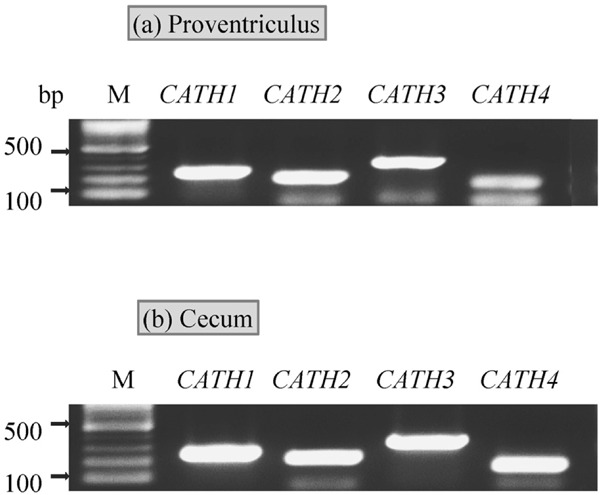
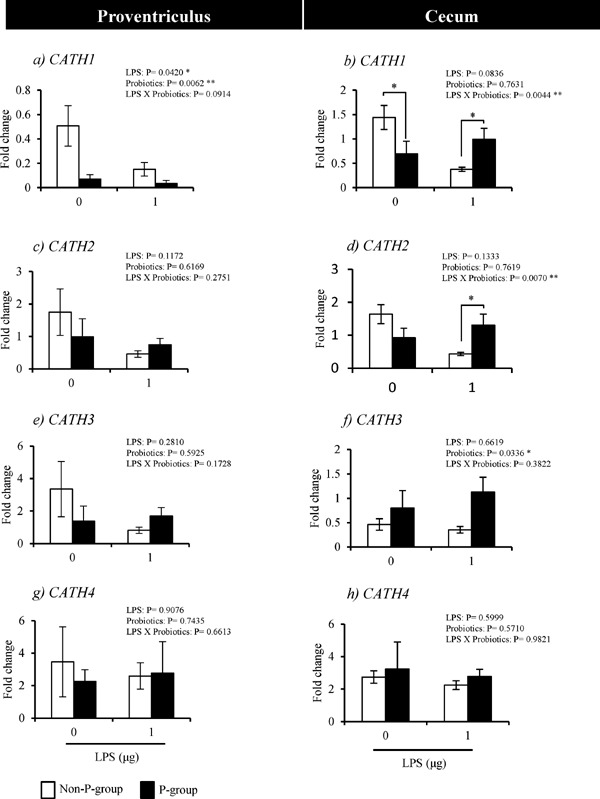
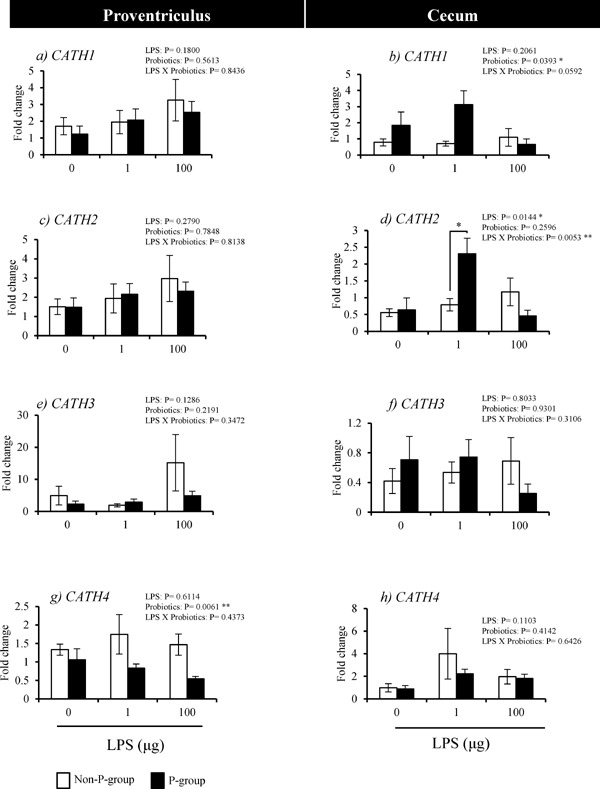
The aim of this study was to determine whether probiotic-feeding affected the expression of cathelicidins (), a major family of antimicrobial peptides, in response to lipopolysaccharides (LPS) challenge in the proventriculus and cecum of broiler chicks. One-day-old male Chunky broiler chicks were fed with or without 0.4% probiotics for 7 days (P-group and non-P-group, respectively). Then, they were orally challenged with no LPS (0-LPS), 1 g LPS (1-LPS), or 100 g LPS (100-LPS) (=5 in all groups) in Experiment 1, and with no LPS or 1 g LPS (=6 in all groups) in Experiment 2. Five hours after LPS challenge, the proventriculi and ceca were collected to analyze expression. Expression of was examined at first by reverse transcription-polymerase chain reaction (RT-PCR) using the 0-LPS chicks of non-P-group. The differences in expression upon probiotics-feeding and LPS were analyzed by real time-PCR. All four ( and ) were expressed in the proventriculus and cecum of chicks. In the proventriculus, the expression of after LPS challenge did not show significant differences between non-P and P-groups in Experiment 1 and 2. In the cecum, the interactions of the effects of probiotics and LPS on the expression of in Experiment 1 and and in Experiment 2 were significant, and their expression in 1-LPS chicks was higher in P-group than in non-P-group. However, and did not show any significant differences between non-P- and P-groups challenged with LPS. These results suggest that probiotics-feeding may stimulate the immunodefense system mediated by and possibly against infection by Gram-negative bacteria in the cecum.
本研究的目的是确定在肉仔鸡前胃和盲肠中,喂食益生菌是否会影响抗微生物肽的主要家族——cathelicidins()的表达,以应对脂多糖(LPS)刺激。1日龄雄性Chunky肉仔鸡分别喂食或不喂食0.4%的益生菌,持续7天(分别为P组和非P组)。然后,在实验1中,它们口服无LPS(0-LPS)、1 g LPS(1-LPS)或100 g LPS(100-LPS)(每组=5只),在实验2中口服无LPS或1 g LPS(每组=6只)。LPS刺激5小时后,收集前胃和盲肠以分析表达。首先使用非P组的0-LPS雏鸡通过逆转录-聚合酶链反应(RT-PCR)检测的表达。通过实时PCR分析喂食益生菌和LPS后表达的差异。所有四种(和)均在雏鸡的前胃和盲肠中表达。在前胃中,LPS刺激后,非P组和P组在实验1和2中的表达没有显著差异。在盲肠中,实验1中益生菌和LPS对表达的影响以及实验2中和的相互作用是显著的,并且在1-LPS雏鸡中,P组的表达高于非P组。然而,和在接受LPS刺激的非P组和P组之间没有显示出任何显著差异。这些结果表明,喂食益生菌可能会刺激由介导的免疫防御系统,并可能刺激介导的针对盲肠中革兰氏阴性菌感染的免疫防御系统。