Boden Barry P, Fine Ken M, Spencer Tiahna A, Breit Ilan, Anderson Scott A
The Orthopaedic Center, Centers for Advanced Orthopaedics, Rockville, Maryland, USA.
Department of Athletics, University of Oklahoma, Norman, Oklahoma, USA.
Orthop J Sports Med. 2020 Aug 20;8(8):2325967120943491. doi: 10.1177/2325967120943491. eCollection 2020 Aug.
The incidence of nontraumatic fatalities in high school (HS) and National Collegiate Athletic Association (NCAA) football players has continued at a constant rate since the 1960s.
To describe the causes of nontraumatic fatalities in HS and NCAA football players and provide prevention strategies.
Descriptive epidemiology study.
We reviewed 187 fatalities in HS and NCAA nontraumatic football players catalogued by the National Registry of Catastrophic Sports Injuries during a 20-year period between July 1998 and June 2018.
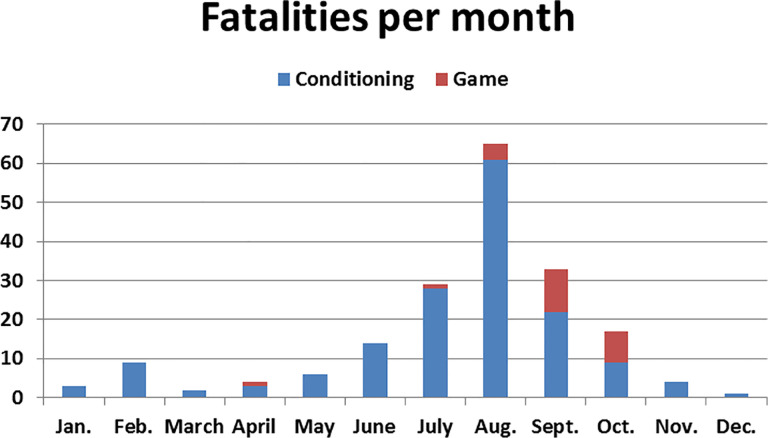
The majority (n = 162; 86.6%) of fatalities occurred during a practice or conditioning session. Most fatalities, when timing was known, (n = 126; 70.6%) occurred outside of the regular playing season, with the highest incidence in the August preseason (n = 64; 34.2%). All documented conditioning sessions were supervised by a coach (n = 92) or strength and conditioning coach (n = 40). The exercise regimen at the time of the fatality involved high-intensity aerobic training in 94.7%. Punishment was identified as the intent in 36 fatalities. The average body mass index of the athletes was 32.6 kg/m. For athletes who died due to exertional heat stroke, the average body mass index was 36.4 kg/m, and 97.1% were linemen.
Most nontraumatic fatalities in HS and NCAA football players occurred during coach-supervised conditioning sessions. The primary cause of exertion-related fatalities was high-intensity aerobic workouts that might have been intended as punishment and/or excess repetitions. Exertion-related fatalities are potentially preventable by applying standards in workout design, holding coaches accountable, and ensuring compliance with the athlete's health and current welfare policies.
自20世纪60年代以来,高中(HS)和美国大学体育协会(NCAA)橄榄球运动员非创伤性死亡的发生率一直保持稳定。
描述HS和NCAA橄榄球运动员非创伤性死亡的原因并提供预防策略。
描述性流行病学研究。
我们回顾了1998年7月至2018年6月期间20年里国家灾难性运动损伤登记处记录的187例HS和NCAA非创伤性橄榄球运动员死亡案例。
大多数死亡(n = 162;86.6%)发生在训练或体能训练期间。在已知时间的情况下,大多数死亡(n = 126;70.6%)发生在常规比赛赛季之外,8月季前赛发生率最高(n = 64;34.2%)。所有记录在案的体能训练课程均由教练(n = 92)或体能教练(n = 40)监督。死亡时的训练方案94.7%涉及高强度有氧训练。在36例死亡案例中,惩罚被确定为死因。运动员的平均体重指数为32.6kg/m²。因运动性中暑死亡的运动员,平均体重指数为36.4kg/m²,97.1%是线卫。
HS和NCAA橄榄球运动员的大多数非创伤性死亡发生在教练监督的体能训练课程期间。与运动相关死亡的主要原因是高强度有氧训练,这可能是作为惩罚和/或过度重复训练。通过在训练设计中应用标准、让教练负责并确保遵守运动员的健康和当前福利政策,与运动相关的死亡是有可能预防的。