Wang Xin-Xing, Zhang Yi, Fan Bi-Fa
Graduate School of Beijing University of Chinese Medicine, Beijing, 100029, People's Republic of China.
Department of Pain, China-Japan Friendship Hospital, Beijing, 100029, People's Republic of China.
Pain Ther. 2020 Dec;9(2):627-635. doi: 10.1007/s40122-020-00196-y. Epub 2020 Sep 11.
Postherpetic neuralgia (PHN) is a neuropathic pain secondary to shingles. Studies have shown that early pain intervention can reduce the incidence or intensity of PHN. The aim of this study was to predict whether a patient with acute herpetic neuralgia will develop PHN and to help clinicians make better decisions.
Five hundred two patients with shingles were reviewed and classified according to whether they had PHN. The risk factors associated with PHN were determined by univariate analysis. Logistic regression and random forest algorithms were used to do machine learning, and then the prediction accuracies of the two algorithms were compared, choosing the superior one to predict the next 60 new cases.
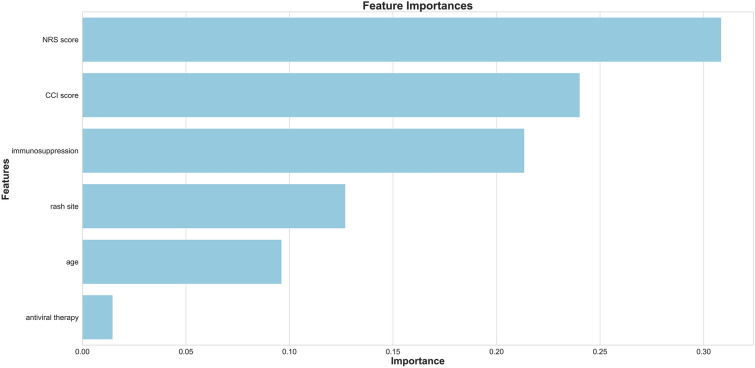
Age, NRS score, rash site, Charlson comorbidity index (CCI) score, antiviral therapy and immunosuppression were found related to the occurrence of PHN. The NRS score was the most closely related factor with an importance of 0.31. As for accuracy, the random forest was 96.24%, better than that of logistic regression in which the accuracy was 92.83%. Then, the random forest model was used to predict 60 newly diagnosed patients with herpes zoster, and the accuracy rate was 88.33% with a 95% confidence interval (CI) of 77.43-95.18%.
This study provides an idea and a method in which, by analyzing the data of previous cases, we can develop a predictive model to predict whether patients with shingles will develop PHN.
带状疱疹后神经痛(PHN)是带状疱疹继发的神经性疼痛。研究表明,早期疼痛干预可降低PHN的发生率或减轻其强度。本研究的目的是预测急性疱疹性神经痛患者是否会发展为PHN,并帮助临床医生做出更好的决策。
对502例带状疱疹患者进行回顾,并根据是否患有PHN进行分类。通过单因素分析确定与PHN相关的危险因素。使用逻辑回归和随机森林算法进行机器学习,然后比较两种算法的预测准确性,选择较优的算法对接下来的60例新病例进行预测。
发现年龄、数字评分量表(NRS)评分、皮疹部位、查尔森合并症指数(CCI)评分、抗病毒治疗和免疫抑制与PHN的发生有关。NRS评分是最密切相关的因素,重要性为0.31。在准确性方面,随机森林为96.24%,优于逻辑回归的92.83%。然后,使用随机森林模型对60例新诊断的带状疱疹患者进行预测,准确率为88.33%,95%置信区间(CI)为77.43 - 95.18%。
本研究提供了一种思路和方法,即通过分析既往病例数据,开发预测模型来预测带状疱疹患者是否会发展为PHN。