Department of Laboratory Medicine, The First Affiliated Hospital of China Medical University, Shenyang, China.
Department of Anorectal Surgery, the First Affiliated Hospital of China Medical University, Shenyang, China.
J Cell Mol Med. 2020 Oct;24(19):11111-11119. doi: 10.1111/jcmm.15558. Epub 2020 Sep 11.
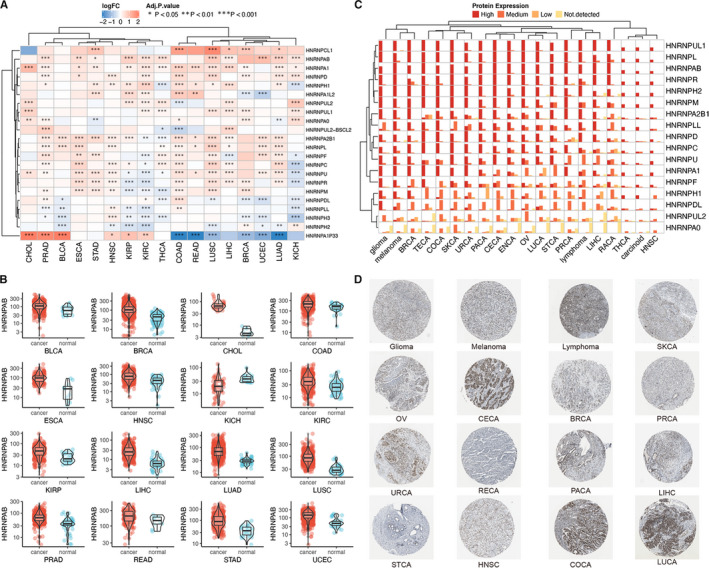
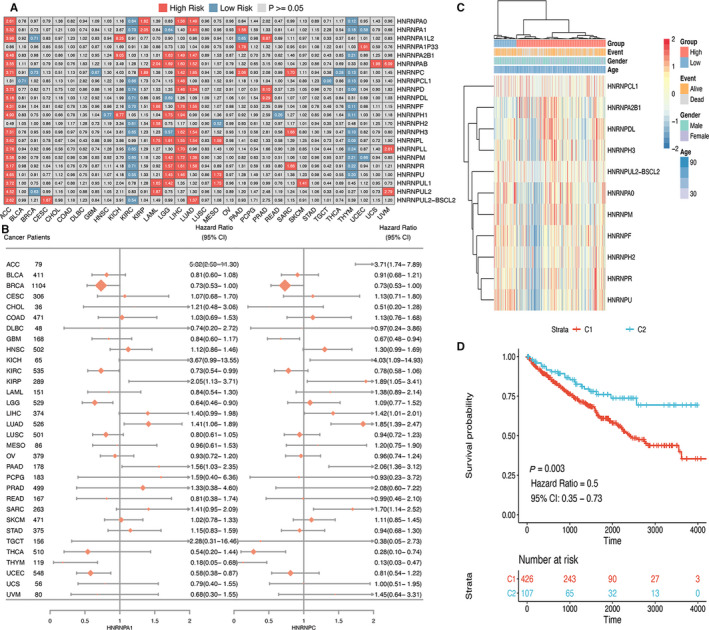
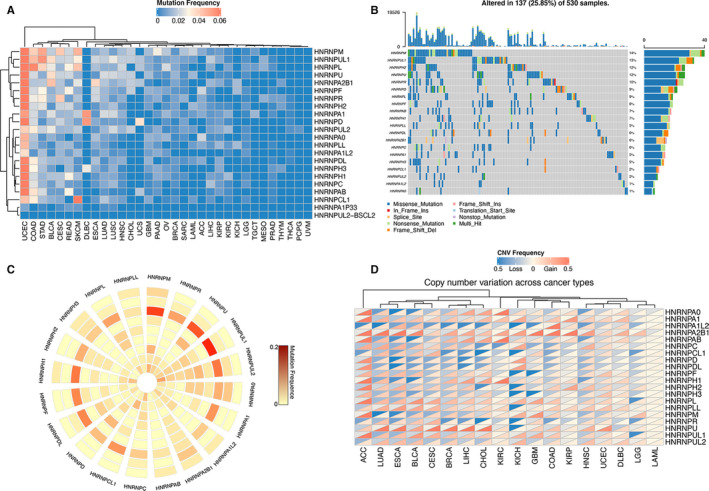
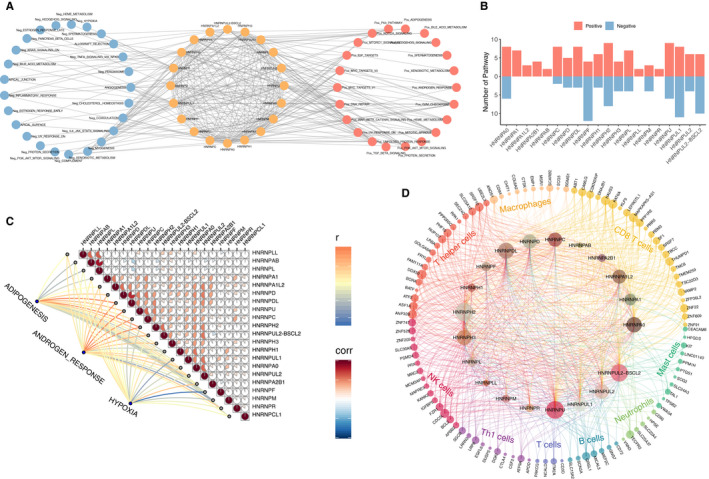
As the most critical alternative splicing regulator, heterogeneous nuclear ribonucleoproteins (hnRNPs) have been reported to be implicated in various aspects of cancer. However, the comprehensive understanding of hnRNPs in cancer is still lacking. The molecular alterations and clinical relevance of hnRNP genes were systematically analysed in 33 cancer types based on next-generation sequence data. The expression, mutation, copy number variation, functional pathways, immune cell correlations and prognostic value of hnRNPs were investigated across different cancer types. HNRNPA1 and HNRNPAB were highly expressed in most tumours. HNRNPM, HNRNPUL1, and HNRNPL showed high mutation frequencies, and most hnRNP genes were frequently mutated in uterine corpus endometrial carcinoma (UCEC). HNRNPA2B1 showed widespread copy number amplification across various cancer types. HNRNPs participated in cancer-related pathways including protein secretion, mitotic spindle, G2/M checkpoint, DNA repair, IL6/JAK/STAT3 signal and coagulation, of which hnRNP genes of HNRNPF, HNRNPH2, HNRNPU and HNRNPUL1 are more likely to be implicated. Significant correlation of hnRNP genes with T help cells, NK cells, CD8 positive T cells and neutrophils was identified. Most hnRNPs were associated with worse survival of adrenocortical carcinoma (ACC), liver hepatocellular carcinoma (LIHC) and lung adenocarcinoma (LUAD), whereas hnRNPs predicted better prognosis in kidney renal clear cell carcinoma (KIRC) and thymoma (THYM). The prognosis analysis of KIRC suggested that hnRNPs gene cluster was significantly associated with overall survival (HR = 0.5, 95% CI = 0.35-0.73, P = 0.003). These findings provide novel evidence for further investigation of hnRNPs in the development and therapy of cancer in the future.
作为最重要的可变剪接调控因子之一,异质核核糖核蛋白(hnRNPs)已被报道与癌症的各个方面有关。然而,对 hnRNPs 在癌症中的全面认识仍然缺乏。基于下一代测序数据,系统分析了 33 种癌症类型中 hnRNP 基因的分子改变和临床相关性。研究了不同癌症类型中 hnRNPs 的表达、突变、拷贝数变异、功能途径、免疫细胞相关性和预后价值。HNRNPA1 和 HNRNPAB 在大多数肿瘤中高表达。HNRNPM、HNRNPUL1 和 HNRNPL 显示出较高的突变频率,大多数 hnRNP 基因在子宫体子宫内膜癌(UCEC)中频繁突变。HNRNPA2B1 在各种癌症类型中广泛扩增。HNRNPs 参与了癌症相关途径,包括蛋白质分泌、有丝分裂纺锤体、G2/M 检查点、DNA 修复、IL6/JAK/STAT3 信号和凝血,其中 HNRNPF、HNRNPH2、HNRNPU 和 HNRNPL1 的 hnRNP 基因更有可能被涉及。鉴定出 hnRNP 基因与 T 辅助细胞、NK 细胞、CD8 阳性 T 细胞和中性粒细胞之间存在显著相关性。大多数 hnRNPs 与肾上腺皮质癌(ACC)、肝肝细胞癌(LIHC)和肺腺癌(LUAD)的生存预后较差相关,而 hnRNPs 预测肾透明细胞癌(KIRC)和胸腺瘤(THYM)的预后较好。KIRC 的预后分析表明,hnRNPs 基因簇与总生存期显著相关(HR=0.5,95%CI=0.35-0.73,P=0.003)。这些发现为未来进一步研究 hnRNPs 在癌症的发生和治疗中的作用提供了新的证据。