Lakshya, Society for Public Health Education and Research, Pune, India.
Johns Hopkins University, Center for Clinical Global Health Education, Pune, India.
Brain Behav. 2020 Nov;10(11):e01837. doi: 10.1002/brb3.1837. Epub 2020 Sep 11.
The COVID-19 pandemic has placed healthcare professionals (HCP) in stressful circumstances with increased patient loads and a high risk of exposure. We sought to assess the mental health and quality of life (QoL) of Indian HCPs, the fourth highest-burden country for COVID-19.
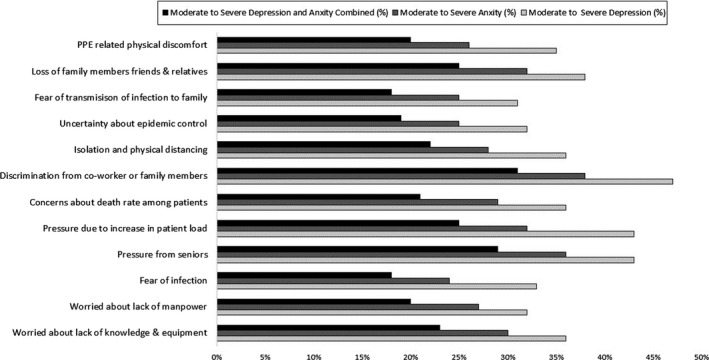
Using snowball sampling, we conducted an online survey in May 2020 among HCPs. Data were collected on demographics, depression, and anxiety using validated tools, quality of life, and perceived stressors. Multivariable logistic regression and principal component analysis were performed to assess risk factors associated with mental health symptoms.
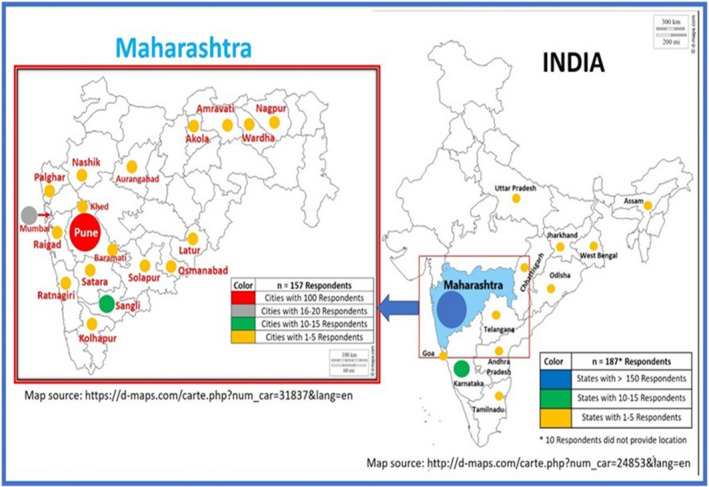
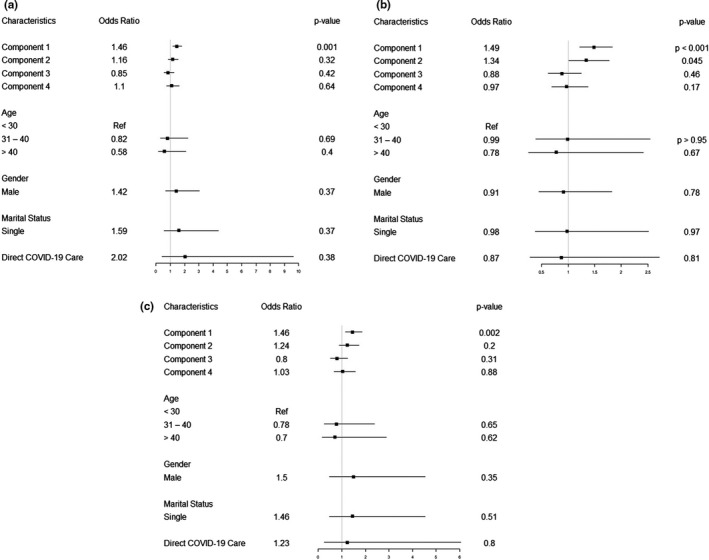
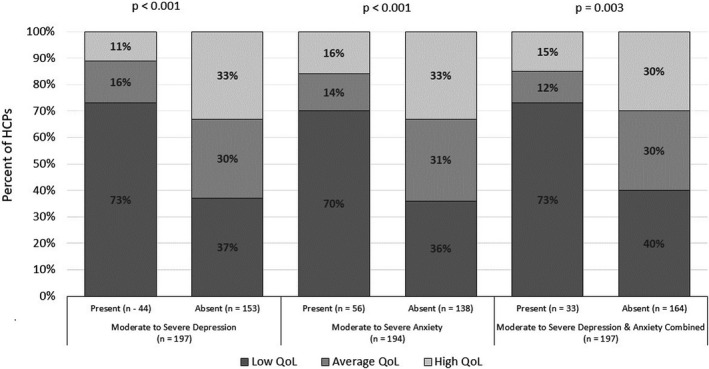
Of 197 HCPs assessed, 157 (80%) were from Maharashtra, 130 (66%) from public hospitals, 47 (24%) nurses, 66 (34%) physicians, 101 (52%) females, and 81 (41%) ≤30 years. Eighty-seven percent provided direct COVID-19 care with 43% caring for >10 patients/day. A large proportion reported symptoms of depression (92, 47%), anxiety (98, 50%), and low QoL (89, 45%). Odds of combined depression and anxiety were 2.37 times higher among single HCPs compared to married (95% CI: 1.03-4.96). Work environment stressors were associated with 46% increased risk of combined depression and anxiety (95% CI: 1.15-1.85). Moderate to severe depression and anxiety were independently associated with increased risk of low QoL [OR: 3.19 (95% CI: 1.30-7.84), OR: 2.84 (95% CI: 1.29-6.29)].
Our study demonstrated a high prevalence of symptoms of depression and anxiety and low QoL among Indian HCPs during the COVID-19 pandemic. There is an urgent need to prevent and treat mental health symptoms among frontline HCPs.
COVID-19 大流行使医护人员(HCP)处于压力环境中,患者人数增加,暴露风险高。我们试图评估印度 HCP 的心理健康和生活质量(QoL),印度是 COVID-19 第四大负担国家。
我们于 2020 年 5 月使用雪球抽样法,在 HCP 中进行了一项在线调查。使用经过验证的工具收集人口统计学、抑郁和焦虑的数据,生活质量和感知压力源。进行多变量逻辑回归和主成分分析,以评估与心理健康症状相关的危险因素。
在评估的 197 名 HCP 中,157 名(80%)来自马哈拉施特拉邦,130 名(66%)来自公立医院,47 名(24%)护士,66 名(34%)医生,101 名(52%)女性,81 名(41%)≤30 岁。87%的人提供直接的 COVID-19 护理,43%的人每天照顾>10 名患者。很大一部分人报告有抑郁症状(92 人,47%)、焦虑症状(98 人,50%)和生活质量低(89 人,45%)。与已婚的 HCP 相比,单身 HCP 同时患有抑郁和焦虑的可能性高 2.37 倍(95%CI:1.03-4.96)。工作环境压力源与同时患有抑郁和焦虑的风险增加 46%相关(95%CI:1.15-1.85)。中重度抑郁和焦虑与生活质量低的风险增加独立相关[OR:3.19(95%CI:1.30-7.84),OR:2.84(95%CI:1.29-6.29)]。
我们的研究表明,在 COVID-19 大流行期间,印度 HCP 中抑郁和焦虑症状以及生活质量低的患病率很高。迫切需要预防和治疗一线 HCP 的心理健康症状。