Department of Medical Oncology, University Medical Centre Groningen and University of Groningen, Groningen, The Netherlands.
Department of Internal Medicine, division of Vascular Medicine, University Medical Centre Groningen and University of Groningen, Groningen, The Netherlands.
Br J Cancer. 2020 Nov;123(11):1599-1607. doi: 10.1038/s41416-020-01049-3. Epub 2020 Sep 14.
Late effects of cisplatin-based chemotherapy in testicular cancer survivors (TCS) include cardiovascular morbidity, but little data is available beyond 20 years. The objective was to assess vascular damage in very long-term TCS.
TCS (treated with chemotherapy or orchiectomy only) and age-matched healthy controls were invited. Study assessment included vascular stiffness with ultrasound measurement of carotid-femoral pulse wave velocity (cf-PWV).
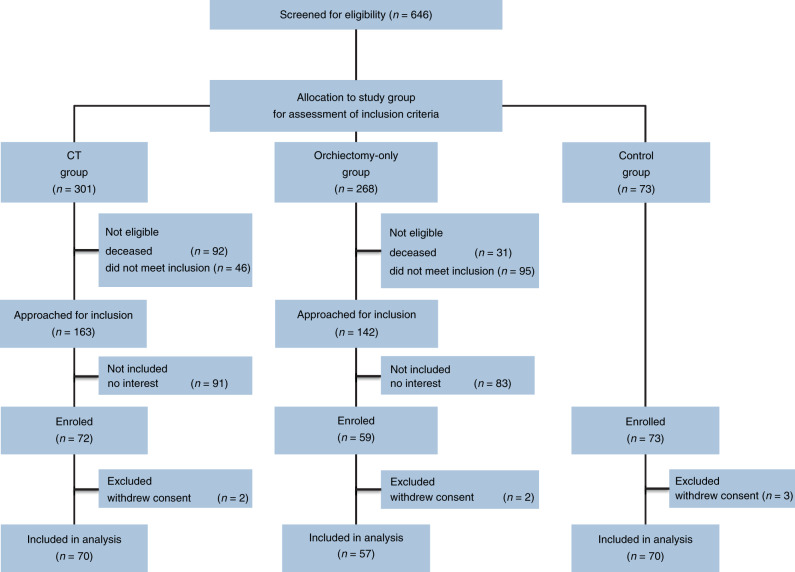
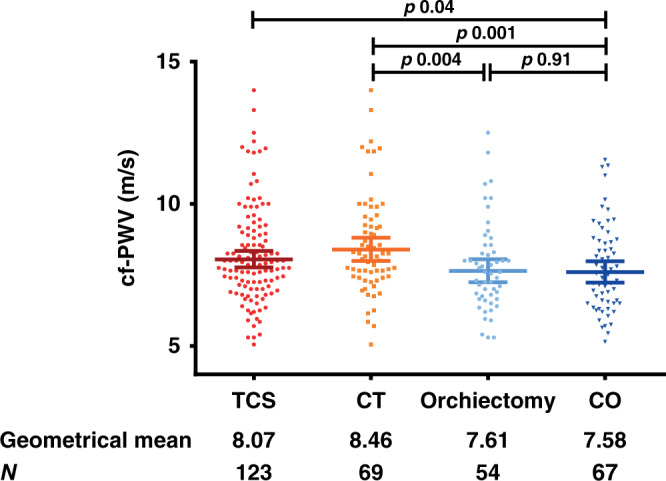
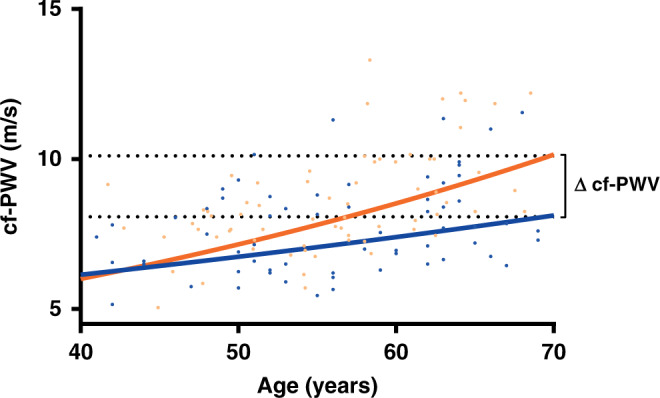
We included 127 TCS consisting of a chemotherapy group (70 patients) and an orchiectomy group (57 patients) along with 70 controls. Median follow-up was 28 years (range: 20-42). The cf-PWV (m/s) was higher in TCS than in controls (geometrical mean 8.05 (SD 1.23) vs. 7.60 (SD 1.21), p = 0.04). The cf-PWV was higher in the chemotherapy group than in the orchiectomy group (geometrical mean 8.39 (SD 1.22) vs. 7.61 (SD 1.21), p < 0.01). In the chemotherapy group cf-PWV increased more rapidly as a function of age compared to controls (regression coefficient b 7.59 × 10 vs. 4.04 × 10; p = 0.03).
Very long-term TCS treated with cisplatin-based chemotherapy show increased vascular damage compatible with "accelerated vascular aging" and continue to be at risk for cardiovascular morbidity, thus supporting the need for intensive cardiovascular risk management.
The clinical trial registration number is NCT02572934.
顺铂为基础的化疗在睾丸癌幸存者(TCS)中的晚期效应包括心血管发病率,但超过 20 年的数据很少。目的是评估非常长期 TCS 的血管损伤。
邀请 TCS(仅接受化疗或睾丸切除术治疗)和年龄匹配的健康对照者参加。研究评估包括使用超声测量颈股脉搏波速度(cf-PWV)评估血管僵硬。
我们纳入了 127 名 TCS,包括化疗组(70 名患者)和睾丸切除术组(57 名患者),以及 70 名对照者。中位随访时间为 28 年(范围:20-42 年)。TCS 的 cf-PWV(m/s)高于对照组(几何均数 8.05(SD 1.23)与 7.60(SD 1.21),p=0.04)。化疗组的 cf-PWV 高于睾丸切除术组(几何均数 8.39(SD 1.22)与 7.61(SD 1.21),p<0.01)。与对照组相比,化疗组 cf-PWV 随年龄的增长呈更快的增加趋势(回归系数 b 7.59×10 与 4.04×10;p=0.03)。
接受顺铂为基础化疗的非常长期 TCS 显示出血管损伤增加,与“加速血管老化”相符,并且继续存在心血管发病率的风险,因此支持需要进行强化心血管风险管理。
临床试验注册号为 NCT02572934。