Travis Zachary D, Sherchan Prativa, Hayes William K, Zhang John H
Department of Earth and Biological Sciences, School of Medicine, Loma Linda University, Loma Linda, CA 92354 USA.
Department of Physiology and Pharmacology, School of Medicine, Loma Linda University, Loma Linda, CA 92354 USA.
Chin Neurosurg J. 2019 Dec 16;5:29. doi: 10.1186/s41016-019-0181-8. eCollection 2019.
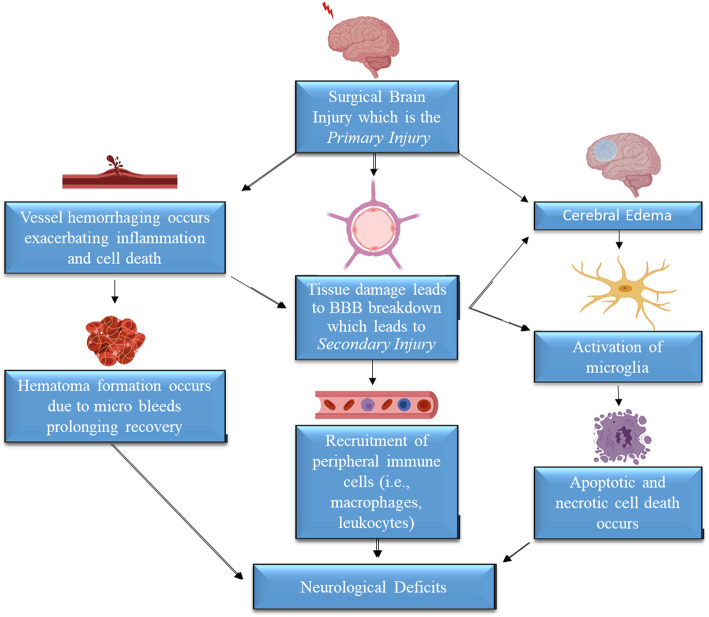
Neurosurgical procedures cause inevitable brain damage from the multitude of surgical manipulations utilized. Incisions, retraction, thermal damage from electrocautery, and intraoperative hemorrhage cause immediate and long-term brain injuries that are directly linked to neurosurgical operations, and these types of injuries, collectively, have been termed surgical brain injury (SBI). For the past decade, a model developed to study the underlying brain pathologies resulting from SBI has provided insight on cellular mechanisms and potential therapeutic targets. This model, as seen in a rat, mouse, and rabbit, mimics a neurosurgical operation and causes commonly encountered post-operative complications such as brain edema, neuroinflammation, and hemorrhage. In this review, we elaborate on SBI and its clinical impact, the SBI animal models and their clinical relevance, the importance of applying therapeutics before neurosurgical procedures (i.e., preconditioning), and the new direction of applying venom-derived proteins to attenuate SBI.
神经外科手术会因使用的大量手术操作而不可避免地导致脑损伤。切口、牵拉、电灼造成的热损伤以及术中出血会导致直接与神经外科手术相关的即刻和长期脑损伤,而这些类型的损伤统称为手术性脑损伤(SBI)。在过去十年中,一种用于研究SBI所致潜在脑病理学的模型为细胞机制和潜在治疗靶点提供了见解。这种在大鼠、小鼠和兔子身上观察到的模型模拟了神经外科手术,并引发常见的术后并发症,如脑水肿、神经炎症和出血。在本综述中,我们详细阐述了SBI及其临床影响、SBI动物模型及其临床相关性、在神经外科手术前应用治疗方法(即预处理)的重要性,以及应用毒液衍生蛋白减轻SBI的新方向。