Department of Applied and Clinical Physiology, Collegium Medicum University of Zielona Gora, Poland.
Students' Scientific Society of Physiology and Pathology, Collegium Medicum University of Zielona Gora, Poland.
Biomed Res Int. 2020 Aug 19;2020:6479630. doi: 10.1155/2020/6479630. eCollection 2020.
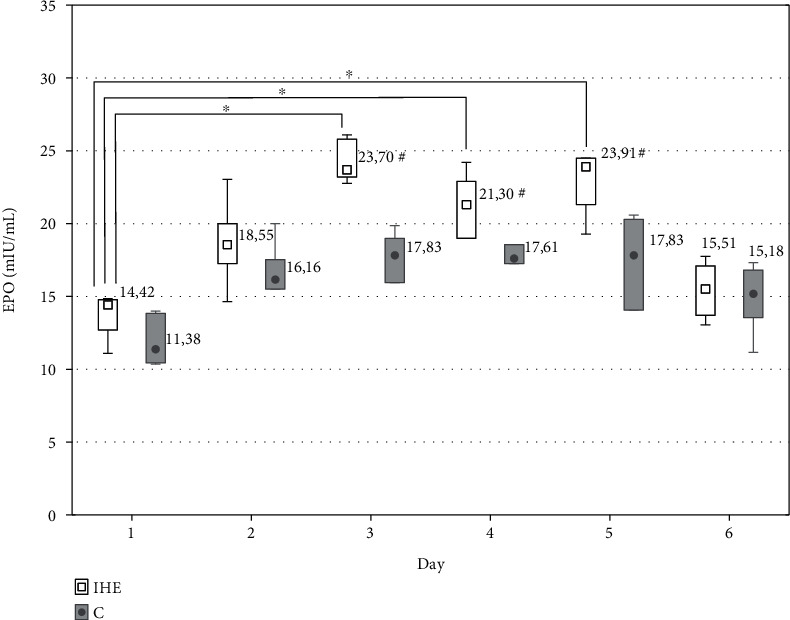
Intermittent exposure to hypoxia (IHE) increases the production of reactive oxygen and nitrogen species as well as erythropoietin (EPO), which stimulates the adaptation to intense physical activity. However, several studies suggest a protective effect of moderate hypoxia in cardiovascular disease (CVD) events. The effects of intense physical activity with IHE on oxi-inflammatory mediators and their interaction with conventional CVD risk factors were investigated. Blood samples were collected from elite athletes (control = 6, IHE = 6) during a 6-day IHE cycle using hypoxicator GO2 altitude. IHE was held once a day, at least 2 hours after training. In serum, hydrogen peroxide (HO), nitric oxide (NO), 3-nitrotyrosine (3-Nitro), proinflammatory cytokines (IL-1 and TNF), high sensitivity C-reactive protein (hsCRP), and heat shock protein 27 (HSP27) were determined by the commercial immunoenzyme (ELISA kits) or colorimetric methods. Serum erythropoietin (EPO) level was measured by ELISA kit every day of hypoxia. IHE was found to significantly increase HO, NO, and HSP27 but to decrease 3NT concentrations. The changes in 3NT and HSP27 following hypoxia proved to enhance NO bioavailability and endothelial function. In the present study, the oxi-inflammatory mediators IL-1 and hsCRP increased in IHE group but they did not exceed the reference values. The serum EPO level increased on the 3 day of IHE, then decreased on 5 day of IHE, and correlated with NO/HO ratio ( = 0.640, < 0.05). There were no changes in haematological markers contrary to lipoproteins such as low-density lipoprotein (LDL) and non-high-density lipoprotein (non-HDL) which showed a decreasing trend in response to hypoxic exposure. The study demonstrated that IHE combined with sports activity reduced a risk of endothelial dysfunction and atherogenesis in athletes even though the oxi-inflammatory processes were enhanced. Therefore, 6-day IHE seems to be a potential therapeutic and nonpharmacological method to reduce CVD risk, especially in elite athletes participating in strenuous training.
间歇性低氧暴露(IHE)会增加活性氧和活性氮物质以及促红细胞生成素(EPO)的产生,从而刺激对剧烈体力活动的适应。然而,几项研究表明,中度低氧对心血管疾病(CVD)事件具有保护作用。本研究旨在探讨剧烈体力活动与 IHE 对氧化炎症介质的影响,及其与传统 CVD 危险因素的相互作用。研究人员使用低氧舱 GO2 海拔仪,在为期 6 天的 IHE 周期中,从精英运动员(对照组 6 人,IHE 组 6 人)身上采集血液样本。IHE 每天进行一次,至少在训练后 2 小时进行。在血清中,通过商业免疫酶(ELISA 试剂盒)或比色法测定过氧化氢(HO)、一氧化氮(NO)、3-硝基酪氨酸(3-Nitro)、促炎细胞因子(IL-1 和 TNF)、高敏 C 反应蛋白(hsCRP)和热休克蛋白 27(HSP27)的水平。每天通过 ELISA 试剂盒测量血清促红细胞生成素(EPO)水平。研究发现,IHE 显著增加了 HO、NO 和 HSP27,但降低了 3NT 浓度。低氧后 3NT 和 HSP27 的变化被证明增强了 NO 的生物利用度和内皮功能。在本研究中,IHE 组的促炎介质 IL-1 和 hsCRP 增加,但未超过参考值。IHE 第 3 天 EPO 水平升高,第 5 天 EPO 水平下降,与 NO/HO 比值呈正相关( = 0.640, < 0.05)。与脂蛋白(如低密度脂蛋白(LDL)和非高密度脂蛋白(non-HDL))相反,血液学标志物没有变化,这些脂蛋白在低氧暴露时呈下降趋势。研究表明,IHE 结合运动可降低运动员发生内皮功能障碍和动脉粥样硬化的风险,尽管氧化炎症过程增强。因此,6 天的 IHE 似乎是一种潜在的治疗和非药物方法,可以降低 CVD 风险,特别是在参加剧烈训练的精英运动员中。