Tanaka Yoshiki, Yoshikaie Kunihito, Takeuchi Azusa, Ichikawa Muneyoshi, Mori Tomoyuki, Uchino Sayaka, Sugano Yasunori, Hakoshima Toshio, Takagi Hiroshi, Nonaka Gen, Tsukazaki Tomoya
Nara Institute of Science and Technology, Ikoma, Nara 630-0192, Japan.
Institute for Quantitative Biosciences, The University of Tokyo, Bunkyo-ku, Tokyo 113-0032, Japan.
Sci Adv. 2020 Aug 26;6(35):eaba7637. doi: 10.1126/sciadv.aba7637. eCollection 2020 Aug.
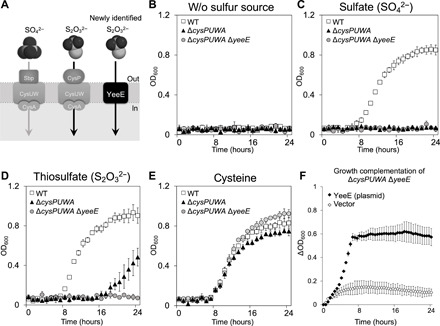
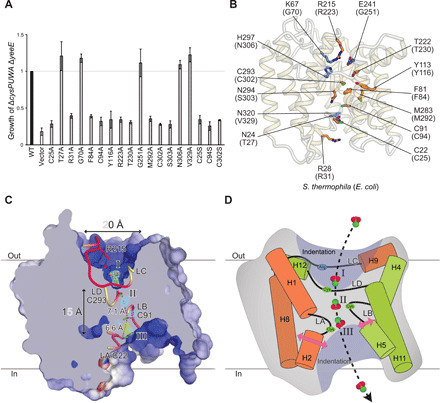
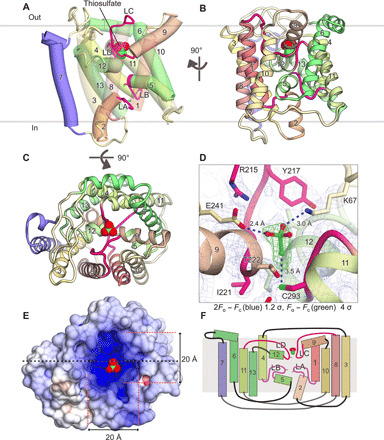
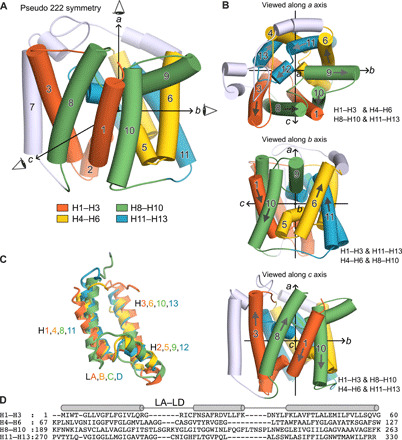
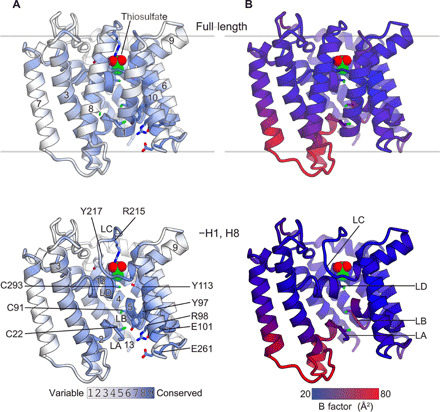
We have demonstrated that a bacterial membrane protein, YeeE, mediates thiosulfate uptake. Thiosulfate is used for cysteine synthesis in bacteria as an inorganic sulfur source in the global biological sulfur cycle. The crystal structure of YeeE at 2.5-Å resolution reveals an unprecedented hourglass-like architecture with thiosulfate in the positively charged outer concave side. YeeE is composed of loops and 13 helices including 9 transmembrane α helices, most of which show an intramolecular pseudo 222 symmetry. Four characteristic loops are buried toward the center of YeeE and form its central region surrounded by the nine helices. Additional electron density maps and successive molecular dynamics simulations imply that thiosulfate can remain temporally at several positions in the proposed pathway. We propose a plausible mechanism of thiosulfate uptake via three important conserved cysteine residues of the loops along the pathway.
我们已经证明,一种细菌膜蛋白YeeE介导硫代硫酸盐的摄取。在全球生物硫循环中,硫代硫酸盐作为无机硫源用于细菌中的半胱氨酸合成。YeeE的2.5埃分辨率晶体结构揭示了一种前所未有的沙漏状结构,硫代硫酸盐位于带正电荷的外凹侧。YeeE由环和13个螺旋组成,包括9个跨膜α螺旋,其中大部分呈现分子内伪222对称性。四个特征环朝向YeeE的中心埋藏,并形成由九个螺旋包围的中心区域。额外的电子密度图和连续的分子动力学模拟表明,硫代硫酸盐可以在提议的途径中的几个位置暂时停留。我们提出了一种通过该途径中环的三个重要保守半胱氨酸残基摄取硫代硫酸盐的合理机制。