Esterling Lisa, Wijayatunge Ranjula, Brown Krystal, Morris Brian, Hughes Elisha, Pruss Dmitry, Manley Susan, Bowles Karla R, Ross Theodora S
Myriad Genetic Laboratories, Salt Lake City, UT.
University of Texas Southwestern Medical Center, Dallas, TX.
JCO Precis Oncol. 2020 Aug 27;4. doi: 10.1200/PO.20.00020. eCollection 2020.
Hereditary cancer genetic testing can inform personalized medical management for individuals at increased cancer risk. However, many variants in cancer predisposition genes are individually rare, and traditional tools may be insufficient to evaluate pathogenicity. This analysis presents data on variant classification and reclassification over a 20-year period.
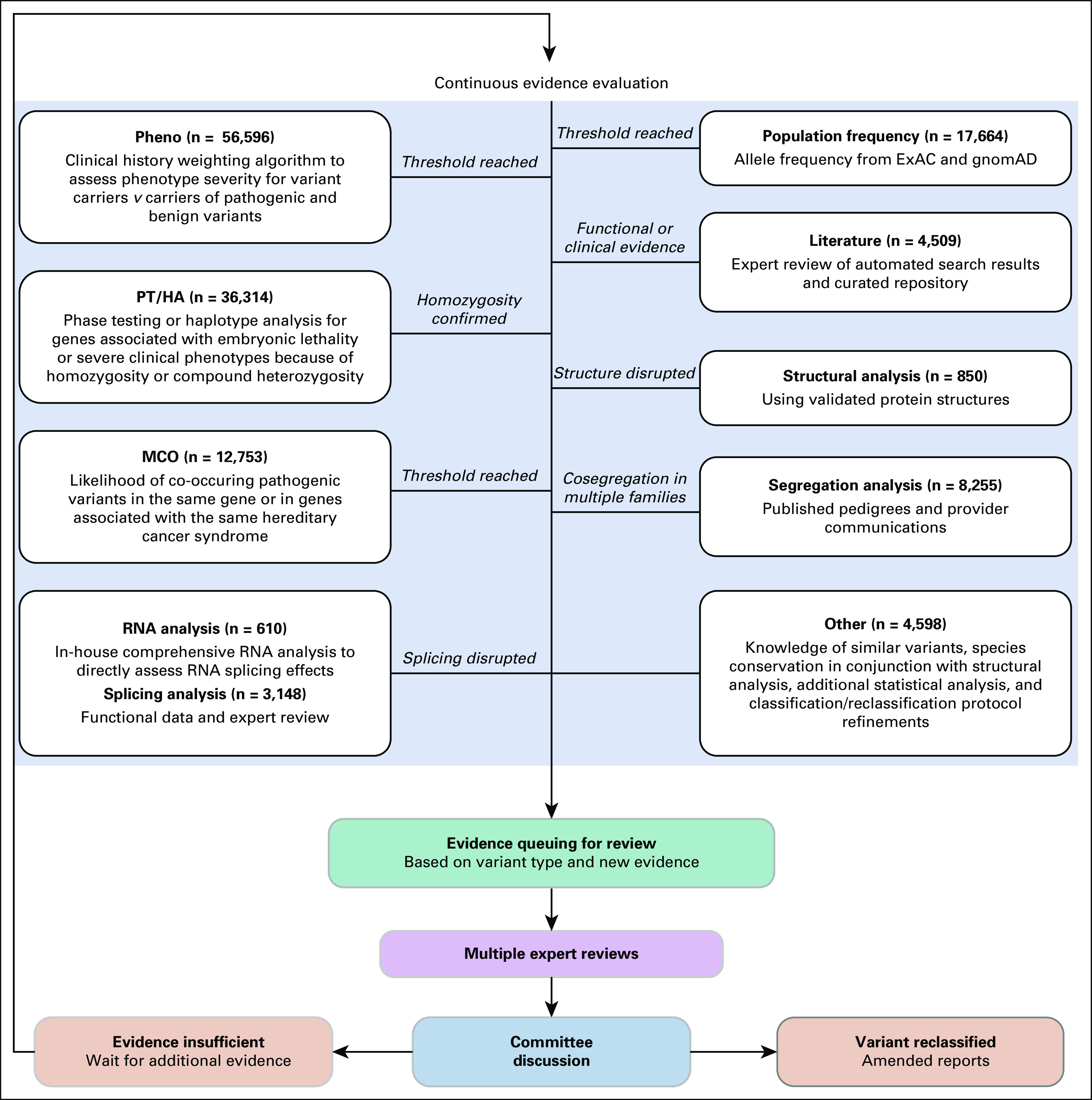
This is a retrospective analysis of > 1.9 million individuals who received hereditary cancer genetic testing from a single clinical laboratory (March 1997 to December 2017). Variant classification included review of evidence from traditional tools (eg, population frequency databases, literature) and laboratory-developed tools (eg, novel statistical methods, in-house RNA analysis) by a multidisciplinary expert committee. Variants may have been reclassified more than once and with more than one line of evidence.
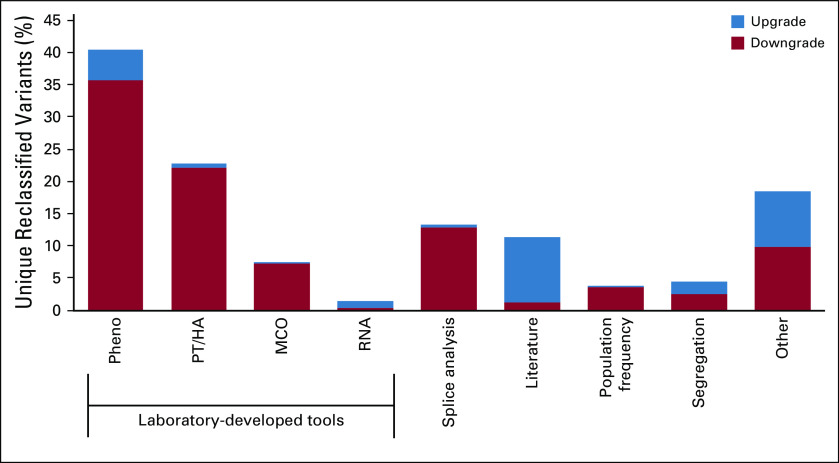
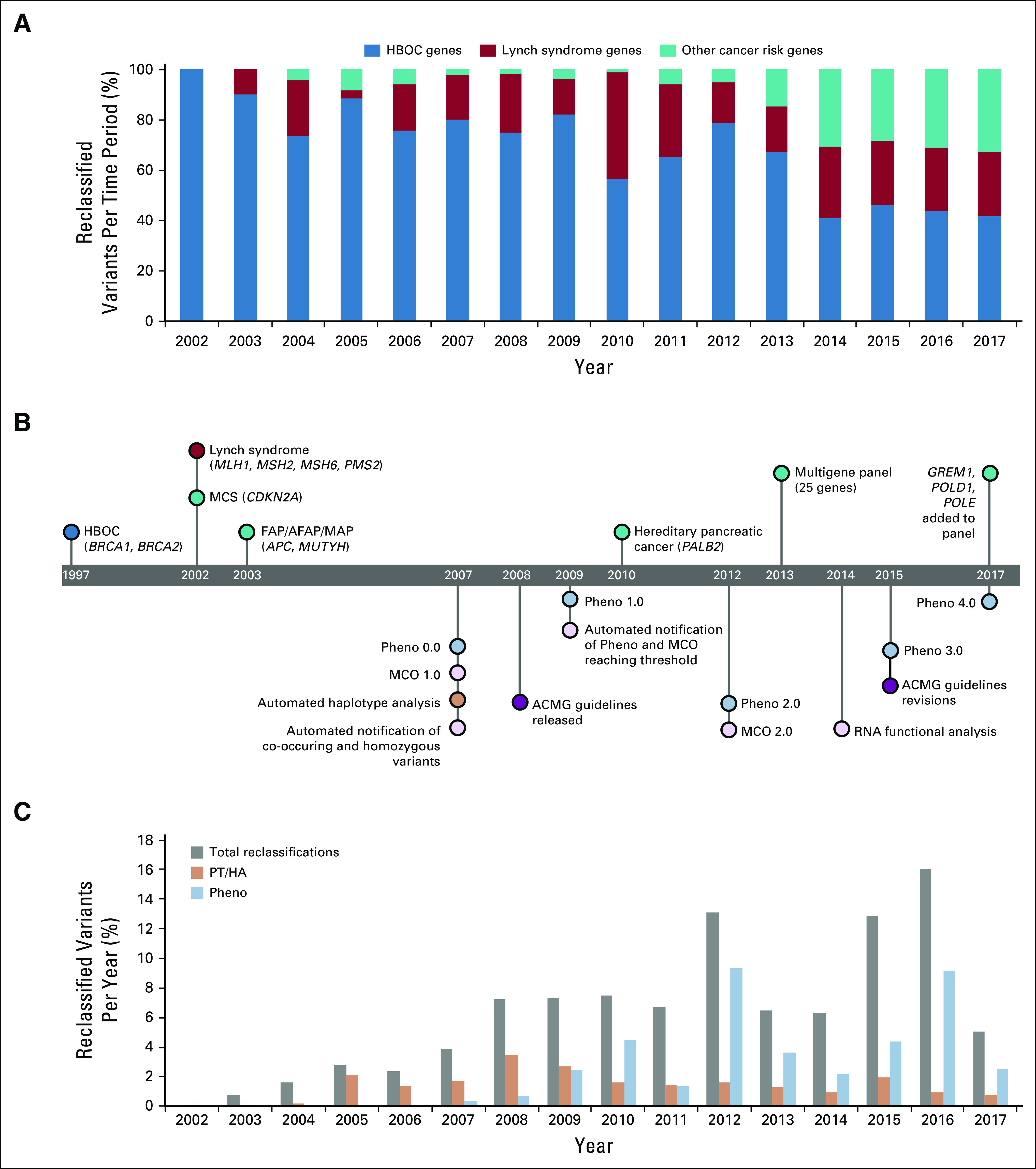
In this time period, 62,842 unique variants were observed across 25 cancer predisposition genes, and 2,976 variants were reclassified. Overall, 82.1% of reclassification events were downgrades (eg, variant of uncertain significance [VUS] to benign), and 17.9% were upgrades (eg, VUS to pathogenic). Among reclassified variants, 82.8% were initially classified as VUS, and 47.5% were identified in ≤ 20 individuals (allele frequency ≤ 0.001%). Laboratory-developed tools were used in 72.3% of variant reclassification events, which affected > 600,000 individuals. More than 1.3 million patients were identified as carrying a variant that was reclassified within this 20-year time period.
The variant classification program used by the laboratory evaluated here enabled the reclassification of variants that were individually rare. Laboratory-developed tools were a key component of this program and were used in the majority of reclassifications. This demonstrates the importance of using robust and novel tools to reclassify rare variants to appropriately inform personalized medical management.
遗传性癌症基因检测可为癌症风险增加的个体提供个性化医疗管理依据。然而,癌症易感基因中的许多变异个体罕见,传统工具可能不足以评估其致病性。本分析展示了20年间变异分类和重新分类的数据。
这是一项对超过190万人的回顾性分析,这些人在一家临床实验室接受了遗传性癌症基因检测(1997年3月至2017年12月)。变异分类包括多学科专家委员会对传统工具(如人群频率数据库、文献)和实验室开发工具(如新型统计方法、内部RNA分析)的证据审查。变异可能不止一次且依据多条证据进行重新分类。
在此期间,在25个癌症易感基因中观察到62,842个独特变异,2,976个变异被重新分类。总体而言,82.1%的重新分类事件为降级(如意义未明变异[VUS]变为良性),17.9%为升级(如VUS变为致病性)。在重新分类的变异中,82.8%最初被分类为VUS,47.5%在≤20个人中被鉴定出(等位基因频率≤0.001%)。实验室开发工具在72.3%的变异重新分类事件中被使用,这些事件影响了超过60万人。超过130万患者被鉴定为携带在此20年期间被重新分类的变异。
此处评估的实验室所使用的变异分类程序能够对个体罕见的变异进行重新分类。实验室开发工具是该程序的关键组成部分,在大多数重新分类中被使用。这证明了使用强大且新颖的工具对罕见变异进行重新分类以适当地为个性化医疗管理提供信息的重要性。