Google, Mountain View, CA, United States of America.
Department of Biomedical Data Science, Stanford University, Stanford, CA, United States of America.
Contemp Clin Trials. 2020 Oct;97:106145. doi: 10.1016/j.cct.2020.106145. Epub 2020 Sep 12.
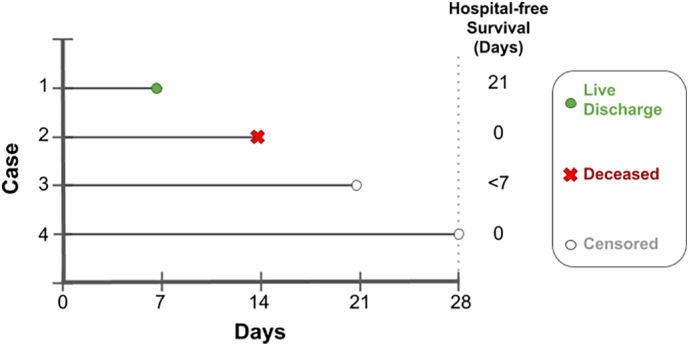
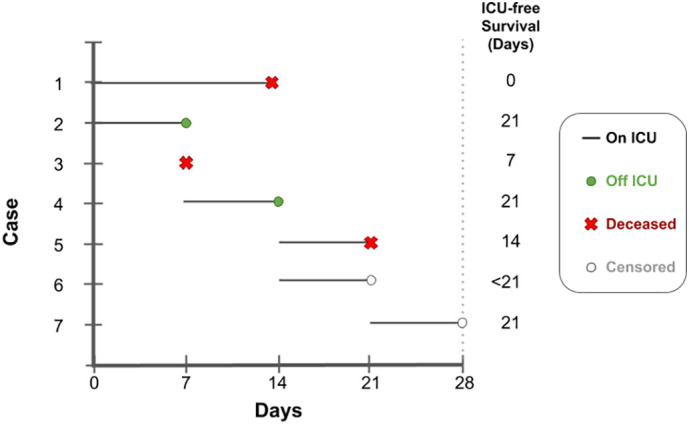
To evaluate the efficacy and safety of a new treatment for COVID-19 vs. standard care, certain key endpoints are related to the duration of a specific event, such as hospitalization, ICU stay, or receipt of supplemental oxygen. However, since patients may die in the hospital during study follow-up, using, for example, the duration of hospitalization to assess treatment efficacy can be misleading. If the treatment tends to prolong patients' survival compared with standard care, patients in the new treatment group may spend more time in hospital. This can lead to a "survival bias" issue, where a treatment that is effective for preventing death appears to prolong an undesirable outcome. On the other hand, by using hospital-free survival time as the endpoint, we can circumvent the survival bias issue. In this article, we use reconstructed data from a recent, large clinical trial for COVID-19 to illustrate the advantages of this approach. For the analysis of ICU stay or oxygen usage, where the initiating event is potentially an outcome of treatment, standard survival analysis techniques may not be appropriate. We also discuss issues with analyzing the durations of such events.
为了评估一种新的 COVID-19 治疗方法与标准治疗相比的疗效和安全性,某些关键终点与特定事件的持续时间有关,例如住院、入住 ICU 或接受补充氧气。然而,由于患者在研究随访期间可能会在医院死亡,因此使用例如住院时间来评估治疗效果可能会产生误导。如果与标准治疗相比,治疗倾向于延长患者的生存时间,那么新治疗组的患者可能会在医院中花费更多时间。这可能导致“生存偏差”问题,即一种有效预防死亡的治疗方法似乎会延长不良结局。另一方面,通过使用无住院生存时间作为终点,我们可以规避生存偏差问题。在本文中,我们使用最近的一项大型 COVID-19 临床试验的重建数据来说明这种方法的优势。对于 ICU 入住或氧气使用的分析,其中起始事件可能是治疗的结果,标准的生存分析技术可能并不适用。我们还讨论了分析此类事件持续时间的问题。