Clinical Division and Laboratory of Intensive Care Medicine, Department of Cellular and Molecular Medicine, KU Leuven, Herestraat 49, B-3000, Leuven, Belgium.
Crit Care. 2020 Sep 14;24(1):557. doi: 10.1186/s13054-020-03254-1.
Circulating growth-differentiation factor-15 (GDF15), a cellular stress marker, abruptly increases during critical illness, but its later time course remains unclear. GDF15 physiologically controls oral intake by driving aversive responses to nutrition. Early parenteral nutrition (PN) in ICU patients has overall been shown not beneficial. We hypothesized that low GDF15 can identify patients who benefit from early PN, tolerate enteral nutrition (EN), and resume spontaneous oral intake.
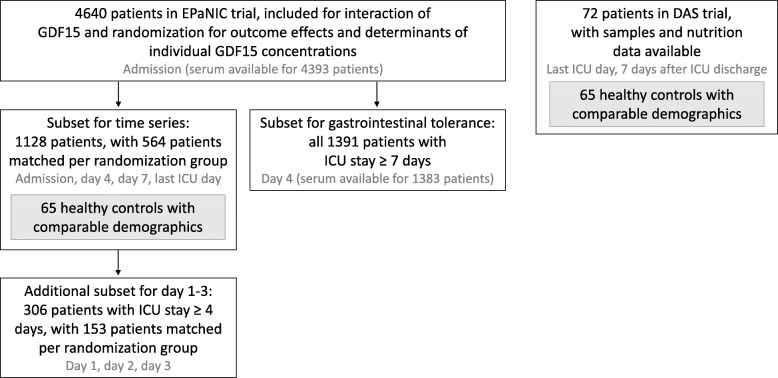
In secondary analyses of the EPaNIC-RCT on timing of PN initiation (early PN versus late PN) and the prospective observational DAS study, we documented the time course of circulating GDF15 in ICU (N = 1128) and 1 week post-ICU (N = 72), compared with healthy subjects (N = 65), and the impact hereon of randomization to early PN versus late PN in propensity score-matched groups (N = 564/group). Interaction between upon-admission GDF15 and randomization for its outcome effects was investigated (N = 4393). Finally, association between GDF15 and EN tolerance in ICU (N = 1383) and oral intake beyond ICU discharge (N = 72) was studied.
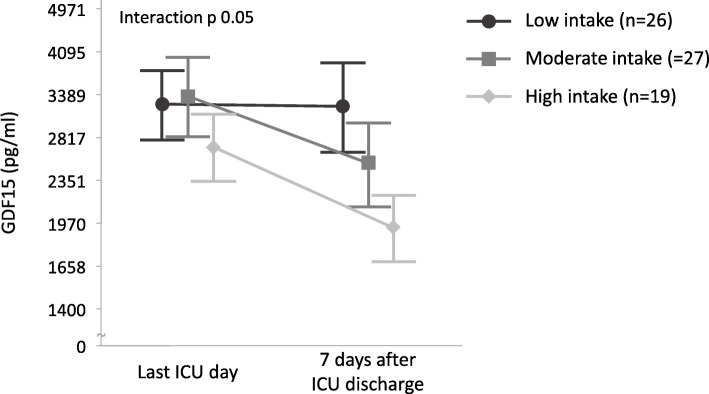
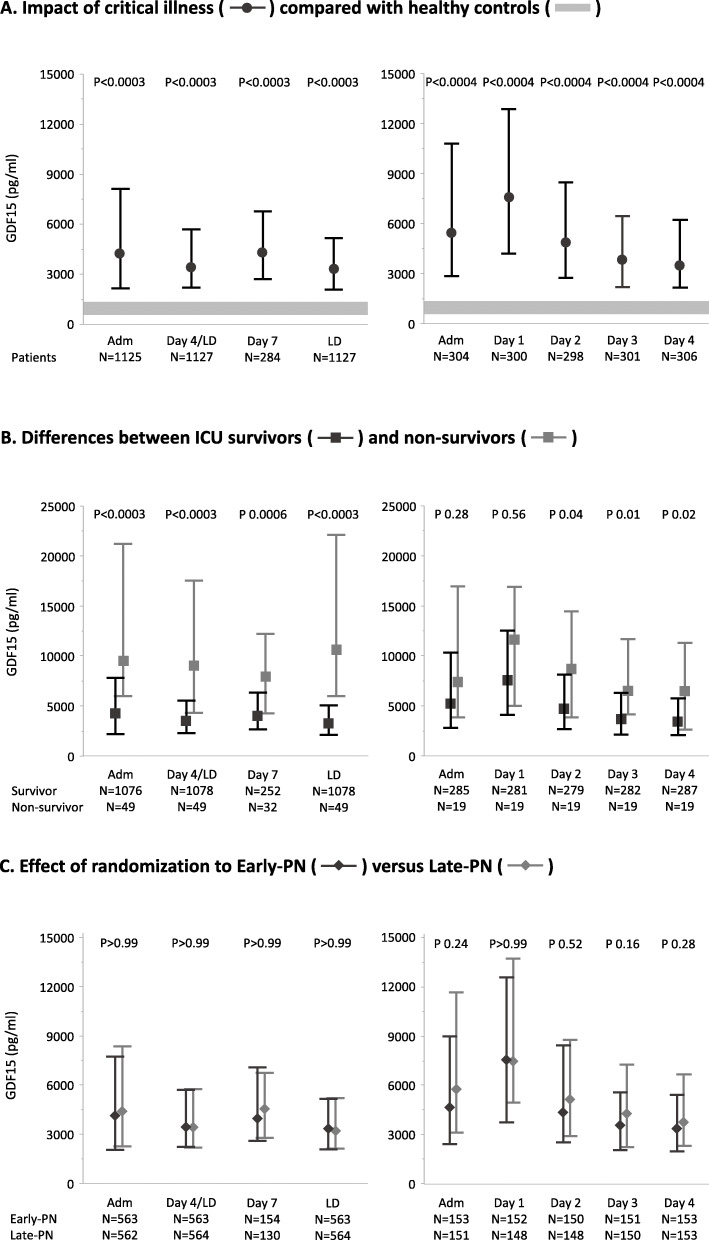
GDF15 was elevated throughout ICU stay, similarly in early PN and late PN patients, and remained high beyond ICU discharge (p < 0.0001). Upon-admission GDF15 did not interact with randomization to early PN versus late PN for its outcome effects, but higher GDF15 independently related to worse outcomes (p ≤ 0.002). Lower GDF15 was only weakly related to gastrointestinal tolerance (p < 0.0001) and a steeper drop in GDF15 with more oral intake after ICU discharge (p = 0.05).
In critically ill patients, high GDF15 reflected poor prognosis and may contribute to aversive responses to nutrition. However, the potential of GDF15 as "ready-to-feed indicator" appears limited.
ClinicalTrials.gov , NCT00512122, registered 31 July 2007, https://www.clinicaltrials.gov/ct2/show/NCT00512122 (EPaNIC trial) and ISRCTN, ISRCTN 98806770, registered 11 November 2014, http://www.isrctn.com/ISRCTN98806770 (DAS trial).
循环生长分化因子 15(GDF15)是一种细胞应激标志物,在危重病期间急剧增加,但其后的时间过程尚不清楚。GDF15 通过驱动对营养的厌恶反应来生理性地控制口腔摄入。早期 ICU 患者的肠外营养(PN)总体上没有益处。我们假设低 GDF15 可以识别从早期 PN 中受益、耐受肠内营养(EN)和恢复自主口服摄入的患者。
在早期 PN 与晚期 PN 启动时机的 EPaNIC-RCT 的二次分析和前瞻性观察性 DAS 研究中,我们记录了 ICU(N=1128)和 ICU 后 1 周(N=72)循环 GDF15 的时间过程,与健康受试者(N=65)进行比较,并在倾向评分匹配组(N=564/组)中比较了随机分组到早期 PN 与晚期 PN 的影响。研究了入院时 GDF15 与随机分组对其结果影响之间的相互作用(N=4393)。最后,研究了 GDF15 与 ICU 期间 EN 耐受性(N=1383)和 ICU 出院后口服摄入量(N=72)之间的关系。
GDF15 在整个 ICU 住院期间升高,在早期 PN 和晚期 PN 患者中相似,并且在 ICU 出院后仍保持较高水平(p<0.0001)。入院时 GDF15 与随机分组到早期 PN 与晚期 PN 之间的结果影响没有相互作用,但较高的 GDF15 独立地与较差的结果相关(p≤0.002)。较低的 GDF15 仅与胃肠道耐受性有微弱相关性(p<0.0001),且 ICU 出院后 GDF15 下降较快与更多的口服摄入相关(p=0.05)。
在危重病患者中,高 GDF15 反映了不良预后,并可能导致对营养的厌恶反应。然而,GDF15 作为“准备喂养指标”的潜力似乎有限。
ClinicalTrials.gov,NCT00512122,注册于 2007 年 7 月 31 日,https://www.clinicaltrials.gov/ct2/show/NCT00512122(EPaNIC 试验)和 ISRCTN,ISRCTN 98806770,注册于 2014 年 11 月 11 日,http://www.isrctn.com/ISRCTN98806770(DAS 试验)。