Institute of Materials Research, Helmholtz-Zentrum Geesthacht Centre for Materials and Coastal Research, Geesthacht, Germany.
Institute of Polymer and Composites, Hamburg University of Technology, Hamburg, Germany.
Sci Rep. 2020 Sep 14;10(1):15006. doi: 10.1038/s41598-020-71694-4.
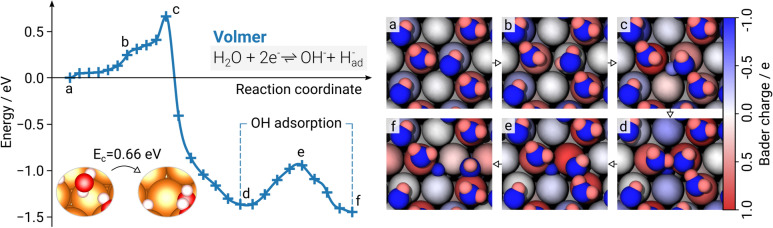
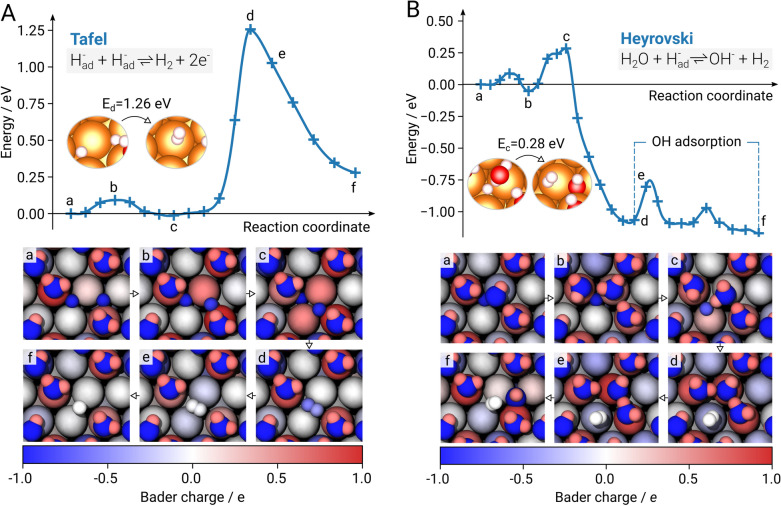
Magnesium is the lightest structural engineering material and bears high potential to manufacture automotive components, medical implants and energy storage systems. However, the practical use of untreated magnesium alloys is restricted as they are prone to corrosion. An essential prerequisite for the control or prevention of the degradation process is a deeper understanding of the underlying corrosion mechanisms. Prior investigations of the formation of gaseous hydrogen during the corrosion of magnesium indicated that the predominant mechanism for this process follows the Volmer-Heyrovský rather than the previously assumed Volmer-Tafel pathway. However, the energetic and electronic states of both reaction paths as well as the charge state of dissolved magnesium have not been fully unraveled yet. In this study, density functional theory calculations were employed to determine these parameters for the Volmer, Tafel and Heyrovský steps to gain a comprehensive understanding of the major corrosion mechanisms responsible for the degradation of magnesium.
镁是最轻的结构工程材料,具有很大的潜力用于制造汽车部件、医疗植入物和储能系统。然而,未经处理的镁合金的实际应用受到限制,因为它们容易腐蚀。控制或防止降解过程的一个基本前提是更深入地了解潜在的腐蚀机制。先前对镁腐蚀过程中气态氢形成的研究表明,该过程的主要机制遵循 Volmer-Heyrovský 而不是以前假设的 Volmer-Tafel 途径。然而,这两个反应途径的能量和电子状态以及溶解镁的电荷状态尚未完全阐明。在这项研究中,使用密度泛函理论计算来确定 Volmer、Tafel 和 Heyrovský 步骤的这些参数,以全面了解导致镁降解的主要腐蚀机制。