University of Washington, Seattle, Washington (J.H.R., A.C.L., D.M., E.B., K.L.N., J.P.H., N.S., M.R., D.A.N., H.Y.C.).
Kaiser Permanente Washington Health Research Institute, Seattle, Washington (M.L.J.).
Ann Intern Med. 2021 Jan;174(1):42-49. doi: 10.7326/M20-3799. Epub 2020 Sep 15.
Homeless shelters are a high-risk setting for severe acute respiratory syndrome coronavirus 2 (SARS-CoV-2) transmission because of crowding and shared hygiene facilities.
To investigate SARS-CoV-2 case counts across several adult and family homeless shelters in a major metropolitan area.
Cross-sectional, community-based surveillance study. (ClinicalTrials.gov: NCT04141917).
14 homeless shelters in King County, Washington.
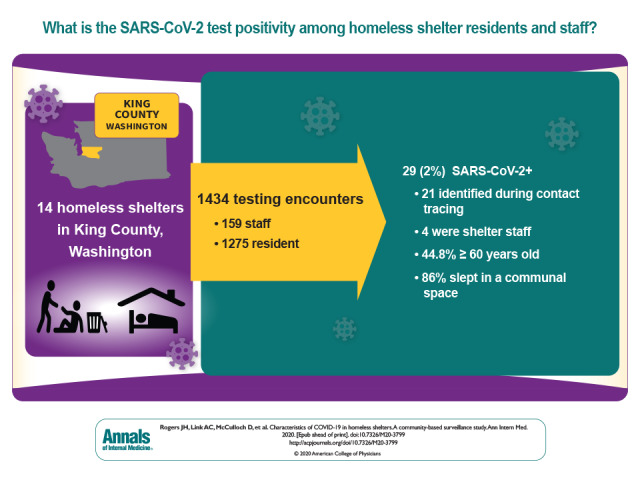
A total of 1434 study encounters were done in shelter residents and staff, regardless of symptoms.
2 strategies were used for SARS-CoV-2 testing: routine surveillance and contact tracing ("surge testing") events.
The primary outcome measure was test positivity rate of SARS-CoV-2 infection at shelters, determined by dividing the number of positive cases by the total number of participant encounters, regardless of symptoms. Sociodemographic, clinical, and virologic variables were assessed as correlates of viral positivity.
Among 1434 encounters, 29 (2% [95% CI, 1.4% to 2.9%]) cases of SARS-CoV-2 infection were detected across 5 shelters. Most ( = 21 [72.4%]) were detected during surge testing events rather than routine surveillance, and most ( = 21 [72.4% {CI, 52.8% to 87.3%}]) were asymptomatic at the time of sample collection. Persons who were positive for SARS-CoV-2 were more frequently aged 60 years or older than those without SARS-CoV-2 (44.8% vs. 15.9%). Eighty-six percent of persons with positive test results slept in a communal space rather than in a private or shared room.
Selection bias due to voluntary participation and a relatively small case count.
Active surveillance and surge testing were used to detect multiple cases of asymptomatic and symptomatic SARS-CoV-2 infection in homeless shelters. The findings suggest an unmet need for routine viral testing outside of clinical settings for homeless populations.
Gates Ventures.
由于拥挤和共用卫生设施,收容所是严重急性呼吸综合征冠状病毒 2(SARS-CoV-2)传播的高风险场所。
调查一个主要大都市区的几个成人和家庭收容所中 SARS-CoV-2 的病例数。
横断面、基于社区的监测研究。(ClinicalTrials.gov:NCT04141917)。
华盛顿州金县的 14 个收容所。
无论症状如何,对收容所居民和工作人员进行了总计 1434 次研究接触。
使用了 2 种策略进行 SARS-CoV-2 检测:常规监测和接触者追踪(“激增检测”)事件。
主要结局指标是收容所 SARS-CoV-2 感染的检测阳性率,通过将阳性病例数除以参与者接触的总数来确定,无论症状如何。评估了社会人口统计学、临床和病毒学变量作为病毒阳性的相关性。
在 1434 次接触中,在 5 个收容所中发现了 29 例(2%[95%CI,1.4%至 2.9%])SARS-CoV-2 感染病例。大多数(=21[72.4%])是在激增检测事件中而不是常规监测中发现的,大多数(=21[72.4%{CI,52.8%至 87.3%})在样本采集时无症状。SARS-CoV-2 检测呈阳性的人比未感染 SARS-CoV-2 的人更频繁地年龄在 60 岁或以上(44.8%比 15.9%)。86%的阳性检测结果者睡在公共空间,而不是私人或共享房间。
由于自愿参与和相对较小的病例数,存在选择偏倚。
主动监测和激增检测用于检测无症和有症状的 SARS-CoV-2 在收容所中的感染。研究结果表明,无家可归人群在临床环境之外,对常规病毒检测的需求尚未得到满足。
盖茨基金会。