Department of Biology, Stanford University, Stanford, California, United States of America.
Department of Genetics, Stanford University School of Medicine, Stanford, California, United States of America.
PLoS Biol. 2020 Sep 15;18(9):e3000852. doi: 10.1371/journal.pbio.3000852. eCollection 2020 Sep.
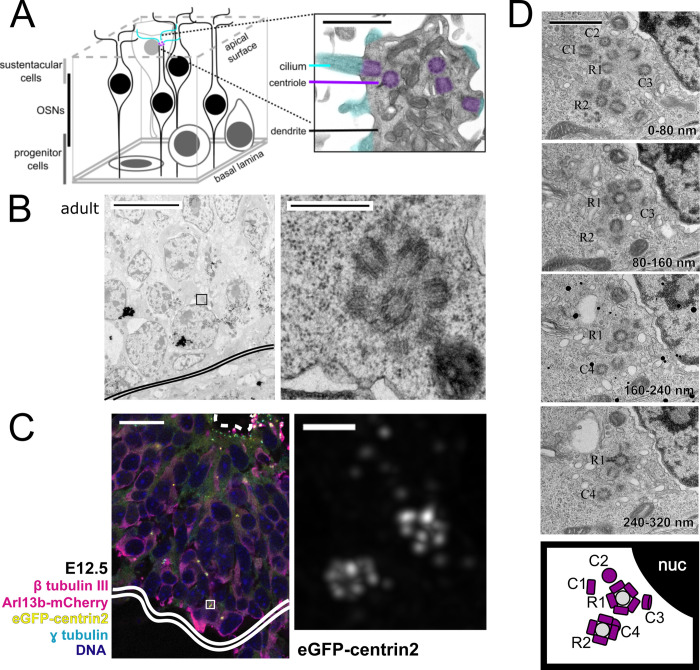
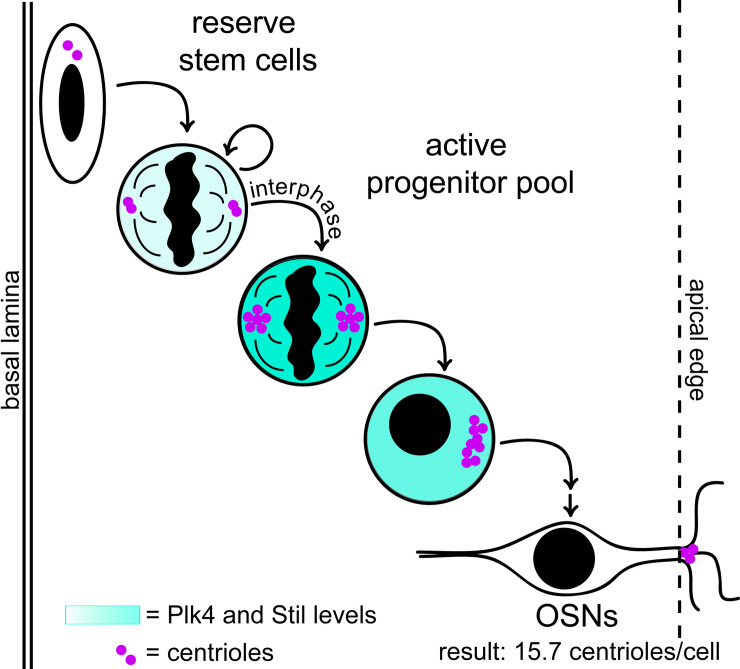
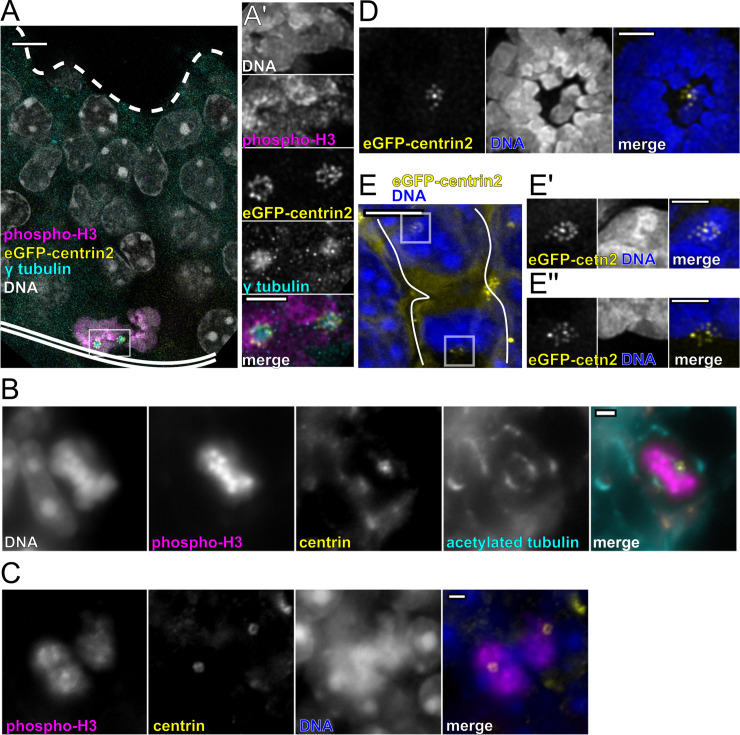
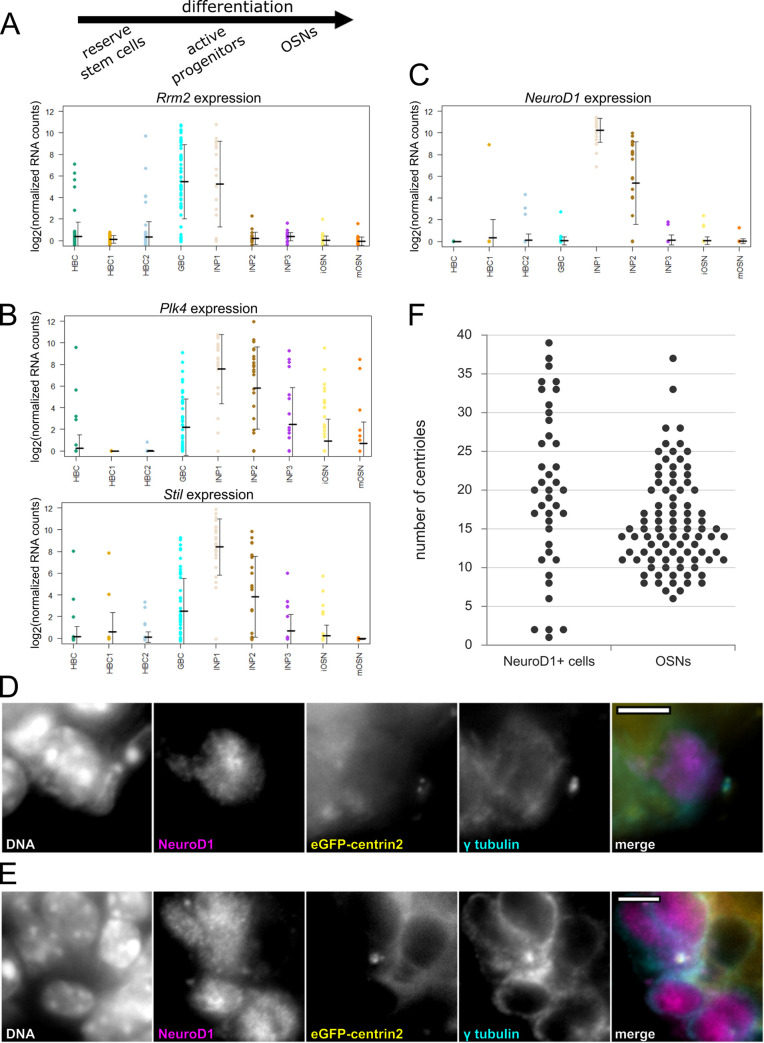
Olfaction in most animals is mediated by neurons bearing cilia that are accessible to the environment. Olfactory sensory neurons (OSNs) in chordates usually have multiple cilia, each with a centriole at its base. OSNs differentiate from stem cells in the olfactory epithelium, and how the epithelium generates cells with many centrioles is not yet understood. We show that centrioles are amplified via centriole rosette formation in both embryonic development and turnover of the olfactory epithelium in adult mice, and rosette-bearing cells often have free centrioles in addition. Cells with amplified centrioles can go on to divide, with centrioles clustered at each pole. Additionally, we found that centrioles are amplified in immediate neuronal precursors (INPs) concomitant with elevation of mRNA for polo-like kinase 4 (Plk4) and SCL/Tal1-interrupting locus gene (Stil), key regulators of centriole duplication. These results support a model in which centriole amplification occurs during a transient state characterized by elevated Plk4 and Stil in early INP cells. These cells then go on to divide at least once to become OSNs, demonstrating that cell division with amplified centrioles, known to be tolerated in disease states, can occur as part of a normal developmental program.
在大多数动物中,嗅觉是由能够接触到环境的带有纤毛的神经元介导的。脊椎动物的嗅觉感觉神经元 (OSN) 通常具有多个纤毛,每个纤毛的基部都有一个中心粒。OSN 从嗅上皮的干细胞分化而来,而上皮细胞如何产生具有多个中心粒的细胞尚不清楚。我们表明,中心粒通过在胚胎发育和成年小鼠嗅上皮的更新过程中形成中心粒玫瑰花结而被放大,并且带有玫瑰花结的细胞通常还有游离的中心粒。具有放大的中心粒的细胞可以继续分裂,每个极都有中心粒聚集。此外,我们发现中心粒在瞬时神经元前体 (INP) 中被放大,同时伴随着 Polo 样激酶 4 (Plk4) 和 SCL/Tal1 中断基因 (Stil) 的 mRNA 水平升高,这是中心粒复制的关键调节因子。这些结果支持这样一种模型,即中心粒放大发生在以早期 INP 细胞中 Plk4 和 Stil 水平升高为特征的短暂状态中。这些细胞随后至少分裂一次成为 OSN,表明在疾病状态下已知可耐受的具有放大中心粒的细胞分裂可以作为正常发育计划的一部分发生。