Soerensen Anne Vest, Ellebaek Eva, Bastholt Lars, Schmidt Henrik, Donia Marco, Svane Inge Marie
Department of Oncology, Herlev Hospital, Copenhagen University Hospital, Borgmester Ib Juuls Vej 1, 2730 Herlev, Denmark.
Department of Oncology, Odense University Hospital, J.B. Winsloews vej 4, 5000 Odense C, Denmark.
Cancers (Basel). 2020 Sep 11;12(9):2591. doi: 10.3390/cancers12092591.
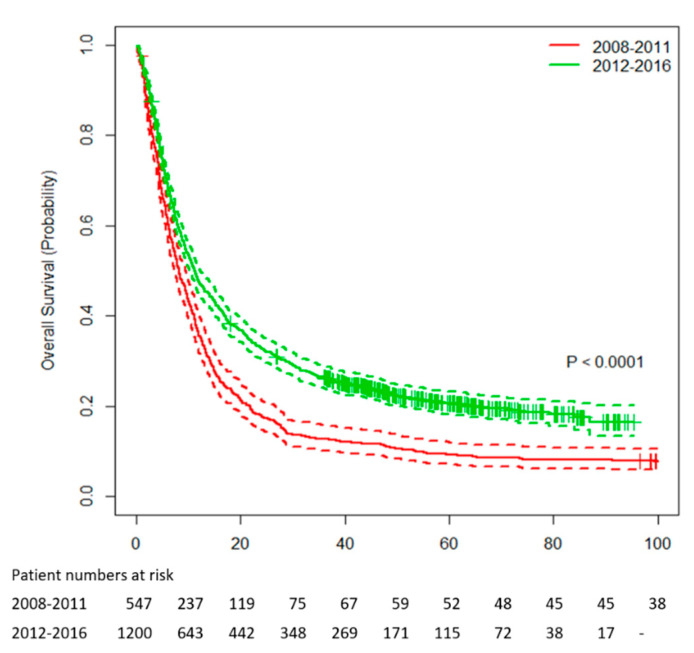
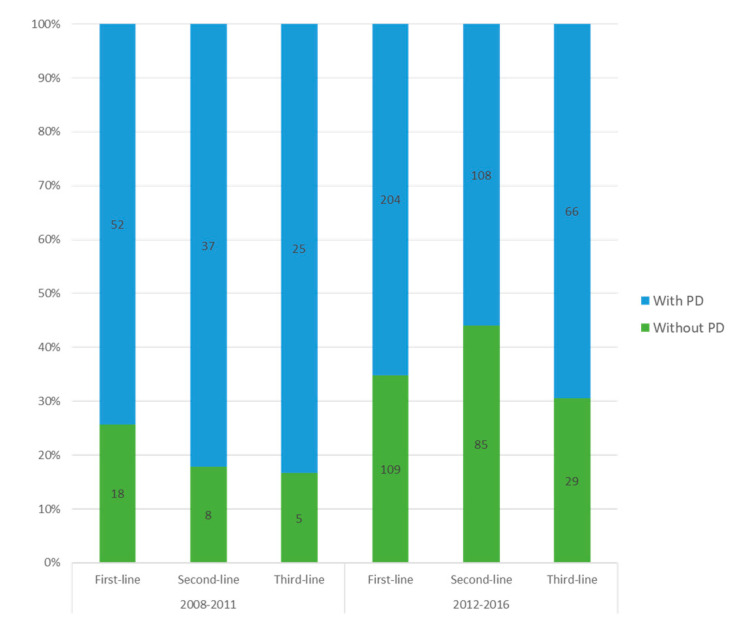
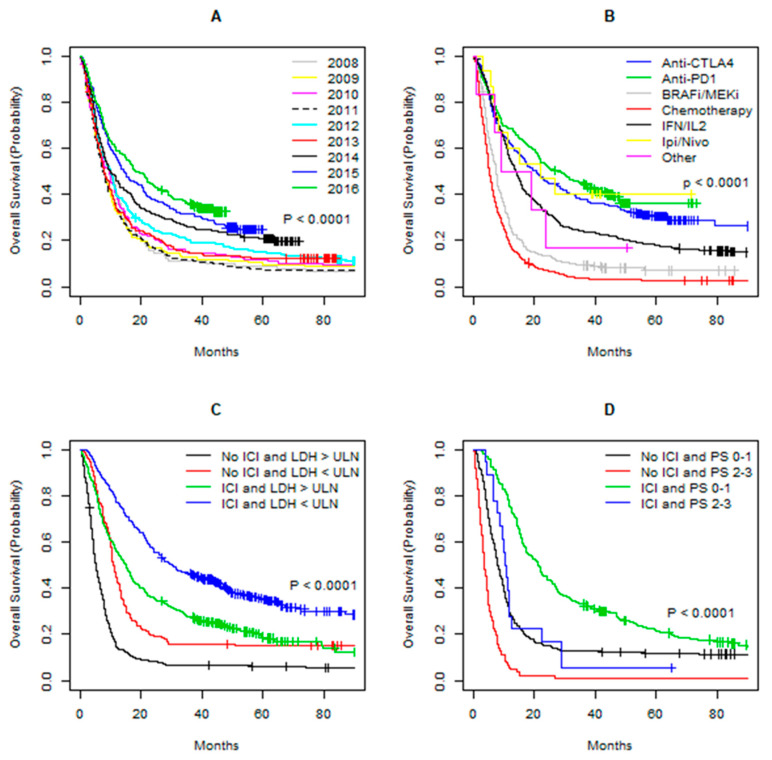
Approval of immune checkpoint-inhibitors (ICIs) and BRAF-inhibitors has revolutionized the treatment of metastatic melanoma. Although these drugs have improved overall survival (OS) in clinical trials, real-world evidence for improved long-term survival is still scarce. Clinical data were extracted from the Danish Metastatic Melanoma database. This nation-wide cohort contains data on all patients who received systemic treatment for metastatic melanoma between 2008 and 2016. Ipilimumab, the first approved ICI, was implemented as standard-of-care in Denmark in 2012. Hence, patients were divided in a pre-ICI (2008-2011) and an ICI (2012-2016) era. Patients were defined as long-term survivors if they were alive 3 years after initiation of systemic therapy. Data from 1754 patients were retrieved. Patients treated in the ICI era had an improved median OS (11.3 months, 95% confidence interval (CI) 10.3-12.3) compared with those in the pre-ICI era (median OS 8.3 months, 95% CI 7.4-9.5, < 0.0001). A higher proportion of long-term survivors was observed in the ICI era (survivors >3 years increased from 13% to 26% and survivors >5 years increased from 9% to 21%; both < 0.0001). For long-term survivors, known prognostic factors were equally distributed between the two periods, except that long-term survivors in the pre-ICI era were younger. For long-term survivors, 70% were without progression in the ICI era compared with 43% in the pre-ICI era ( < 0.0001). For all patients, the proportion without progression increased from 5% to 18% between the pre-ICI and the ICI era ( < 0.0001), respectively. Implementation of ICI has led to a significant increase in progression-free, long-term survival for real-life patients with metastatic melanoma.
免疫检查点抑制剂(ICIs)和BRAF抑制剂的获批彻底改变了转移性黑色素瘤的治疗方式。尽管这些药物在临床试验中提高了总生存期(OS),但改善长期生存的真实世界证据仍然匮乏。临床数据取自丹麦转移性黑色素瘤数据库。这个全国性队列包含了2008年至2016年间所有接受转移性黑色素瘤全身治疗患者的数据。首个获批的ICI——伊匹单抗于2012年在丹麦作为标准治疗方案实施。因此,患者被分为ICI前(2008 - 2011年)和ICI(2012 - 2016年)两个时代。如果患者在全身治疗开始后3年仍存活,则被定义为长期幸存者。检索到了1754例患者的数据。与ICI前时代的患者相比(中位OS 8.3个月,95%置信区间(CI)7.4 - 9.5,<0.0001),ICI时代治疗的患者中位OS有所改善(11.3个月,95% CI 10.3 - 12.3)。在ICI时代观察到更高比例的长期幸存者(存活超过3年者从13%增至26%,存活超过5年者从9%增至21%;均<0.0001)。对于长期幸存者,已知的预后因素在两个时期分布相同,只是ICI前时代的长期幸存者更年轻。对于长期幸存者,ICI时代70%无疾病进展,而ICI前时代为43%(<0.0001)。对于所有患者,无疾病进展的比例在ICI前和ICI时代分别从5%增至18%(<0.0001)。ICI的实施使转移性黑色素瘤真实世界患者的无进展长期生存率显著提高。