Harvard Radiation Oncology Program, Boston, Massachusetts.
Department of Medical Oncology, Dana-Farber Cancer Institute, Department of Medicine, Brigham and Women's Hospital, Harvard Medical School, Boston, Massachusetts.
JAMA Netw Open. 2022 Aug 1;5(8):e2225459. doi: 10.1001/jamanetworkopen.2022.25459.
In 2015, first-line programmed cell death 1 (PD-1) immune checkpoint inhibitors (ICI) were Food and Drug Administration (FDA)-approved and National Comprehensive Cancer Network (NCCN)-recommended for patients with stage IV melanoma. Few studies have assessed the overall survival (OS) and usage rate associated with first-line ICI following 2015.
To determine the rates of ICI use for metastatic melanoma following FDA approval in 2015 and characterize OS associated with first-line ICI use in this patient population.
DESIGN, SETTING, AND PARTICIPANTS: In this retrospective, nationwide cohort study, adult patients (≥20 years of age) with newly diagnosed stage IV cutaneous melanoma from 2010 to 2019 were identified using the US National Cancer Database (NCDB). Data were released by NCDB in March 2022 and analyzed in June 2022.
Patients were compared based on first-line ICI receipt vs not.
The OS and use of first-line ICI in 2016 to 2019 were assessed using multivariable Cox and logistic regression, respectively. To account for immortal time bias in receiving ICI, landmark time points were used (the 50th and 75th percentile times from diagnosis to ICI initiation).
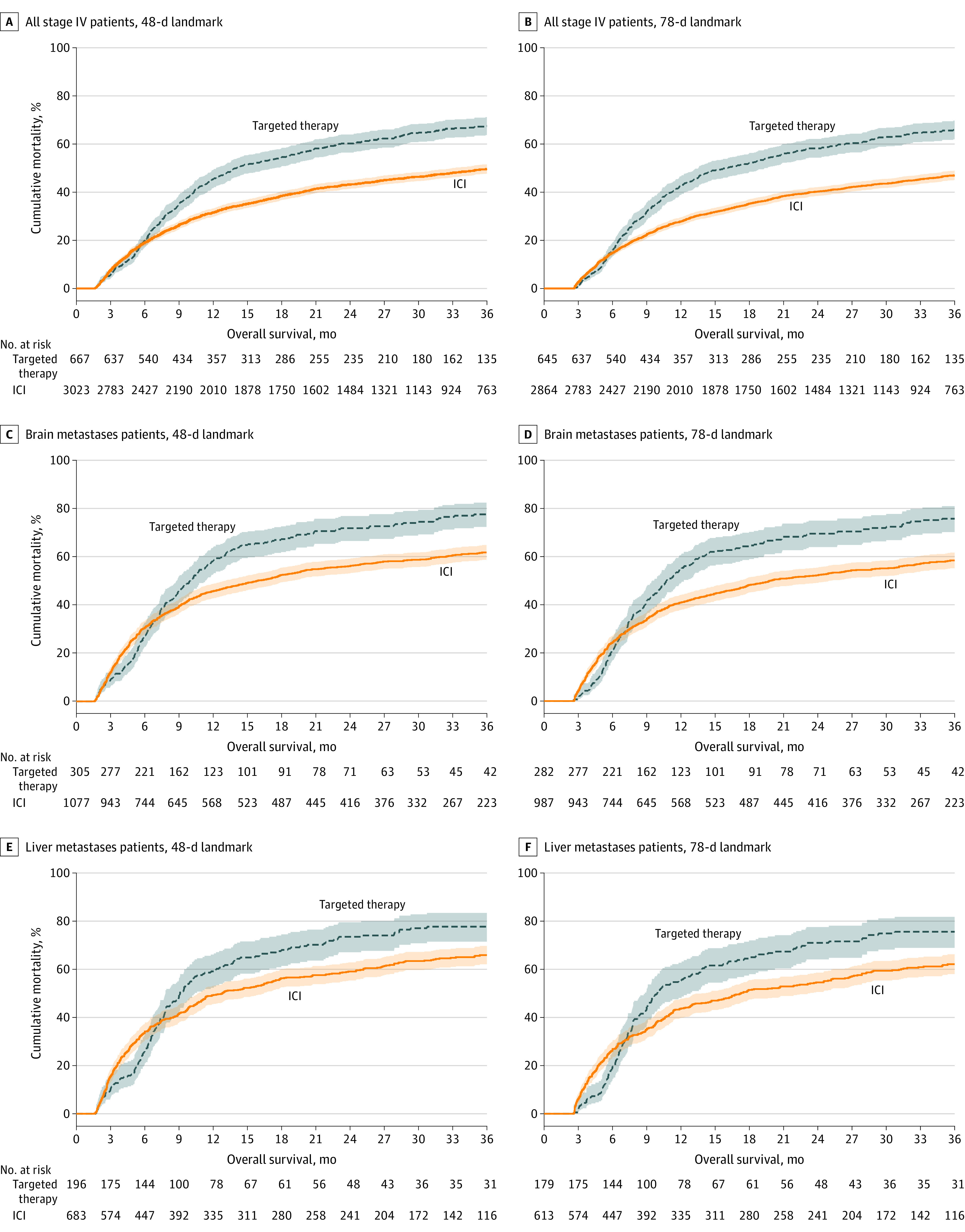
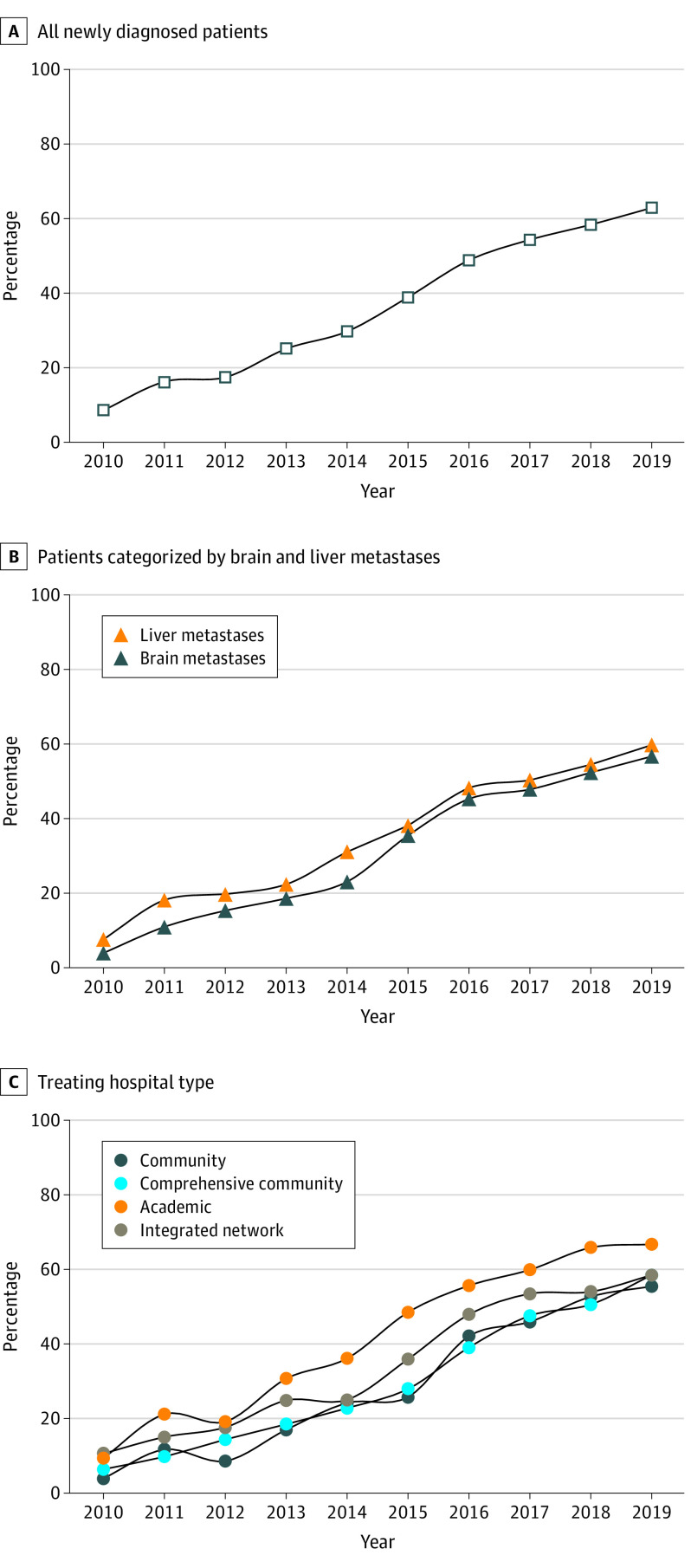
Among 16 831 patients with stage IV melanoma, 11 435 (67.9%) of patients were male; 116 (0.69%) were Asian or Pacific Islander, 475 (2.82%) were Hispanic, 270 (1.60%) were non-Hispanic Black, 15 711 (93.55%) were non-Hispanic White, and 145 (0.86%) were other race and ethnicity; the median (IQR) age at diagnosis was 64 (54-73) years. First-line immunotherapy use increased from 8.9% (127 of 1429) in 2010 to 38.8% (685 of 1766) in 2015, and 62.5% (1223 of 1958) in 2019. Median OS improved from 7.7 months (95% CI, 7.1-8.6 months) in 2010 to 17.5 months (95% CI, 14.9-19.8 months) in 2018. For patients diagnosed in 2016 or later, OS improved with first-line ICI (median OS using the 78-day landmark: 43.7 months [95% CI, 38.1-49.1 months] vs 16.1 months [95% CI, 13.5-19.3 months] for targeted therapy or chemotherapy; adjusted P < .001)-even after adjusting for patient, disease, and treatment factors. Results were similar for the 48-day landmark. This included patients presenting with brain metastases (first-line ICI median OS using the 78-day landmark: 19.9 months [95% CI, 17.2-25.0 months] vs 10.7 months for targeted therapy [95% CI, 9.5-12.3 months], adjusted P = .001). First-line ICI use varied by patients' age, insurance status, zip code-level household income, and treating hospital type.
Following anti-PD-1 approval in 2015, first-line ICI was associated with substantial OS improvements for patients with stage IV melanoma, including those with brain metastases. As of 2019, 38% of patients still were not receiving first-line ICI in the US, with use varying by patients' socioeconomic factors.
2015 年,首批程序性细胞死亡 1(PD-1)免疫检查点抑制剂(ICI)获得食品和药物管理局(FDA)批准,并被国家综合癌症网络(NCCN)推荐用于 IV 期黑色素瘤患者。很少有研究评估 2015 年后使用一线 ICI 的总生存期(OS)和使用率。
确定 2015 年 FDA 批准后转移性黑色素瘤使用 ICI 的比率,并描述该患者人群中使用一线 ICI 与 OS 的关联。
设计、地点和参与者:在这项回顾性的全国性队列研究中,使用美国国家癌症数据库(NCDB)从 2010 年到 2019 年确定了新诊断为 IV 期皮肤黑色素瘤的成年患者(≥20 岁)。NCDB 于 2022 年 3 月发布数据,并于 2022 年 6 月进行分析。
根据患者是否接受一线 ICI 治疗进行比较。
分别使用多变量 Cox 回归和逻辑回归评估 2016 年至 2019 年的 OS 和一线 ICI 的使用情况。为了考虑到接受 ICI 的不朽时间偏倚,使用了地标时间点(从诊断到 ICI 开始的第 50 个和第 75 个百分位数时间)。
在 16831 名 IV 期黑色素瘤患者中,11435 名(67.9%)为男性;116 名(0.69%)为亚洲或太平洋岛民,475 名(2.82%)为西班牙裔,270 名(1.60%)为非西班牙裔黑人,15711 名(93.55%)为非西班牙裔白人,145 名(0.86%)为其他种族和民族;中位(IQR)年龄为 64(54-73)岁。一线免疫治疗的使用率从 2010 年的 8.9%(127/1429)增加到 2015 年的 38.8%(685/1766),再增加到 2019 年的 62.5%(1223/1958)。中位 OS 从 2010 年的 7.7 个月(95%CI,7.1-8.6 个月)延长至 2018 年的 17.5 个月(95%CI,14.9-19.8 个月)。对于在 2016 年或之后确诊的患者,使用一线 ICI 的 OS 得到改善(使用 78 天地标时间的中位 OS:43.7 个月[95%CI,38.1-49.1 个月]与 16.1 个月[95%CI,13.5-19.3 个月]相比,用于靶向治疗或化疗;调整后的 P <.001)-即使在调整了患者、疾病和治疗因素后也是如此。48 天地标也有类似的结果。这包括有脑转移的患者(使用 78 天地标时间的一线 ICI 中位 OS:19.9 个月[95%CI,17.2-25.0 个月]与靶向治疗的 10.7 个月[95%CI,9.5-12.3 个月],调整后的 P = 0.001)。一线 ICI 的使用因患者的年龄、保险状况、邮政编码级别的家庭收入和治疗医院类型而异。
在 2015 年抗 PD-1 获批后,一线 ICI 与 IV 期黑色素瘤患者的 OS 显著改善相关,包括有脑转移的患者。截至 2019 年,美国仍有 38%的患者未接受一线 ICI 治疗,其使用情况因患者的社会经济因素而异。