Department of Clinical Neurosciences, University of Cambridge, Cambridge, UK.
Health Research Board Stroke Clinical Trials Network Ireland, Catherine McAuley Centre, Dublin, Ireland.
Eur Stroke J. 2023 Jun;8(2):541-548. doi: 10.1177/23969873231168367. Epub 2023 Apr 3.
For reasons poorly understood, strokes frequently occur in patients with atrial fibrillation (AF) despite oral anticoagulation. Better data are needed to inform randomised trials (RCTs) of new strategies to prevent recurrence in these patients. We investigate the relative contribution of competing stroke mechanisms in patients with AF who have stroke despite anticoagulation (OAC+) compared with those who are anticoagulant naïve (OAC-) at the time of their event.
We performed a cross-sectional study leveraging data from a prospective stroke registry (2015-2022). Eligible patients had ischemic stroke and AF. Stroke classification was performed by a single stroke-specialist blinded to OAC status using TOAST criteria. The presence of atherosclerotic plaque was determined using duplex ultrasonography, computerised tomography (CT) or magnetic resonance (MR) angiography. Imaging was reviewed by a single reader. Logistic regression was used to identify independent predictors of stroke despite anticoagulation.
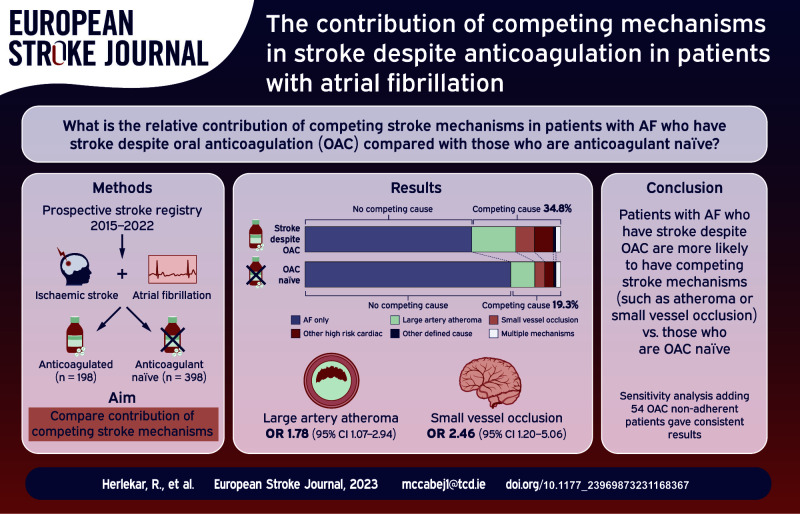
Of 596 patients included, 198 (33.2%) were in the OAC+ group. A competing cause for stroke was more frequent in patients with OAC+ versus OAC- (69/198 (34.8%)) versus 77/398 (19.3%), < 0.001). After adjustment, both small vessel occlusion (odds ratio (OR): 2.46, 95% CI: 1.20-5.06) and arterial atheroma (⩾50% stenosis) (OR: 1.78, 95% CI: 1.07-2.94) were independently associated with stroke despite anticoagulation.
Patients with AF-associated stroke despite OAC are much more likely than patients who are OAC-naïve to have competing stroke mechanisms. Rigorous investigation for alternative stroke causes in stroke despite OAC has a high diagnostic yield. These data should be used to guide patient selection for future RCTs in this population.
由于原因尚不清楚,尽管接受了口服抗凝治疗,心房颤动(AF)患者仍经常发生中风。需要更好的数据来为这些患者的新预防复发策略的随机试验(RCT)提供信息。我们调查了在接受抗凝治疗(OAC+)的 AF 患者中发生中风的患者(OAC+)与在发生事件时未接受抗凝治疗(OAC-)的患者中,竞争中风机制的相对贡献。
我们进行了一项利用前瞻性中风登记处(2015-2022 年)数据的横断面研究。符合条件的患者有缺血性中风和 AF。中风分类由一位对 OAC 状态盲目的单一中风专家根据 TOAST 标准进行。使用双工超声、计算机断层扫描(CT)或磁共振(MR)血管造影确定动脉粥样硬化斑块的存在。由一名单一读者对成像进行审查。使用逻辑回归确定尽管接受抗凝治疗仍发生中风的独立预测因素。
在纳入的 596 名患者中,有 198 名(33.2%)患者在 OAC+组。与 OAC-组(69/198(34.8%))相比,OAC+组患者发生中风的竞争原因更为常见,且差异具有统计学意义(77/398(19.3%)),<0.001)。调整后,小血管闭塞(比值比(OR):2.46,95%CI:1.20-5.06)和动脉粥样硬化(≥50%狭窄)(OR:1.78,95%CI:1.07-2.94)均与抗凝治疗后中风独立相关。
与 OAC 初治的 AF 相关中风患者相比,OAC 治疗的 AF 相关中风患者更有可能存在其他中风机制。对 OAC 后中风的替代中风原因进行严格调查具有较高的诊断收益。这些数据应用于指导该人群未来 RCT 中的患者选择。