Faculty of Kinesiology, Sport and Recreation, University of Alberta, Edmonton, AB T6G 2H9, Canada.
Department of Sport Science, University of Innsbruck, 6020 Innsbruck, Austria.
Int J Environ Res Public Health. 2020 Sep 13;17(18):6662. doi: 10.3390/ijerph17186662.
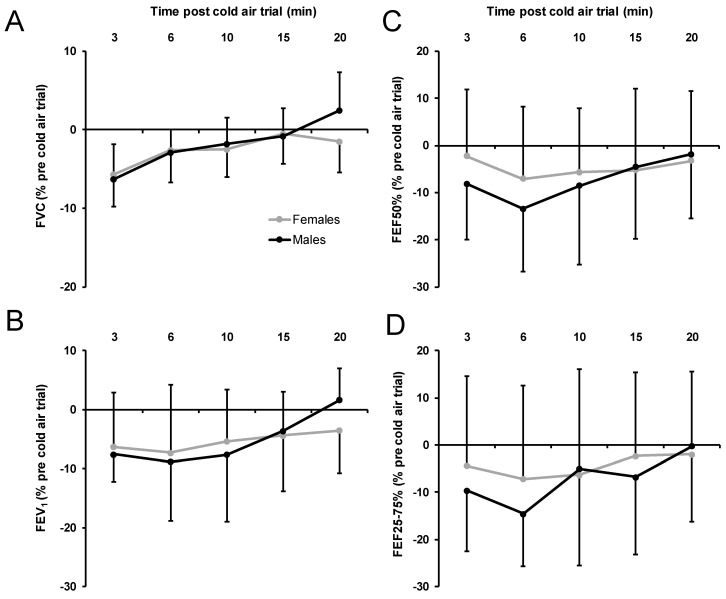
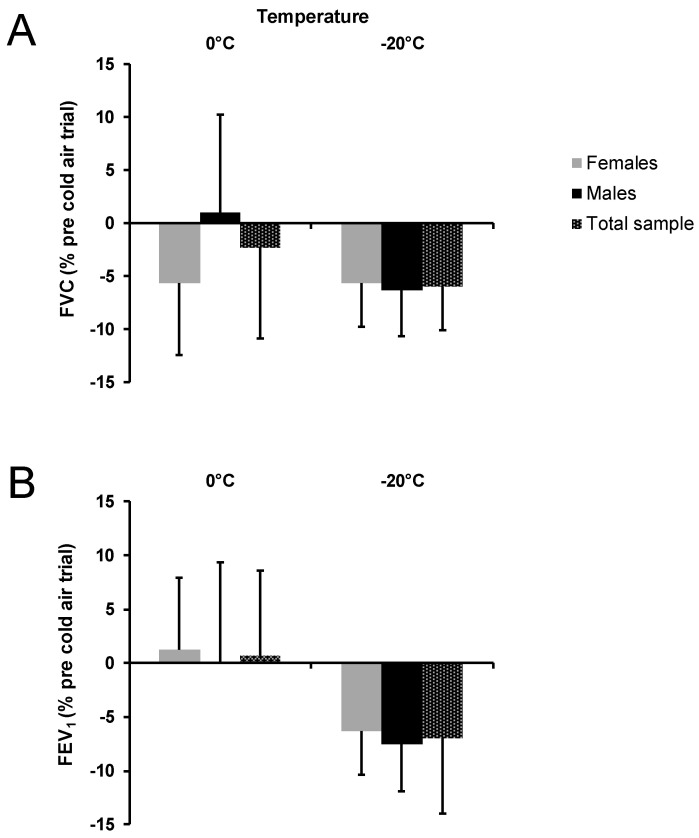
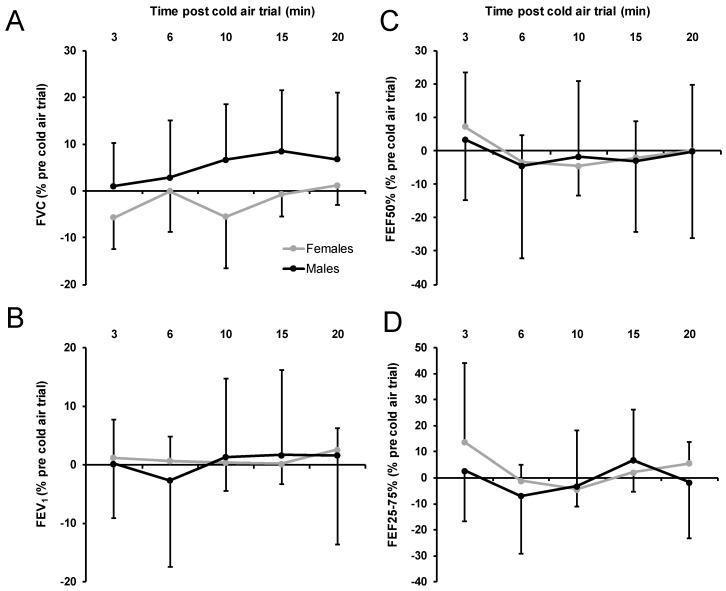
Research has shown that cold air exercise causes significant respiratory dysfunction, especially in female athletes. However, how female and male athletes respond to cold air exercise is not known. Thus, we aimed to compare acute respiratory responses (function, recovery and symptoms) in males and females after high-intensity cold air exercise. Eighteen (nine female) athletes completed two environmental chamber running trials at 0 °C and -20 °C (humidity 34 ± 5%) on different days in a randomized starting order. Spirometry was performed pre, 3, 6, 10, 15 and 20 min post. Respiratory symptoms were measured posttrial and heart rate and rating of perceived exertion were assessed during each trial. No significant differences in delta change (pre to post) were found at either temperature between sexes for FEV, FVC, FEF50% and FEF25-75%. At -20 °C, FEV decreased similarly in both sexes (males: 7.5%, females: 6.3%) but not at 0 °C, = 0.003. Postexertion respiratory function recovery and reported symptoms were not different between sexes at either temperature. These results indicate no sex-based differences in acute respiratory responses (function, recovery and symptoms) to cold air exercise. However, intense exercise at -20 °C is challenging to the respiratory system in both sexes and may lead to altered respiratory responses compared to mild winter conditions like 0 °C.
研究表明,冷空气运动可导致明显的呼吸功能障碍,尤其在女性运动员中更为显著。然而,我们尚不清楚女性和男性运动员对冷空气运动的反应有何不同。因此,我们旨在比较男性和女性在高强度冷空气运动后的急性呼吸反应(功能、恢复和症状)。18 名(9 名女性)运动员在不同天以随机起始顺序在 0°C 和-20°C(湿度 34±5%)的两个环境室跑步试验中完成了两次。在预、3、6、10、15 和 20 分钟时进行肺活量测定。在试验后测量呼吸症状,在每次试验期间评估心率和感知用力程度。在两种温度下,性别间的 delta 变化(预到后)在 FEV、FVC、FEF50%和 FEF25-75% 方面均无显著差异。在-20°C 时,两种性别中 FEV 的下降相似(男性:7.5%,女性:6.3%),但在 0°C 时并非如此, = 0.003。在两种温度下,运动后呼吸功能恢复和报告的症状在性别间均无差异。这些结果表明,冷空气运动后的急性呼吸反应(功能、恢复和症状)在性别间无差异。然而,-20°C 下的剧烈运动对男女双方的呼吸系统都是一种挑战,与 0°C 等温和的冬季条件相比,可能导致呼吸反应改变。