
通过西弗吉尼亚州女性群体血浆生物标志物和 microRNAs 预测非酒精性脂肪肝疾病。
Predicting Nonalcoholic Fatty Liver Disease through a Panel of Plasma Biomarkers and MicroRNAs in Female West Virginia Population.
机构信息
Departments of Surgery and Biomedical Sciences, Marshall University Joan C. Edwards School of Medicine, Huntington, WV 25701, USA.
Departments of Biomedical Sciences and Medical Education, Marshall University Joan C. Edwards School of Medicine, Huntington, WV 25701, USA.
出版信息
Int J Mol Sci. 2020 Sep 13;21(18):6698. doi: 10.3390/ijms21186698.
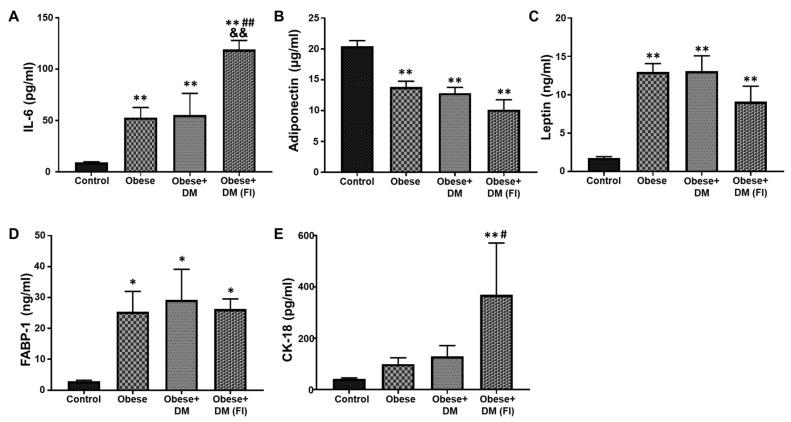
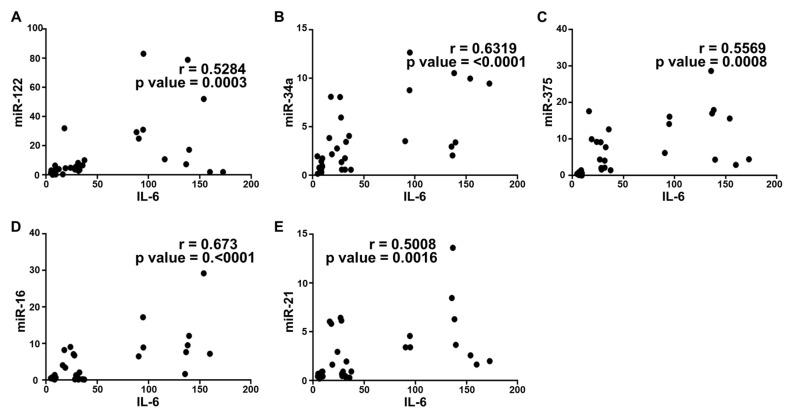
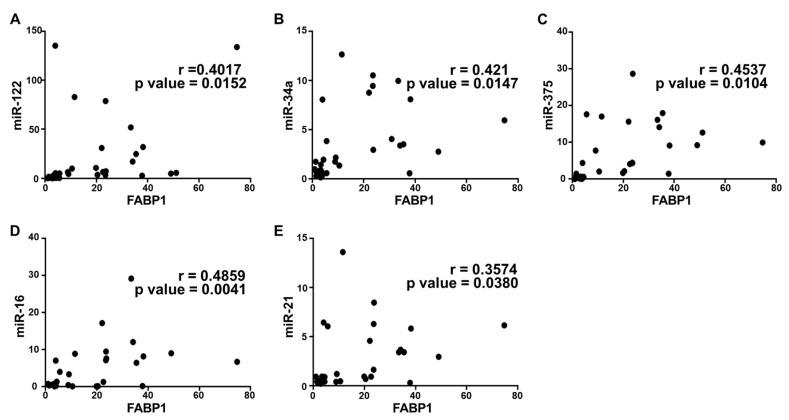
(1) Background: Nonalcoholic fatty liver disease (NAFLD) is primarily characterized by the presence of fatty liver, hepatic inflammation and fibrogenesis eventually leading to nonalcoholic steatohepatitis (NASH) or cirrhosis. Obesity and diabetes are common risk factors associated with the development and progression of NAFLD, with one of the highest prevalence of these diseased conditions in the West Virginia population. Currently, the diagnosis of NAFLD is limited to radiologic studies and biopsies, which are not cost-effective and highly invasive. Hence, this study aimed to develop a panel and assess the progressive levels of circulatory biomarkers and miRNA expression in patients at risk for progression to NASH to allow early intervention strategies. (2) Methods: In total, 62 female patients were enrolled and blood samples were collected after 8-10 h of fasting. Computed tomography was performed on abdomen/pelvis following IV contrast administration. The patients were divided into the following groups: Healthy subjects with normal BMI and normal fasting blood glucose (Control, n = 20), Obese with high BMI and normal fasting blood glucose (Obese, n = 20) and Obese with high fasting blood glucose (Obese + DM, n = 22). Based on findings from CT, another subset was created from Obese + DM group with patients who showed signs of fatty liver infiltration (Obese + DM(FI), n = 10). ELISA was performed for measurement of plasma biomarkers and RT-PCR was performed for circulating miRNA expression. (3) Results: Our results show significantly increased levels of plasma IL-6, Leptin and FABP-1, while significantly decreased level of adiponectin in Obese, Obese + DM and Obese + DM(FI) group, as compared to healthy controls. The level of CK-18 was significantly increased in Obese + DM(FI) group as compared to control. Subsequently, the expression of miR-122, miR-34a, miR-375, miR-16 and miR-21 was significantly increased in Obese + DM and Obese + DM(FI) group as compared to healthy control. Our results also show distinct correlation of IL-6, FABP-1 and adiponectin levels with the expression of miRNAs in relation to the extent of NAFLD progression. (4) Conclusion: Our results support the clinical application of these biomarkers and miRNAs in monitoring the progression of NAFLD, suggesting a more advanced diagnostic potential of this panel than conventional methods. This panel may provide an appropriate method for early prognosis and management of NAFLD and subsequent adverse hepatic pathophysiology, potentially reducing the disease burden on the West Virginia population.
(1)背景:非酒精性脂肪性肝病(NAFLD)的主要特征是存在脂肪肝、肝炎症和纤维化,最终导致非酒精性脂肪性肝炎(NASH)或肝硬化。肥胖症和糖尿病是与 NAFLD 发展和进展相关的常见危险因素,在西弗吉尼亚州人群中,这些疾病的患病率最高。目前,NAFLD 的诊断仅限于影像学研究和活检,这些方法既不具有成本效益,也具有高度侵入性。因此,本研究旨在开发一个面板,并评估处于进展为 NASH 风险中的患者的循环生物标志物和 miRNA 表达的渐进水平,以允许早期干预策略。(2)方法:总共纳入了 62 名女性患者,并在禁食 8-10 小时后采集血液样本。腹部/骨盆在静脉注射造影剂后进行计算机断层扫描。患者分为以下几组:BMI 正常和空腹血糖正常的健康受试者(对照组,n=20)、BMI 高和空腹血糖正常的肥胖者(肥胖组,n=20)和高空腹血糖的肥胖者(肥胖+DM 组,n=22)。根据 CT 结果,从肥胖+DM 组中创建了另一个亚组,其中患者有脂肪肝浸润迹象(肥胖+DM(FI)组,n=10)。进行 ELISA 以测量血浆生物标志物,进行 RT-PCR 以测量循环 miRNA 表达。(3)结果:我们的结果表明,与健康对照组相比,肥胖组、肥胖+DM 组和肥胖+DM(FI)组中血浆 IL-6、瘦素和 FABP-1 的水平显著升高,而脂联素的水平显著降低。CK-18 在肥胖+DM(FI)组中的水平明显高于对照组。随后,与健康对照组相比,肥胖+DM 和肥胖+DM(FI)组中 miR-122、miR-34a、miR-375、miR-16 和 miR-21 的表达明显增加。我们的结果还表明,IL-6、FABP-1 和脂联素水平与 miRNA 的表达与 NAFLD 进展程度之间存在明显的相关性。(4)结论:我们的结果支持这些生物标志物和 miRNA 在监测 NAFLD 进展中的临床应用,表明该面板比传统方法具有更高的诊断潜力。该面板可能为 NAFLD 及随后的肝脏不良病理生理学的早期预后和管理提供一种适当的方法,从而有可能减轻西弗吉尼亚州人群的疾病负担。



 Zotero 插件