Department of Biology, Monmouth University, West Long Branch, NJ, USA.
Department of Evolutionary Genetics, Max-Planck-Institute for Evolutionary Biology, Plön, Germany.
BMC Evol Biol. 2020 Sep 15;20(1):120. doi: 10.1186/s12862-020-01666-9.
The three main subspecies of house mice, Mus musculus castaneus, Mus musculus domesticus, and Mus musculus musculus, are estimated to have diverged ~ 350-500KYA. Resolution of the details of their evolutionary history is complicated by their relatively recent divergence, ongoing gene flow among the subspecies, and complex demographic histories. Previous studies have been limited to some extent by the number of loci surveyed and/or by the scope of the method used. Here, we apply a method (IMa3) that provides an estimate of a population phylogeny while allowing for complex histories of gene exchange.
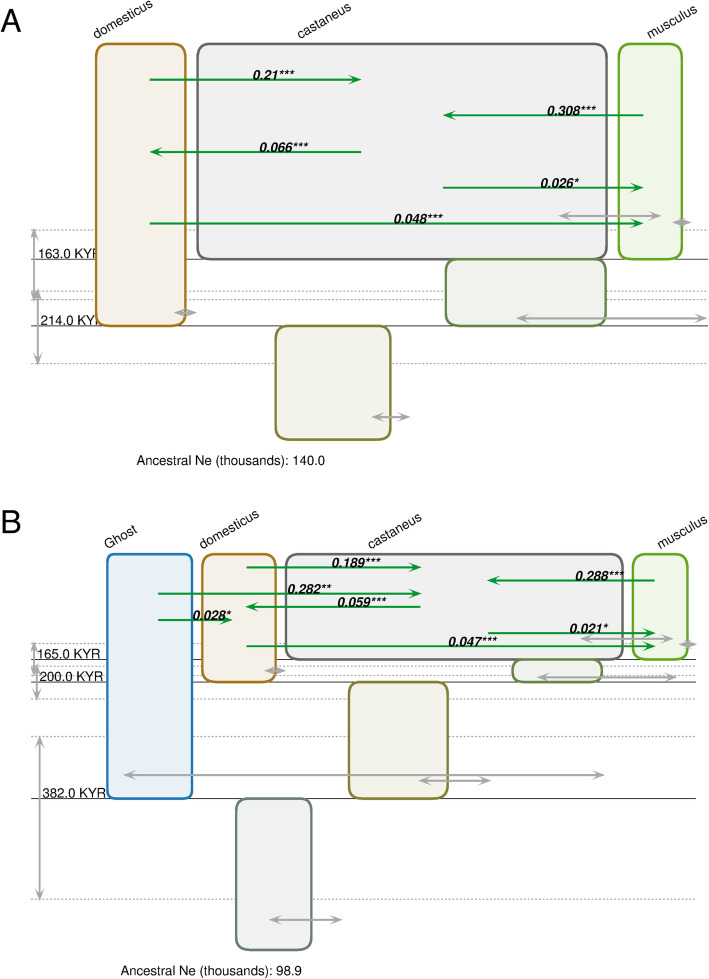
Results strongly support a topology with M. m. domesticus as sister to M. m. castaneus and M. m. musculus. In addition, we find evidence of gene flow between all pairs of subspecies, but that gene flow is most restricted from M. m. musculus into M. m. domesticus. Estimates of other key parameters are dependent on assumptions regarding generation time and mutation rate in house mice. Nevertheless, our results support previous findings that the effective population size, N of M. m. castaneus is larger than that of the other two subspecies, that the three subspecies began diverging ~ 130 - 420KYA, and that the time between divergence events was short.
Joint demographic and phylogenetic analyses of genomic data provide a clearer picture of the history of divergence in house mice.
家鼠的三个主要亚种,即 Mus musculus castaneus、Mus musculus domesticus 和 Mus musculus musculus,据估计在 350-500 千年前就已经分化。由于它们最近才分化,亚种之间仍有基因流动,以及复杂的种群历史,因此要解析它们的进化历史细节较为复杂。以前的研究在某种程度上受到调查的基因座数量和/或使用的方法范围的限制。在这里,我们应用了一种方法(IMa3),该方法提供了种群系统发育的估计,同时允许进行复杂的基因交换历史研究。
结果强烈支持了一种拓扑结构,即 M. m. domesticus 是 M. m. castaneus 和 M. m. musculus 的姐妹种。此外,我们发现所有亚种之间都有基因流动的证据,但基因流动最受限制的是从 M. m. musculus 到 M. m. domesticus。其他关键参数的估计取决于家鼠世代时间和突变率的假设。然而,我们的结果支持了先前的发现,即 M. m. castaneus 的有效种群大小 N 大于其他两个亚种,这三个亚种在 130-420 千年前开始分化,而且分化事件之间的时间很短。
对基因组数据进行联合人口统计学和系统发育分析,提供了一个更清晰的家鼠分化历史图景。