State Key Laboratory of Microbial Metabolism, Joint International Research Laboratory of Metabolic & Developmental Sciences and School of Life Sciences and Biotechnology, Shanghai Jiao Tong University, Shanghai, People's Republic of China.
State Key Laboratory of Bioorganic and Natural Products Chemistry, Center for Excellence in Molecular Synthesis, Shanghai Institute of Organic Chemistry, University of Chinese Academy of Sciences, Chinese Academy of Sciences, Shanghai, People's Republic of China.
mBio. 2020 Sep 15;11(5):e01334-20. doi: 10.1128/mBio.01334-20.
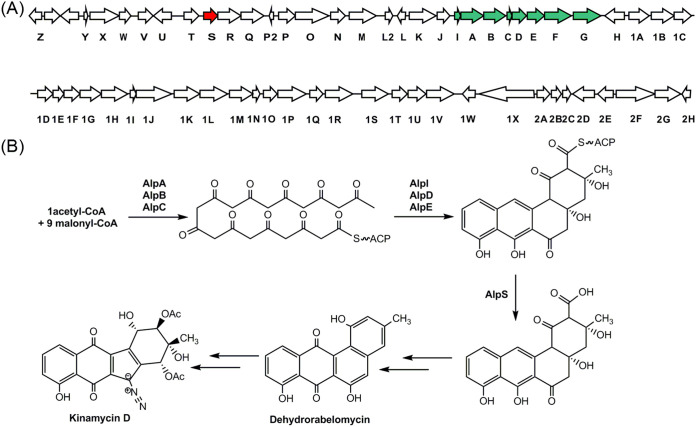
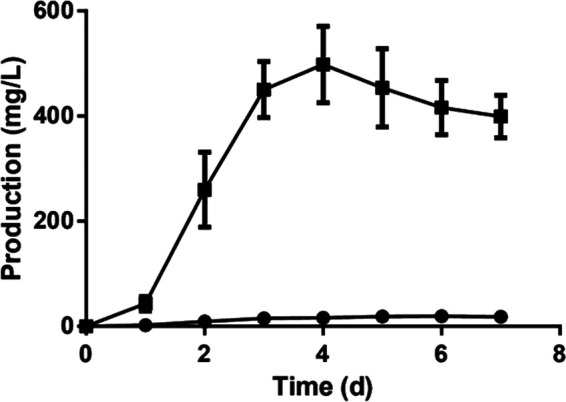
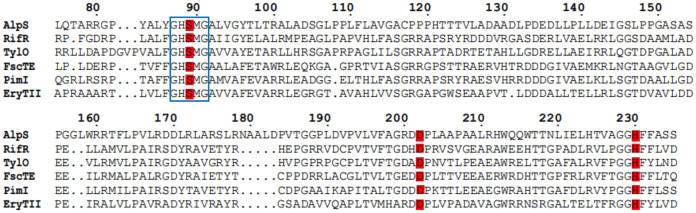
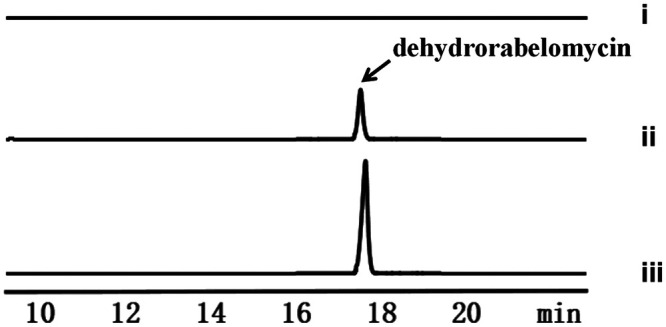
Type II polyketides are a group of secondary metabolites with various biological activities. In nature, biosynthesis of type II polyketides involves multiple enzymatic steps whereby key enzymes, including ketoacyl-synthase (KS), chain length factor (KS), and acyl carrier protein (ACP), are utilized to elongate the polyketide chain through a repetitive condensation reaction. During each condensation, the biosynthesis intermediates are covalently attached to KS or ACP via a thioester bond and are then cleaved to release an elongated polyketide chain for successive postmodification. Despite its critical role in type II polyketide biosynthesis, the enzyme and its corresponding mechanism for type II polyketide chain release through thioester bond breakage have yet to be determined. Here, kinamycin was used as a model compound to investigate the chain release step of type II polyketide biosynthesis. Using a genetic knockout strategy, we confirmed that AlpS is required for the complete biosynthesis of kinamycins. Further biochemical assays revealed high hydrolytic activity of AlpS toward a thioester bond in an aromatic polyketide-ACP analog, suggesting its distinct role in offloading the polyketide chain from ACP during the kinamycin biosynthesis. Finally, we successfully utilized AlpS to enhance the heterologous production of dehydrorabelomycin in by nearly 25-fold, which resulted in 0.50 g/liter dehydrorabelomycin in a simple batch-mode shake flask culture. Taken together, our results provide critical knowledge to gain an insightful understanding of the chain-releasing process during type II polyketide synthesis, which, in turn, lays a solid foundation for future new applications in type II polyketide bioproduction.
II 型聚酮是一类具有多种生物活性的次级代谢产物。在自然界中,II 型聚酮的生物合成涉及多个酶促步骤,其中包括酮酰基合成酶 (KS)、链长因子 (KS) 和酰基载体蛋白 (ACP) 等关键酶,通过重复的缩合反应来延长聚酮链。在每次缩合过程中,生物合成中间体通过硫酯键共价连接到 KS 或 ACP 上,然后被切割以释放出一个延长的聚酮链,以便进行后续的修饰。尽管它在 II 型聚酮生物合成中起着至关重要的作用,但该酶及其对应的通过硫酯键断裂释放 II 型聚酮链的机制尚未确定。在这里,我们使用金霉素作为模型化合物来研究 II 型聚酮生物合成的链释放步骤。通过遗传敲除策略,我们证实 AlpS 是金霉素完全生物合成所必需的。进一步的生化分析表明,AlpS 对芳香聚酮-ACP 类似物中的硫酯键具有很高的水解活性,这表明它在金霉素生物合成过程中从 ACP 上卸下聚酮链的独特作用。最后,我们成功地利用 AlpS 提高了异源生产脱水雷伯霉素的产量,在简单的分批摇瓶培养中,脱水雷伯霉素的产量增加了近 25 倍,达到了 0.50 g/L。总之,我们的研究结果为深入了解 II 型聚酮合成中的链释放过程提供了重要的知识,这为未来在 II 型聚酮生物生产中的新应用奠定了坚实的基础。