Department of Computer Science, University of Verona, Strada Le Grazie 15, Ca' Vignal 2, 37134, Verona, Italy.
Department of Neurosciences, Biomedicine and Movement Sciences, Neurology Section, University of Verona, Piazzale L.A. Scuro 10, 37134, Verona, Italy.
Sci Rep. 2020 Sep 15;10(1):15061. doi: 10.1038/s41598-020-69514-w.
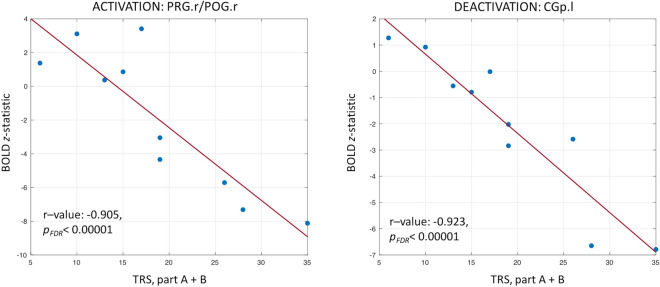
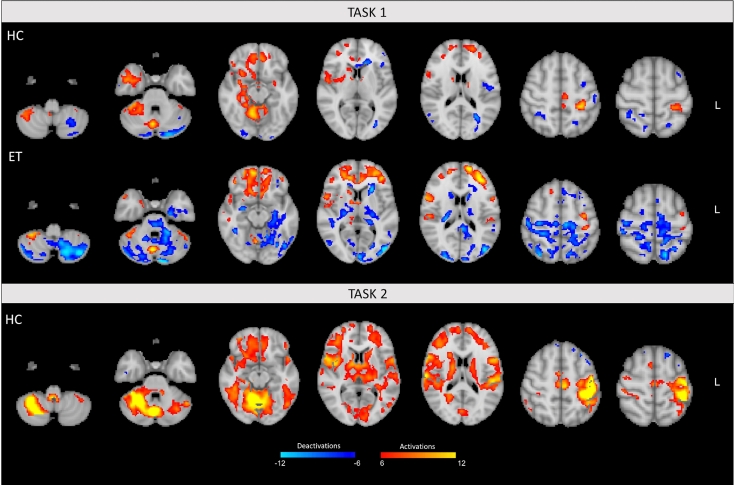
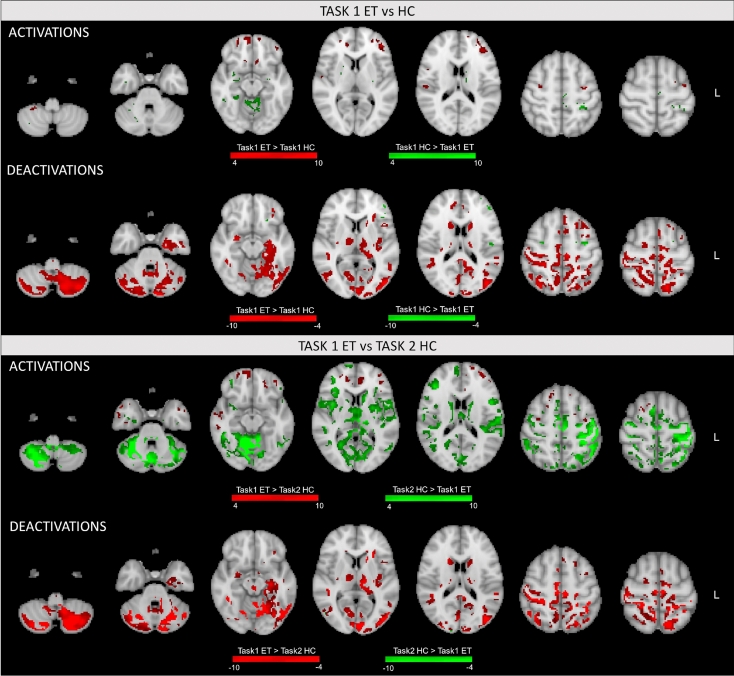
The pathophysiology of essential tremor (ET) is controversial and might be further elucidated by advanced neuroimaging. Focusing on homogenous ET patients diagnosed according to the 2018 consensus criteria, this study aimed to: (1) investigate whether task functional MRI (fMRI) can identify networks of activated and deactivated brain areas, (2) characterize morphometric and functional modulations, relative to healthy controls (HC). Ten ET patients and ten HC underwent fMRI while performing two motor tasks with their upper limb: (1) maintaining a posture (both groups); (2) simulating tremor (HC only). Activations/deactivations were obtained from General Linear Model and compared across groups/tasks. Voxel-based morphometry and linear regressions between clinical and fMRI data were also performed. Few cerebellar clusters of gray matter loss were found in ET. Conversely, widespread fMRI alterations were shown. Tremor in ET (task 1) was associated with extensive deactivations mainly involving the cerebellum, sensory-motor cortex, and basal ganglia compared to both tasks in HC, and was negatively correlated with clinical tremor scales. Homogeneous ET patients demonstrated deactivation patterns during tasks triggering tremor, encompassing a network of cortical and subcortical regions. Our results point towards a marked cerebellar involvement in ET pathophysiology and the presence of an impaired cerebello-thalamo-cortical tremor network.
特发性震颤(ET)的病理生理学存在争议,通过先进的神经影像学可以进一步阐明。本研究聚焦于根据 2018 年共识标准诊断的同质 ET 患者,旨在:(1)研究任务功能磁共振成像(fMRI)是否可以识别激活和失活的大脑区域网络,(2)相对于健康对照组(HC),描述形态和功能的调节。10 名 ET 患者和 10 名 HC 接受 fMRI 检查,同时进行上肢的两项运动任务:(1)保持姿势(两组);(2)模拟震颤(仅 HC)。通过一般线性模型获得激活/失活,并在组间/任务间进行比较。还进行了基于体素的形态学和 fMRI 数据与临床数据之间的线性回归。在 ET 中发现了几个小脑灰质损失的小脑簇。相反,显示了广泛的 fMRI 改变。与 HC 相比,ET 中的震颤(任务 1)与广泛的失活有关,主要涉及小脑、感觉运动皮层和基底节,与临床震颤量表呈负相关。同质 ET 患者在触发震颤的任务中表现出失活模式,包括皮质和皮质下区域的网络。我们的研究结果表明小脑在 ET 病理生理学中具有显著的作用,并且存在受损的小脑-丘脑-皮质震颤网络。