Di Pietro Martina, Russo Mirella, Dono Fedele, Carrarini Claudia, Thomas Astrid, Di Stefano Vincenzo, Telese Roberta, Bonanni Laura, Sensi Stefano L, Onofrj Marco, Franciotti Raffaella
Department of Neuroscience, Imaging and Clinical Sciences, "G. D'Annunzio" University of Chieti-Pescara, Chieti, Italy.
Center for Advanced Studies and Technology (CAST), "G. D'Annunzio" University, Chieti, Italy.
Front Neurol. 2021 Sep 9;12:661130. doi: 10.3389/fneur.2021.661130. eCollection 2021.
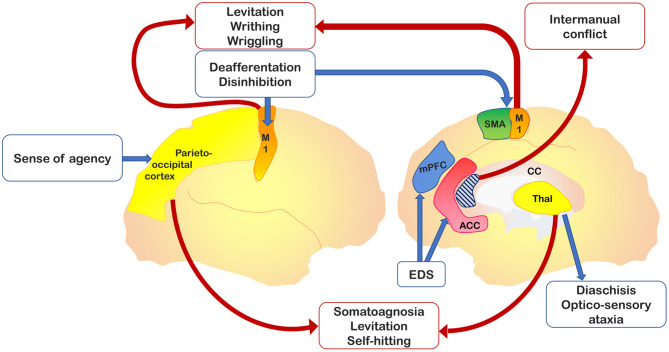
Consensus criteria on corticobasal degeneration (CBD) include alien limb (AL) phenomena. However, the gist of the behavioral features of AL is still "a matter of debate." CBD-related AL has so far included the description of involuntary movements, frontal release phenomena (frontal AL), or asomatognosia (posterior or "real" AL). In this context, the most frequent symptoms are language and praxis deficits and cortical sensory misperception. However, asomatognosia requires, by definition, intact perception and cognition. Thus, to make a proper diagnosis of AL in the context of CBD, cognitive and language dysfunctions must be carefully verified and objectively assessed. We reviewed the current literature on AL in CBD and now propose that the generic use of the term AL should be avoided. This catchall AL term should instead be deconstructed. We propose that the term AL is appropriate to describe clinical features associated with specific brain lesions. More discrete sets of regionally bound clinical signs that depend on dysfunctions of specific brain areas need to be assessed and presented when posing the diagnosis. Thus, in our opinion, the AL term should be employed in association with precise descriptions of the accompanying involuntary movements, sensory misperceptions, agnosia-asomatognosia contents, and the presence of utilization behavior. The review also offers an overview of functional magnetic resonance imaging-based studies evaluating AL-related phenomena. In addition, we provide a complementary set of video clips depicting CBD-related involuntary movements that should not mistakenly be interpreted as signs of AL.
皮质基底节变性(CBD)的共识标准包括异己肢体(AL)现象。然而,AL行为特征的要点仍然“存在争议”。迄今为止,与CBD相关的AL包括对不自主运动、额叶释放现象(额叶AL)或自体失认症(后部或“真正的”AL)的描述。在这种情况下,最常见的症状是语言和运用障碍以及皮质感觉错误认知。然而,根据定义,自体失认症需要完整的感知和认知。因此,为了在CBD背景下对AL做出正确诊断,必须仔细核实并客观评估认知和语言功能障碍。我们回顾了当前关于CBD中AL的文献,现在建议应避免普遍使用AL这个术语。这个包罗万象的AL术语应该进行解构。我们建议,AL这个术语适用于描述与特定脑损伤相关的临床特征。在进行诊断时,需要评估并呈现更多取决于特定脑区功能障碍的、更离散的局部性临床体征集合。因此,我们认为,AL这个术语应与对伴随的不自主运动、感觉错误认知、失认症 - 自体失认症内容以及利用行为的存在的精确描述一起使用。该综述还概述了基于功能磁共振成像的评估AL相关现象的研究。此外,我们提供了一组补充视频片段,描绘了与CBD相关的不自主运动,不应将其错误地解释为AL的体征。