Ye Mushi, Tian Huanshu, Lin Shanhong, Mo Jierong, Li Zhuo, Chen Xiaojun, Liu Jianjun
Laboratory of Urology, Affiliated Hospital of Guangdong Medical University, Zhanjiang, Guangdong 524000, P.R. China.
Oncol Lett. 2020 Nov;20(5):169. doi: 10.3892/ol.2020.12032. Epub 2020 Aug 27.
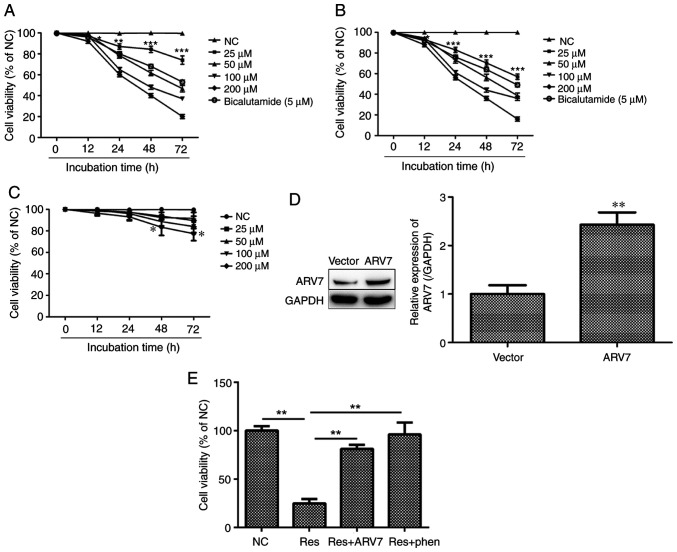
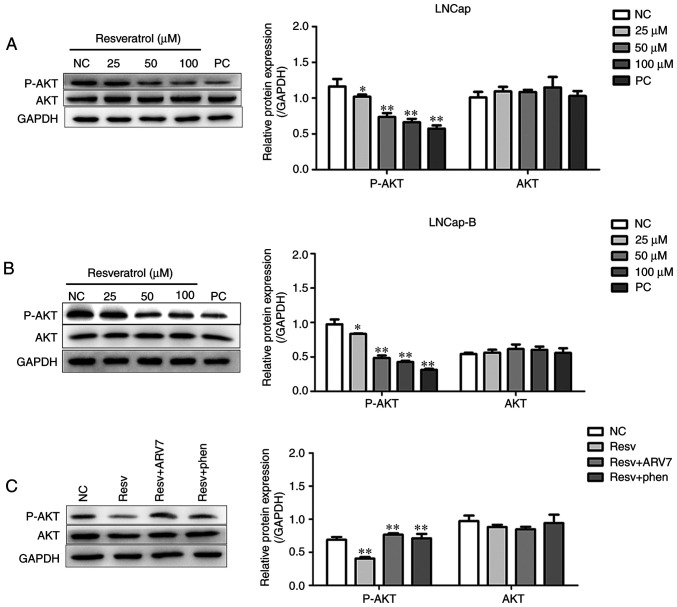
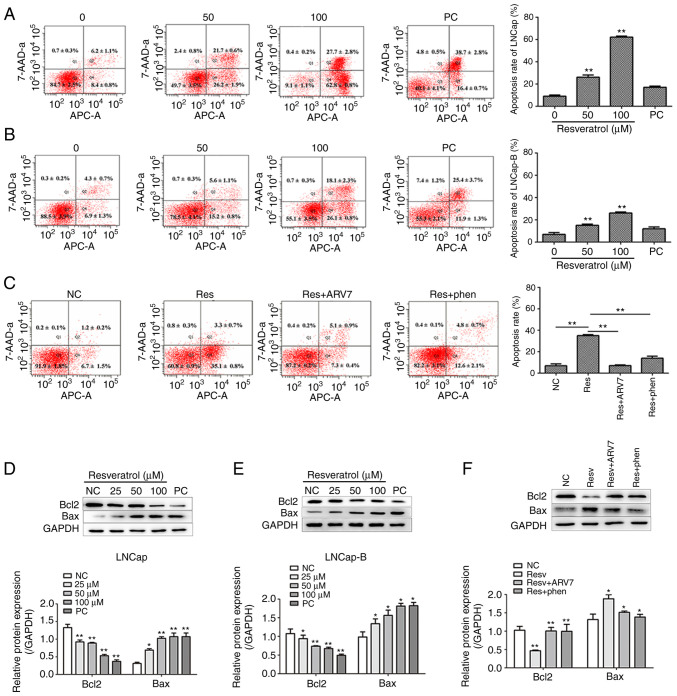
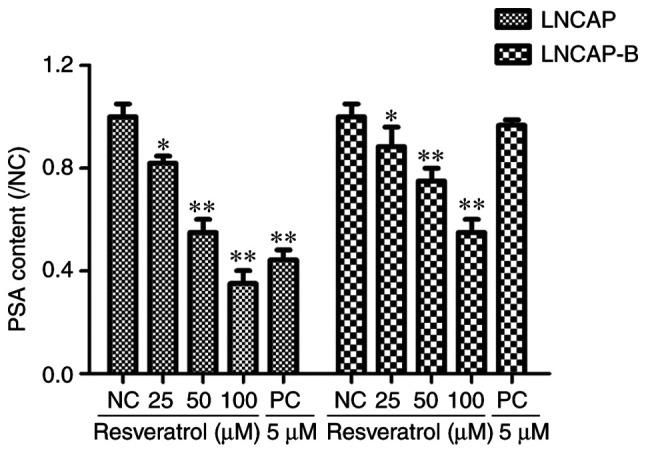
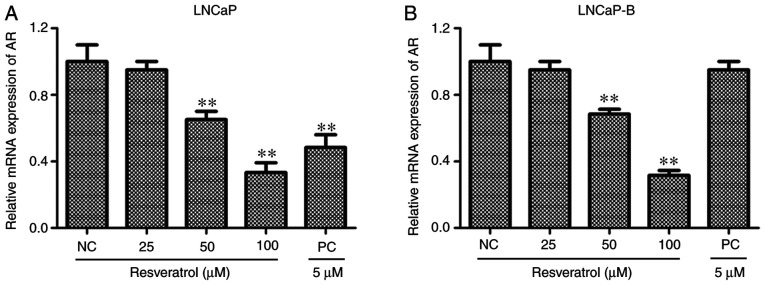
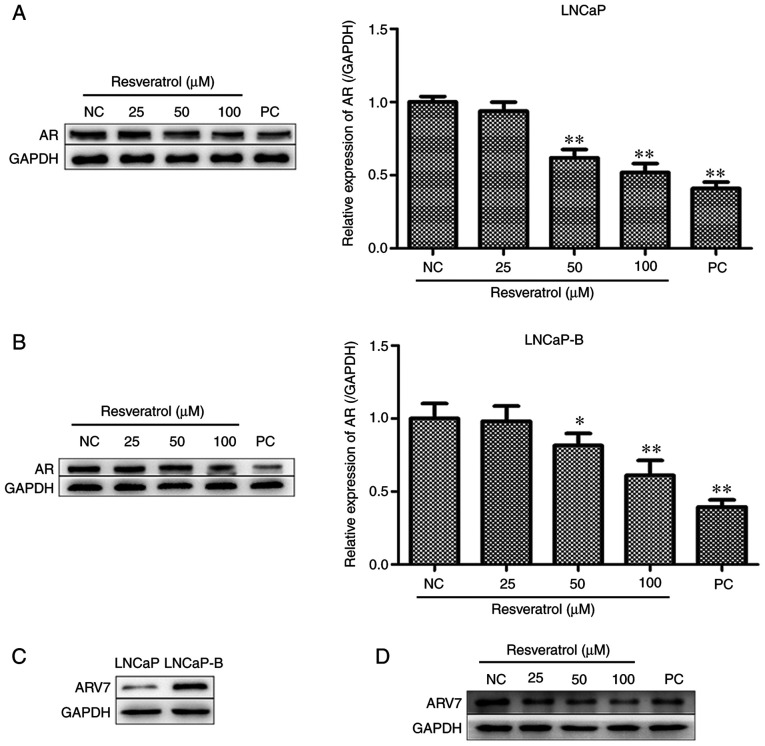
Prostate cancer is a common malignant tumor of the male genitourinary system and its incidence increases with age. Studies have shown that resveratrol (Res) inhibits cancer cell proliferation, migration, invasion and promotes apoptosis. The present study evaluated the effect of Res in two human prostate cancer cell lines (the androgen-dependent LNCaP cell line and the non-androgen-independent LNCaP-B cell line) on proliferation and apoptosis. A proliferation assay was used to demonstrate that Res inhibited proliferation of LNCaP and LNCaP-B cells in the range of 25-100 µM, and the effect was time- and dose-dependent. Using flow cytometry, it was reported that various concentrations of Res induced apoptosis in LNCaP and LNCaP-B cells, and that the apoptotic effect of Res was dose-dependent. A chemiluminescence assay showed that Res inhibited prostate specific antigen levels in LNCaP and LNCaP-B cells. Reverse transcription quantitative-PCR showed that Res inhibited the expression of androgen receptor () in LNCaP and LNCaP-B cells at the mRNA level. Western blot analysis showed that Res suppressed the expression of AR protein as well as protein kinase B (AKT) phosphorylation. To study the effect of Res on the expression of AR splicing variant 7 (ARV7) and the PI3K/AKT signaling pathway in prostate cancer cells, as well as the underlying molecular mechanisms, the recombinant ARV7 expression vector Pcdna3.1-ARV7 was transfected into LNCaP and LNCaP cells and the aforementioned experiments were repeated. It was revealed that Res acted via the ARV7 and the AKT pathways. Taken together, the present results suggested that Res suppresses the proliferation of prostate cancer cells, promotes apoptosis and inhibits the expression of AR mRNA and protein. These effects likely resulted from inhibition of ARV7 and the AKT signaling pathway.
前列腺癌是男性生殖泌尿系统常见的恶性肿瘤,其发病率随年龄增长而增加。研究表明,白藜芦醇(Res)可抑制癌细胞增殖、迁移、侵袭并促进细胞凋亡。本研究评估了Res对两种人前列腺癌细胞系(雄激素依赖的LNCaP细胞系和非雄激素依赖的LNCaP-B细胞系)增殖和凋亡的影响。增殖实验表明,Res在25-100µM范围内可抑制LNCaP和LNCaP-B细胞的增殖,且该作用具有时间和剂量依赖性。通过流式细胞术报告显示,不同浓度的Res可诱导LNCaP和LNCaP-B细胞凋亡,且Res的凋亡作用具有剂量依赖性。化学发光分析表明,Res可抑制LNCaP和LNCaP-B细胞中前列腺特异性抗原水平。逆转录定量PCR显示,Res在mRNA水平上抑制LNCaP和LNCaP-B细胞中雄激素受体()的表达。蛋白质免疫印迹分析表明,Res可抑制AR蛋白的表达以及蛋白激酶B(AKT)的磷酸化。为研究Res对前列腺癌细胞中AR剪接变体7(ARV7)表达及PI3K/AKT信号通路的影响及其潜在分子机制,将重组ARV7表达载体Pcdna3.1-ARV7转染至LNCaP和LNCaP细胞中,并重复上述实验。结果表明,Res通过ARV7和AKT途径发挥作用。综上所述,本研究结果提示,Res可抑制前列腺癌细胞增殖、促进细胞凋亡并抑制AR mRNA和蛋白的表达。这些作用可能是通过抑制ARV7和AKT信号通路实现的。