Walker Jennifer D, Pyper Evelyn, Jones Carmen R, Khan Saba, Chong Nelson, Legge Dan, Schull Michael J, Henry David
Institute for Clinical Evaluative Sciences, Toronto, ON, Canada.
School of Rural and Northern Health, Laurentian University, Sudbury, ON, Canada.
Int J Popul Data Sci. 2018 May 22;3(1):450. doi: 10.23889/ijpds.v3i1.450.
The importance of Indigenous data sovereignty and Indigenous-led research processes is increasingly being recognized in Canada and internationally. For First Nations in Ontario, Canada, access to routinely-collected demographic and health systems data is critical to planning and measuring health status and outcomes in their populations. Linkage of this data with the Indian Register (IR), under First Nations data governance, has unlocked data for use by First Nations organizations and communities.
To describe the linkage of the IR database to the Ontario Registered Persons Database (RPDB) within the context of Indigenous data sovereignty principles.
Deterministic and probabilistic record linkage methods were used to link the IR to the RPDB. There is no established population of First Nations people living in Ontario with which we could establish a linkage rate. Accordingly, several approaches were taken to determine a denominator that would represent the total population of First Nations we would hope to link to the RPDB.
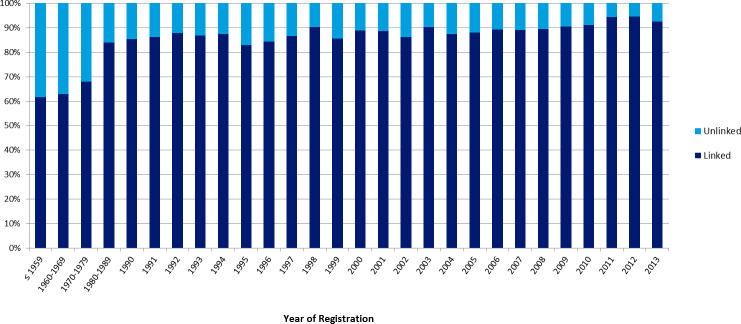
Overall, 201,678 individuals in the national IR database matched to Ontario health records by way of the RPDB, of which 98,562 were female and 103,116 were male. Of those First Nations individuals linked to the RPDB, 90.2% (n=181,915) lived in Ontario when they first registered with IR, or were affiliated with an Ontario First Nation Community. The proportion of registered First Nations people linking to the RPDB improved across time, from 62.8% in the 1960s to 94.5% in 2012.
This linkage of the IR and RPDB has resulted in the creation of the largest First Nations health research study cohort in Canada. The linked data are being used by First Nations communities to answer questions that ultimately promote wellbeing, effective policy, and healing.
加拿大国内及国际上越来越认识到原住民数据主权和原住民主导的研究过程的重要性。对于加拿大安大略省的第一民族而言,获取常规收集的人口统计和卫生系统数据对于规划和衡量其人口的健康状况及成果至关重要。在第一民族数据治理下,将这些数据与印第安登记册(IR)相链接,为第一民族组织和社区解锁了可用数据。
在原住民数据主权原则的背景下,描述IR数据库与安大略省注册人员数据库(RPDB)的链接情况。
使用确定性和概率性记录链接方法将IR与RPDB相链接。没有居住在安大略省的第一民族人群体可用于确定链接率。因此,采取了几种方法来确定一个分母,该分母将代表我们希望与RPDB链接的第一民族总人口。
总体而言,国家IR数据库中的201,678人通过RPDB与安大略省的健康记录相匹配,其中98,562人为女性,103,116人为男性。在那些与RPDB链接的第一民族个体中,90.2%(n = 181,915)在首次向IR注册时居住在安大略省,或隶属于安大略省的第一民族社区。与RPDB链接的注册第一民族人口比例随时间有所提高,从20世纪60年代的62.8%提高到2012年的94.5%。
IR与RPDB的这种链接促成了加拿大最大的第一民族健康研究队列的创建。这些链接数据正被第一民族社区用于回答最终促进福祉、有效政策制定和康复的问题。