School of Health Information Science, University of Victoria, Victoria, Canada.
Department of Sociology, University of Victoria, Victoria, Canada.
J Am Med Inform Assoc. 2020 Nov 1;27(11):1774-1783. doi: 10.1093/jamia/ocaa158.
The lack of precise and inclusive gender, sex, and sexual orientation (GSSO) data in electronic health records (EHRs) is perpetuating inequities of sexual and gender minorities (SGM). We conducted a rapid review on how GSSO documentation in EHRs should be modernized to improve the health of SGM.
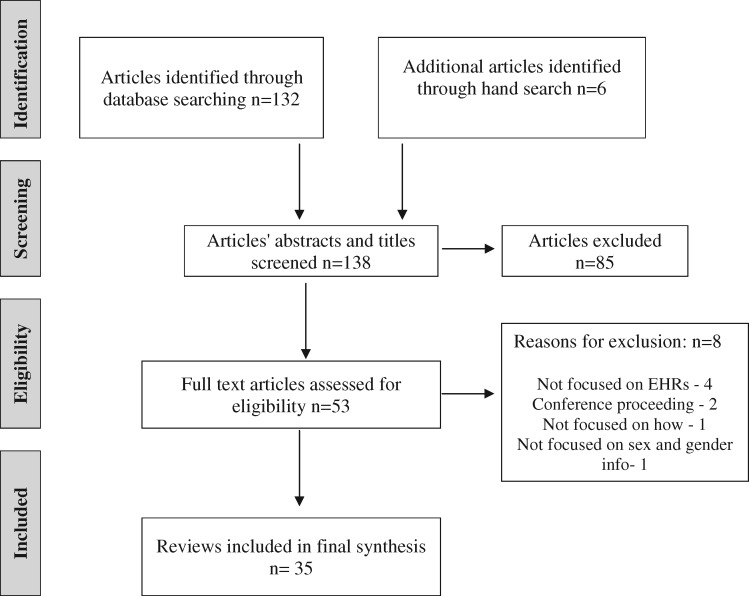
We searched MEDLINE from 2015 to 2020 with terms for gender, sex, sexual orientation, and electronic health/medical records. Only literature reviews, primary studies, and commentaries from peer-reviewed journals in English were included. Two researchers screened citations and reviewed articles with help from a third to reach consensus. Covidence, Excel, and Atlas-TI were used to track articles, extract data, and synthesize findings, respectively.
Thirty-five articles were included. The 5 themes to modernize GSSO documentation in EHRs were (1) creating an inclusive, culturally competent environment with precise terminology and standardized data collection; (2) refining guidelines for identifying and matching SGM patients with their care needs; (3) improving patient-provider relationships by addressing patient rights and provider competencies; (4) recognizing techno-socio-organizational aspects when implementing GSSO in EHRs; and (5) addressing invisibility of SGM by expanding GSSO research.
The literature on GSSO documentation in EHRs is expanding. While this trend is encouraging, there are still knowledge gaps and practical challenges to enabling meaningful changes, such as organizational commitments to ensure affirming environments, and coordinated efforts to address technical, organizational, and social aspects of modernizing GSSO documentation. The adoption of an inclusive EHR to meet SGM needs is a journey that will evolve over time.
电子健康记录(EHR)中缺乏精确和全面的性别、性和性取向(GSSO)数据,这使得性少数群体和性别少数群体(SGM)的不平等现象持续存在。我们对如何使 EHR 中的 GSSO 文档现代化以改善 SGM 的健康状况进行了快速审查。
我们使用性别、性、性取向和电子健康/医疗记录的术语,从 2015 年至 2020 年在 MEDLINE 上进行了搜索。仅包括英语同行评审期刊的文献综述、原始研究和评论。两名研究人员在第三名研究人员的帮助下筛选引文并审查文章,以达成共识。Covidence、Excel 和 Atlas-TI 分别用于跟踪文章、提取数据和综合研究结果。
共纳入 35 篇文章。使 EHR 中 GSSO 文档现代化的 5 个主题是:(1)创建一个包容、文化上有能力的环境,使用精确的术语和标准化的数据收集;(2)完善识别和满足 SGM 患者及其护理需求的指南;(3)通过解决患者权利和提供者能力问题改善医患关系;(4)在 EHR 中实施 GSSO 时认识到技术、社会和组织方面;(5)通过扩大 GSSO 研究来解决 SGM 的隐形问题。
EHR 中 GSSO 文档的文献正在增加。虽然这种趋势令人鼓舞,但在实现有意义的变革方面仍存在知识差距和实际挑战,例如组织承诺确保支持性环境,以及协调努力解决现代化 GSSO 文档的技术、组织和社会方面的问题。采用包容的 EHR 来满足 SGM 的需求是一个随着时间的推移而不断发展的过程。