Kim Dong Kyu, Jo Ara, Lim Hee Suk, Kim Jin Youp, Eun Kyoung Mi, Oh Jayoung, Kim Joon Kon, Cho Seong Ho, Kim Dae Woo
Department of Otorhinolaryngology-Head and Neck Surgery, Hallym University Chuncheon Sacred Heart Hospital and Institute of New Frontier Research, Hallym University College of Medicine, Chuncheon, Korea.
Division of Allergy-Immunology, Department of Internal Medicine, University of South Florida Morsani College of Medicine, Tampa, FL, USA.
Allergy Asthma Immunol Res. 2020 Nov;12(6):980-993. doi: 10.4168/aair.2020.12.6.980.
Recent studies have revealed the pathogenic role of interleukin (IL)-22 in atopic dermatitis and asthma. However, little is known about the role of IL-22 in the pathophysiology of chronic rhinosinusitis with nasal polyps. We aimed to investigate the expression of IL-22 and its pathogenic function in type 2 immune reactions of nasal polyps (NP).
Protein levels of inflammatory mediators were determined by multiplex immunoassay, and principal component analysis (PCA) was performed. Immunofluorescence analysis and mast cell culture were used to determine the cellular sources of IL-22. Normal human bronchial epithelial (NHBE) cells were stimulated using IL-22 in combination with diverse cytokines, and thymic stromal lymphopoietin (TSLP) was measured.
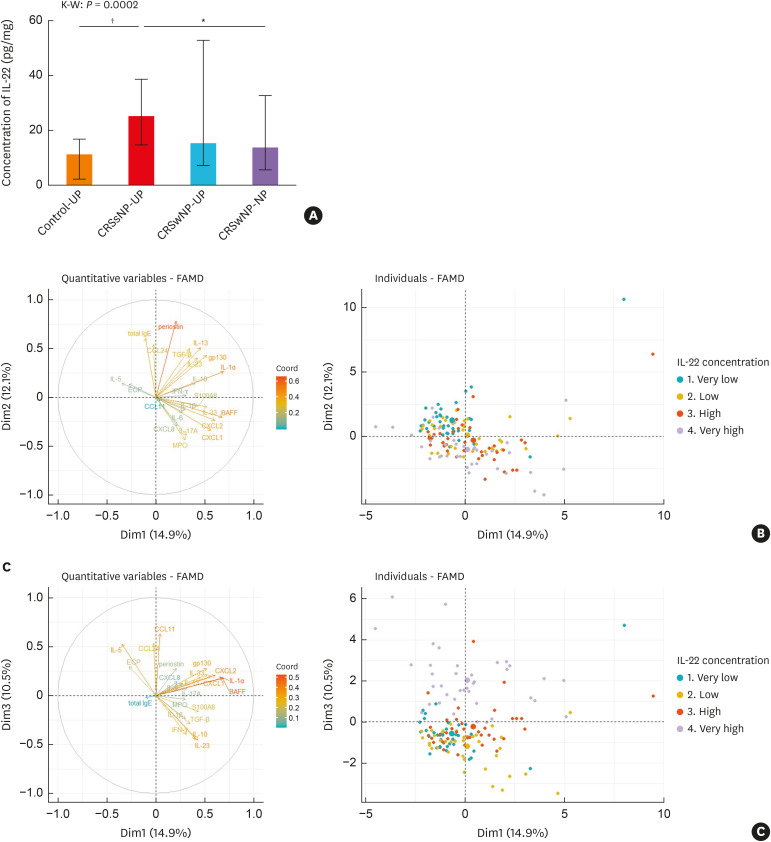
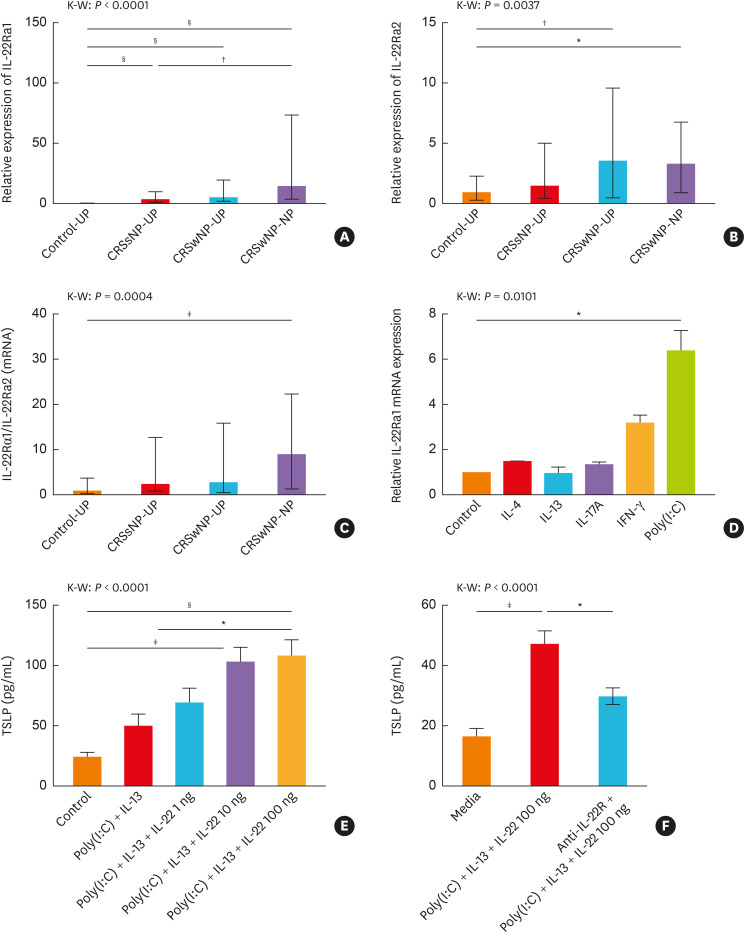
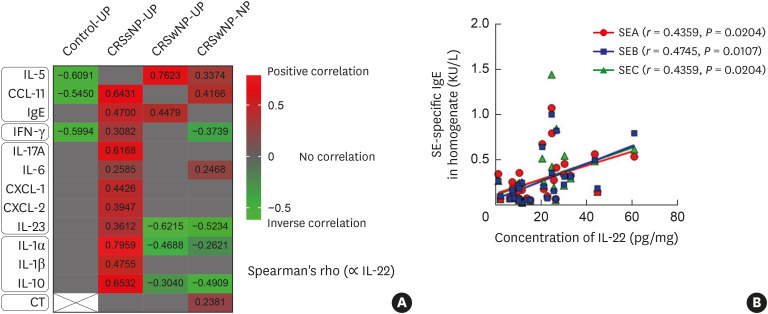
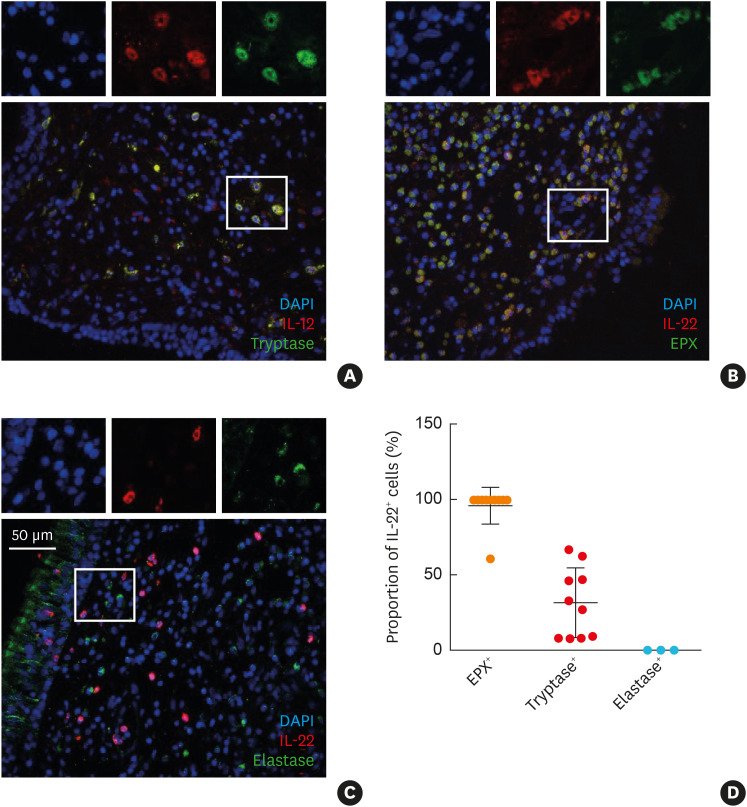
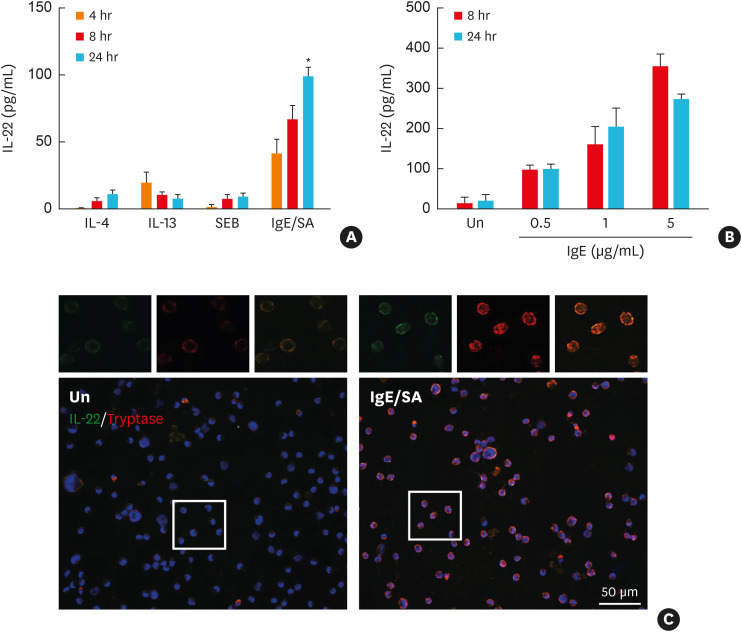
IL-22 expression was not up-regulated in NP compared with control tissues, but IL-22-high NP revealed distinct features characterized by type 2 inflammatory cytokines such as chemokine (C-C motif) ligand (CCL)-11, CCL-24, and IL-5 on the PCA. Additionally, IL-22 positively correlated with type 2 immune mediators and the disease severity in NP. For the localization of the cellular sources of IL-22 in eosinophilic NP, it was expressed in cells mostly composed of eosinophil peroxidase-positive cells and partially of tryptase-positive cells. The human mast cell line, LAD2 cells, released IL-22 mediated by immunoglobulin E. Moreover, IL-22 receptor subunit alpha-1 (IL-22Ra1) expression was significantly increased in NP. IL-22Ra1 was up-regulated with poly(I:C) stimulation in NHBE cells. Furthermore, TSLP production was enhanced when stimulated with a combination of IL-13, poly(I:C), and IL-22. Treatment with anti-IL-22Ra1 also inhibited IL-22-induced enhancement of TSLP production.
IL-22 was associated with type 2 inflammatory reactions in NP. The IL-22/IL-22Ra1 axis was enhanced and might be involved in type 2 inflammatory reactions via TSLP production in NP.
近期研究揭示了白细胞介素(IL)-22在特应性皮炎和哮喘中的致病作用。然而,关于IL-22在伴鼻息肉的慢性鼻-鼻窦炎病理生理学中的作用知之甚少。我们旨在研究IL-22在鼻息肉(NP)2型免疫反应中的表达及其致病功能。
通过多重免疫测定法测定炎症介质的蛋白水平,并进行主成分分析(PCA)。采用免疫荧光分析和肥大细胞培养来确定IL-22的细胞来源。使用IL-22联合多种细胞因子刺激正常人支气管上皮(NHBE)细胞,并检测胸腺基质淋巴细胞生成素(TSLP)。
与对照组织相比,NP中IL-22表达未上调,但在PCA上,IL-22高表达的NP表现出以2型炎性细胞因子如趋化因子(C-C基序)配体(CCL)-11、CCL-24和IL-5为特征的独特特征。此外,IL-22与NP中的2型免疫介质及疾病严重程度呈正相关。对于嗜酸性NP中IL-22细胞来源的定位,它主要在由嗜酸性粒细胞过氧化物酶阳性细胞和部分类胰蛋白酶阳性细胞组成的细胞中表达。人肥大细胞系LAD2细胞释放由免疫球蛋白E介导的IL-22。此外,NP中IL-22受体亚基α-1(IL-22Ra1)表达显著增加。在NHBE细胞中,poly(I:C)刺激可上调IL-22Ra1。此外,当用IL-13、poly(I:C)和IL-22联合刺激时,TSLP产生增加。用抗IL-22Ra1治疗也可抑制IL-22诱导的TSLP产生增强。
IL-22与NP中的2型炎症反应相关。IL-22/IL-22Ra1轴增强,可能通过NP中TSLP的产生参与2型炎症反应。