• 文献检索
  • 文档翻译
  • 深度研究
  • 学术资讯
  • Suppr Zotero 插件Zotero 插件
  • 邀请有礼
  • 套餐&价格
  • 历史记录
应用&插件
Suppr Zotero 插件Zotero 插件浏览器插件Mac 客户端Windows 客户端微信小程序
定价
高级版会员购买积分包购买API积分包
服务
文献检索文档翻译深度研究API 文档MCP 服务
关于我们
关于 Suppr公司介绍联系我们用户协议隐私条款
关注我们

Suppr 超能文献

核心技术专利:CN118964589B侵权必究
粤ICP备2023148730 号-1Suppr @ 2026

文献检索

告别复杂PubMed语法,用中文像聊天一样搜索,搜遍4000万医学文献。AI智能推荐,让科研检索更轻松。

立即免费搜索

文件翻译

保留排版,准确专业,支持PDF/Word/PPT等文件格式,支持 12+语言互译。

免费翻译文档

深度研究

AI帮你快速写综述,25分钟生成高质量综述,智能提取关键信息,辅助科研写作。

立即免费体验

机器学习模型预测儿童铅中毒的验证。

Validation of a Machine Learning Model to Predict Childhood Lead Poisoning.

机构信息

Harris School of Public Policy, University of Chicago, Chicago, Illinois.

Machine Learning Department, Carnegie Mellon University, Pittsburgh, Pennsylvania.

出版信息

JAMA Netw Open. 2020 Sep 1;3(9):e2012734. doi: 10.1001/jamanetworkopen.2020.12734.

DOI:10.1001/jamanetworkopen.2020.12734
PMID:32936296
原文链接:https://pmc.ncbi.nlm.nih.gov/articles/PMC7495240/
Abstract

IMPORTANCE

Childhood lead poisoning causes irreversible neurobehavioral deficits, but current practice is secondary prevention.

OBJECTIVE

To validate a machine learning (random forest) prediction model of elevated blood lead levels (EBLLs) by comparison with a parsimonious logistic regression.

DESIGN, SETTING, AND PARTICIPANTS: This prognostic study for temporal validation of multivariable prediction models used data from the Women, Infants, and Children (WIC) program of the Chicago Department of Public Health. Participants included a development cohort of children born from January 1, 2007, to December 31, 2012, and a validation WIC cohort born from January 1 to December 31, 2013. Blood lead levels were measured until December 31, 2018. Data were analyzed from January 1 to October 31, 2019.

EXPOSURES

Blood lead level test results; lead investigation findings; housing characteristics, permits, and violations; and demographic variables.

MAIN OUTCOMES AND MEASURES

Incident EBLL (≥6 μg/dL). Models were assessed using the area under the receiver operating characteristic curve (AUC) and confusion matrix metrics (positive predictive value, sensitivity, and specificity) at various thresholds.

RESULTS

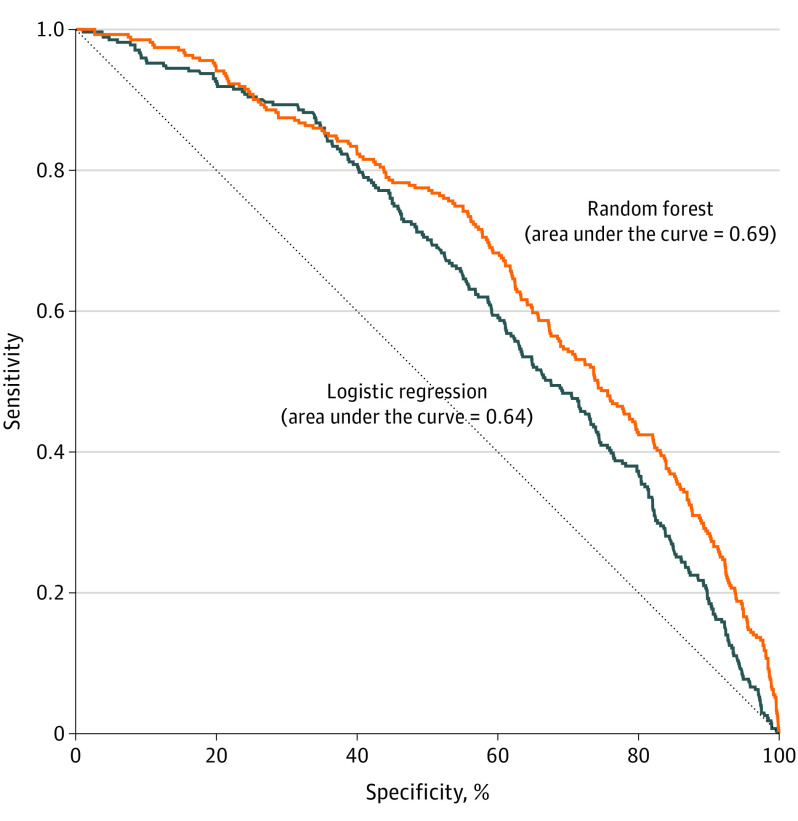
Among 6812 children in the WIC validation cohort, 3451 (50.7%) were female, 3057 (44.9%) were Hispanic, 2804 (41.2%) were non-Hispanic Black, 458 (6.7%) were non-Hispanic White, and 442 (6.5%) were Asian (mean [SD] age, 5.5 [0.3] years). The median year of housing construction was 1919 (interquartile range, 1903-1948). Random forest AUC was 0.69 compared with 0.64 for logistic regression (difference, 0.05; 95% CI, 0.02-0.08). When predicting the 5% of children at highest risk to have EBLLs, random forest and logistic regression models had positive predictive values of 15.5% and 7.8%, respectively (difference, 7.7%; 95% CI, 3.7%-11.3%), sensitivity of 16.2% and 8.1%, respectively (difference, 8.1%; 95% CI, 3.9%-11.7%), and specificity of 95.5% and 95.1% (difference, 0.4%; 95% CI, 0.0%-0.7%).

CONCLUSIONS AND RELEVANCE

The machine learning model outperformed regression in predicting childhood lead poisoning, especially in identifying children at highest risk. Such a model could be used to target the allocation of lead poisoning prevention resources to these children.

摘要

重要性

儿童铅中毒会导致不可逆转的神经行为缺陷,但目前的做法是二级预防。

目的

通过与简约逻辑回归进行比较,验证一种用于预测血铅水平升高(EBLL)的机器学习(随机森林)预测模型。

设计、地点和参与者:本研究为多变量预测模型的时间验证研究,使用了芝加哥公共卫生部妇女、婴儿和儿童(WIC)计划的数据。参与者包括一个 2007 年 1 月 1 日至 12 月 31 日出生的发育队列儿童和一个 2013 年 1 月 1 日至 12 月 31 日出生的验证 WIC 队列。血铅水平一直测量到 2018 年 12 月 31 日。数据分析时间为 2019 年 1 月 1 日至 10 月 31 日。

暴露情况

血铅检测结果;铅调查结果;住房特征、许可证和违规行为;以及人口统计学变量。

主要结果和措施

新发 EBLL(≥6μg/dL)。使用受试者工作特征曲线(ROC)下面积(AUC)和混淆矩阵指标(阳性预测值、敏感性和特异性)在不同阈值下评估模型。

结果

在 WIC 验证队列的 6812 名儿童中,3451 名(50.7%)为女性,3057 名(44.9%)为西班牙裔,2804 名(41.2%)为非西班牙裔黑人,458 名(6.7%)为非西班牙裔白人,442 名(6.5%)为亚裔(平均[标准差]年龄为 5.5[0.3]岁)。房屋建筑的中位数年份为 1919 年(四分位间距,1903-1948)。随机森林 AUC 为 0.69,而逻辑回归为 0.64(差异,0.05;95%置信区间,0.02-0.08)。当预测 EBLL 风险最高的 5%儿童时,随机森林和逻辑回归模型的阳性预测值分别为 15.5%和 7.8%(差异,7.7%;95%置信区间,3.7%-11.3%),敏感性分别为 16.2%和 8.1%(差异,8.1%;95%置信区间,3.9%-11.7%),特异性分别为 95.5%和 95.1%(差异,0.4%;95%置信区间,0.0%-0.7%)。

结论和相关性

机器学习模型在预测儿童铅中毒方面优于回归,尤其是在识别高风险儿童方面。这样的模型可以用于将铅中毒预防资源分配给这些儿童。

https://cdn.ncbi.nlm.nih.gov/pmc/blobs/b41f/7495240/9e3129b659a7/jamanetwopen-e2012734-g002.jpg
https://cdn.ncbi.nlm.nih.gov/pmc/blobs/b41f/7495240/3c580fa96b07/jamanetwopen-e2012734-g001.jpg
https://cdn.ncbi.nlm.nih.gov/pmc/blobs/b41f/7495240/9e3129b659a7/jamanetwopen-e2012734-g002.jpg
https://cdn.ncbi.nlm.nih.gov/pmc/blobs/b41f/7495240/3c580fa96b07/jamanetwopen-e2012734-g001.jpg
https://cdn.ncbi.nlm.nih.gov/pmc/blobs/b41f/7495240/9e3129b659a7/jamanetwopen-e2012734-g002.jpg

相似文献

1
Validation of a Machine Learning Model to Predict Childhood Lead Poisoning.机器学习模型预测儿童铅中毒的验证。
JAMA Netw Open. 2020 Sep 1;3(9):e2012734. doi: 10.1001/jamanetworkopen.2020.12734.
2
Evaluation of Machine-Learning Algorithms for Predicting Opioid Overdose Risk Among Medicare Beneficiaries With Opioid Prescriptions.评估机器学习算法在预测有阿片类药物处方的医疗保险受益人群中阿片类药物过量风险中的应用。
JAMA Netw Open. 2019 Mar 1;2(3):e190968. doi: 10.1001/jamanetworkopen.2019.0968.
3
Development and Validation of an Electronic Health Record-Based Machine Learning Model to Estimate Delirium Risk in Newly Hospitalized Patients Without Known Cognitive Impairment.基于电子病历的机器学习模型开发与验证:用于预测无已知认知障碍的新入院患者发生谵妄的风险。
JAMA Netw Open. 2018 Aug 3;1(4):e181018. doi: 10.1001/jamanetworkopen.2018.1018.
4
A comparison of elevated blood lead levels among children living in foster care, their siblings, and the general population.寄养儿童、其兄弟姐妹及普通人群中儿童血铅水平升高情况的比较。
Pediatrics. 2001 May;107(5):E81. doi: 10.1542/peds.107.5.e81.
5
Machine Learning-Based Prediction of Clinical Outcomes for Children During Emergency Department Triage.基于机器学习的急诊科分诊中儿童临床结局预测。
JAMA Netw Open. 2019 Jan 4;2(1):e186937. doi: 10.1001/jamanetworkopen.2018.6937.
6
Effects of Individual and Neighborhood Characteristics on Childhood Blood Lead Testing and Elevated Blood Lead Levels, A Pennsylvania Birth Cohort Analysis.个体和邻里特征对儿童血铅检测和血铅水平升高的影响:宾夕法尼亚州出生队列分析。
J Prim Care Community Health. 2021 Jan-Dec;12:21501327211017780. doi: 10.1177/21501327211017780.
7
Effect of Residential Lead-Hazard Interventions on Childhood Blood Lead Concentrations and Neurobehavioral Outcomes: A Randomized Clinical Trial.住宅铅危害干预对儿童血铅浓度和神经行为结果的影响:一项随机临床试验。
JAMA Pediatr. 2018 Oct 1;172(10):934-942. doi: 10.1001/jamapediatrics.2018.2382.
8
Prediction of In-hospital Mortality in Emergency Department Patients With Sepsis: A Local Big Data-Driven, Machine Learning Approach.急诊科脓毒症患者院内死亡率的预测:一种基于本地大数据驱动的机器学习方法。
Acad Emerg Med. 2016 Mar;23(3):269-78. doi: 10.1111/acem.12876. Epub 2016 Feb 13.
9
Machine Learning Approaches to Predict 6-Month Mortality Among Patients With Cancer.机器学习方法预测癌症患者 6 个月死亡率。
JAMA Netw Open. 2019 Oct 2;2(10):e1915997. doi: 10.1001/jamanetworkopen.2019.15997.
10
Assessment of a Machine Learning Model Applied to Harmonized Electronic Health Record Data for the Prediction of Incident Atrial Fibrillation.应用于电子健康记录数据标准化的机器学习模型预测心房颤动事件的评估。
JAMA Netw Open. 2020 Jan 3;3(1):e1919396. doi: 10.1001/jamanetworkopen.2019.19396.

引用本文的文献

1
Artificial Intelligence Applications in Emergency Toxicology: Advancements and Challenges.人工智能在急诊毒理学中的应用:进展与挑战。
J Med Internet Res. 2025 Aug 22;27:e73121. doi: 10.2196/73121.
2
Lead exposure in the 21st century: Modeling a path from crisis to prevention.21世纪的铅暴露:构建一条从危机到预防的路径。
Eco Environ Health. 2025 May 29;4(3):100159. doi: 10.1016/j.eehl.2025.100159. eCollection 2025 Sep.
3
Machine learning for predicting medical outcomes associated with acute lithium poisoning.用于预测与急性锂中毒相关医学结果的机器学习

本文引用的文献

1
Effect of Residential Lead-Hazard Interventions on Childhood Blood Lead Concentrations and Neurobehavioral Outcomes: A Randomized Clinical Trial.住宅铅危害干预对儿童血铅浓度和神经行为结果的影响:一项随机临床试验。
JAMA Pediatr. 2018 Oct 1;172(10):934-942. doi: 10.1001/jamapediatrics.2018.2382.
2
Fair Prediction with Disparate Impact: A Study of Bias in Recidivism Prediction Instruments.公平预测与差异影响:累犯预测工具中的偏见研究。
Big Data. 2017 Jun;5(2):153-163. doi: 10.1089/big.2016.0047.
3
Household interventions for preventing domestic lead exposure in children.
Sci Rep. 2025 Apr 25;15(1):14468. doi: 10.1038/s41598-025-94395-2.
4
Predictive modeling of methadone poisoning outcomes in children ≤ 5 years: utilizing machine learning and the National Poison Data System for improved clinical decision-making.5岁及以下儿童美沙酮中毒结局的预测模型:利用机器学习和国家中毒数据系统改善临床决策
Eur J Pediatr. 2025 Feb 11;184(2):186. doi: 10.1007/s00431-024-05957-x.
5
Non-invasive prediction of human embryonic ploidy using artificial intelligence: a systematic review and meta-analysis.使用人工智能对人类胚胎倍性进行无创预测:系统评价与荟萃分析。
EClinicalMedicine. 2024 Oct 24;77:102897. doi: 10.1016/j.eclinm.2024.102897. eCollection 2024 Nov.
6
Development and validation of an explainable machine learning model for predicting multidimensional frailty in hospitalized patients with cirrhosis.用于预测肝硬化住院患者多维衰弱的可解释机器学习模型的开发与验证
Brief Bioinform. 2024 Sep 23;25(6). doi: 10.1093/bib/bbae491.
7
Construction of a machine learning-based prediction model for unfavorable discharge outcomes in patients with ischemic stroke.基于机器学习构建缺血性中风患者不良出院结局预测模型
Heliyon. 2024 Sep 1;10(17):e37179. doi: 10.1016/j.heliyon.2024.e37179. eCollection 2024 Sep 15.
8
Predicting blood lead in Uruguayan children: Individual- vs neighborhood-level ensemble learners.预测乌拉圭儿童的血铅水平:个体层面与社区层面的集成学习器
PLOS Glob Public Health. 2024 Sep 4;4(9):e0003607. doi: 10.1371/journal.pgph.0003607. eCollection 2024.
9
Prediction the prognosis of the poisoned patients undergoing hemodialysis using machine learning algorithms.运用机器学习算法预测行血液透析中毒患者的预后。
BMC Med Inform Decis Mak. 2024 Feb 6;24(1):38. doi: 10.1186/s12911-024-02443-0.
10
Identification and validation of an explainable prediction model of acute kidney injury with prognostic implications in critically ill children: a prospective multicenter cohort study.识别并验证一种对危重症儿童急性肾损伤具有预后意义的可解释预测模型:一项前瞻性多中心队列研究。
EClinicalMedicine. 2024 Jan 5;68:102409. doi: 10.1016/j.eclinm.2023.102409. eCollection 2024 Feb.
预防儿童家庭铅暴露的家庭干预措施。
Cochrane Database Syst Rev. 2016 Oct 16;10(10):CD006047. doi: 10.1002/14651858.CD006047.pub5.
4
Continual Decrease in Blood Lead Level in Americans: United States National Health Nutrition and Examination Survey 1999-2014.美国人血铅水平持续下降:1999 - 2014年美国国家健康与营养检查调查
Am J Med. 2016 Nov;129(11):1213-1218. doi: 10.1016/j.amjmed.2016.05.042. Epub 2016 Jun 21.
5
Prevention of Childhood Lead Toxicity.预防儿童铅毒性
Pediatrics. 2016 Jul;138(1). doi: 10.1542/peds.2016-1493. Epub 2016 Jun 20.
6
Prediction Policy Problems.预测政策问题。
Am Econ Rev. 2015 May;105(5):491-495. doi: 10.1257/aer.p20151023.
7
Transparent Reporting of a multivariable prediction model for Individual Prognosis or Diagnosis (TRIPOD): explanation and elaboration.透明报告个体预后或诊断的多变量预测模型(TRIPOD):解释和说明。
Ann Intern Med. 2015 Jan 6;162(1):W1-73. doi: 10.7326/M14-0698.
8
NTP monograph on health effects of low-level lead.美国国家毒理学计划关于低剂量铅对健康影响的专著。
NTP Monogr. 2012 Jun(1):xiii, xv-148.
9
Primary prevention of lead exposure: the Philadelphia lead safe homes study.铅暴露的一级预防:费城铅安全家园研究。
Public Health Rep. 2011 May-Jun;126 Suppl 1(Suppl 1):76-88. doi: 10.1177/00333549111260S111.
10
Childhood lead poisoning: conservative estimates of the social and economic benefits of lead hazard control.儿童铅中毒:铅危害控制的社会和经济效益保守估计
Environ Health Perspect. 2009 Jul;117(7):1162-7. doi: 10.1289/ehp.0800408. Epub 2009 Mar 31.