• 文献检索
  • 文档翻译
  • 深度研究
  • 学术资讯
  • Suppr Zotero 插件Zotero 插件
  • 邀请有礼
  • 套餐&价格
  • 历史记录
应用&插件
Suppr Zotero 插件Zotero 插件浏览器插件Mac 客户端Windows 客户端微信小程序
定价
高级版会员购买积分包购买API积分包
服务
文献检索文档翻译深度研究API 文档MCP 服务
关于我们
关于 Suppr公司介绍联系我们用户协议隐私条款
关注我们

Suppr 超能文献

核心技术专利:CN118964589B侵权必究
粤ICP备2023148730 号-1Suppr @ 2026

文献检索

告别复杂PubMed语法,用中文像聊天一样搜索,搜遍4000万医学文献。AI智能推荐,让科研检索更轻松。

立即免费搜索

文件翻译

保留排版,准确专业,支持PDF/Word/PPT等文件格式,支持 12+语言互译。

免费翻译文档

深度研究

AI帮你快速写综述,25分钟生成高质量综述,智能提取关键信息,辅助科研写作。

立即免费体验

基于电子病历的机器学习模型开发与验证:用于预测无已知认知障碍的新入院患者发生谵妄的风险。

Development and Validation of an Electronic Health Record-Based Machine Learning Model to Estimate Delirium Risk in Newly Hospitalized Patients Without Known Cognitive Impairment.

机构信息

School of Medicine, University of California, San Francisco.

Clinical Innovation Center, Department of Medicine, University of California, San Francisco.

出版信息

JAMA Netw Open. 2018 Aug 3;1(4):e181018. doi: 10.1001/jamanetworkopen.2018.1018.

DOI:10.1001/jamanetworkopen.2018.1018
PMID:30646095
原文链接:https://pmc.ncbi.nlm.nih.gov/articles/PMC6324291/
Abstract

IMPORTANCE

Current methods for identifying hospitalized patients at increased risk of delirium require nurse-administered questionnaires with moderate accuracy.

OBJECTIVE

To develop and validate a machine learning model that predicts incident delirium risk based on electronic health data available on admission.

DESIGN, SETTING, AND PARTICIPANTS: Retrospective cohort study evaluating 5 machine learning algorithms to predict delirium using 796 clinical variables identified by an expert panel as relevant to delirium prediction and consistently available in electronic health records within 24 hours of admission. The training set comprised 14 227 adult patients with non-intensive care unit hospital stays and no delirium on admission who were discharged between January 1, 2016, and August 31, 2017, from UCSF Health, a large academic health institution. The test set comprised 3996 patients with hospital stays who were discharged between August 1, 2017, and November 30, 2017.

EXPOSURES

Patient demographic characteristics, diagnoses, nursing records, laboratory results, and medications available in electronic health records during hospitalization.

MAIN OUTCOMES AND MEASURES

Delirium was defined as a positive Nursing Delirium Screening Scale or Confusion Assessment Method for the Intensive Care Unit score. Models were assessed using the area under the receiver operating characteristic curve (AUC) and compared against the 4-point scoring system AWOL (age >79 years, failure to spell world backward, disorientation to place, and higher nurse-rated illness severity), a validated delirium risk-assessment tool routinely administered in this cohort.

RESULTS

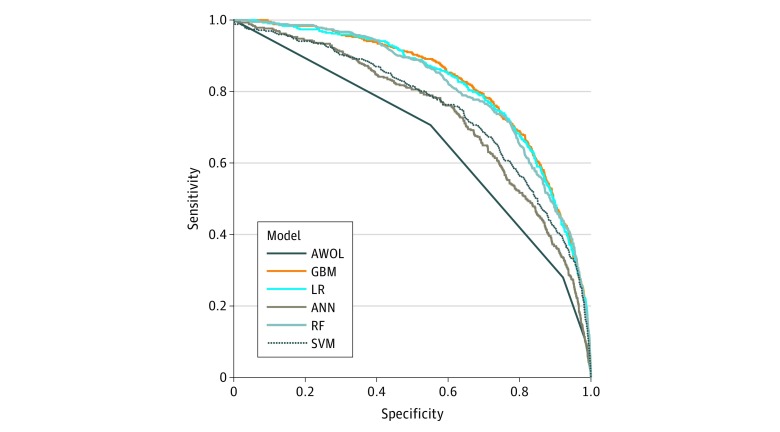
The training set included 14 227 patients (5113 [35.9%] aged >64 years; 7335 [51.6%] female; 687 [4.8%] with delirium), and the test set included 3996 patients (1491 [37.3%] aged >64 years; 1966 [49.2%] female; 191 [4.8%] with delirium). In total, the analysis included 18 223 hospital admissions (6604 [36.2%] aged >64 years; 9301 [51.0%] female; 878 [4.8%] with delirium). The AWOL system achieved a baseline AUC of 0.678. The gradient boosting machine model performed best, with an AUC of 0.855. Setting specificity at 90%, the model had a 59.7% (95% CI, 52.4%-66.7%) sensitivity, 23.1% (95% CI, 20.5%-25.9%) positive predictive value, 97.8% (95% CI, 97.4%-98.1%) negative predictive value, and a number needed to screen of 4.8. Penalized logistic regression and random forest models also performed well, with AUCs of 0.854 and 0.848, respectively.

CONCLUSIONS AND RELEVANCE

Machine learning can be used to estimate hospital-acquired delirium risk using electronic health record data available within 24 hours of hospital admission. Such a model may allow more precise targeting of delirium prevention resources without increasing the burden on health care professionals.

https://cdn.ncbi.nlm.nih.gov/pmc/blobs/cab5/6324291/40229ac559de/jamanetwopen-1-e181018-g002.jpg
https://cdn.ncbi.nlm.nih.gov/pmc/blobs/cab5/6324291/5bda7c471027/jamanetwopen-1-e181018-g001.jpg
https://cdn.ncbi.nlm.nih.gov/pmc/blobs/cab5/6324291/40229ac559de/jamanetwopen-1-e181018-g002.jpg
https://cdn.ncbi.nlm.nih.gov/pmc/blobs/cab5/6324291/5bda7c471027/jamanetwopen-1-e181018-g001.jpg
https://cdn.ncbi.nlm.nih.gov/pmc/blobs/cab5/6324291/40229ac559de/jamanetwopen-1-e181018-g002.jpg
摘要

重要性

目前用于识别住院患者发生谵妄风险的方法需要护士进行中等准确性的问卷调查。

目的

开发和验证一种基于入院时可获得的电子健康数据预测谵妄风险的机器学习模型。

设计、设置和参与者:这是一项回顾性队列研究,使用专家小组确定的 796 个临床变量,通过 5 种机器学习算法来预测谵妄,这些变量被认为与谵妄预测相关且在入院后 24 小时内电子健康记录中始终可用。训练集包括 14227 名非重症监护病房住院且入院时无谵妄的成年患者,他们于 2016 年 1 月 1 日至 2017 年 8 月 31 日从 UCSF Health 出院,这是一家大型学术医疗机构。测试集包括 3996 名 2017 年 8 月 1 日至 11 月 30 日出院的住院患者。

暴露因素

患者的人口统计学特征、诊断、护理记录、实验室结果和住院期间电子健康记录中的药物。

主要结果和测量

谵妄的定义是护理谵妄筛查量表或重症监护病房意识评估方法阳性。使用接收者操作特征曲线(AUC)下的面积评估模型,并与 AWOL(年龄>79 岁、无法向后拼写单词、定向障碍、更高的护士评定疾病严重程度)评分系统进行比较,这是该队列中常规使用的一种经过验证的谵妄风险评估工具。

结果

训练集包括 14227 名患者(5113 [35.9%]年龄>64 岁;7335 [51.6%]女性;687 [4.8%]发生谵妄),测试集包括 3996 名患者(1491 [37.3%]年龄>64 岁;1966 [49.2%]女性;191 [4.8%]发生谵妄)。总共分析了 18223 例住院治疗(6604 [36.2%]年龄>64 岁;9301 [51.0%]女性;878 [4.8%]发生谵妄)。AWOL 系统的基线 AUC 为 0.678。梯度提升机模型表现最佳,AUC 为 0.855。特异性设定为 90%时,该模型的灵敏度为 59.7%(95%CI,52.4%-66.7%)、23.1%(95%CI,20.5%-25.9%)、97.8%(95%CI,97.4%-98.1%)、阴性预测值和需要筛查的人数为 4.8。惩罚逻辑回归和随机森林模型也表现良好,AUC 分别为 0.854 和 0.848。

结论和相关性

机器学习可用于使用入院后 24 小时内可获得的电子健康记录数据来估计医院获得性谵妄风险。这样的模型可能允许更精确地定位谵妄预防资源,而不会增加医疗保健专业人员的负担。

相似文献

1
Development and Validation of an Electronic Health Record-Based Machine Learning Model to Estimate Delirium Risk in Newly Hospitalized Patients Without Known Cognitive Impairment.基于电子病历的机器学习模型开发与验证:用于预测无已知认知障碍的新入院患者发生谵妄的风险。
JAMA Netw Open. 2018 Aug 3;1(4):e181018. doi: 10.1001/jamanetworkopen.2018.1018.
2
Evaluating the performance of machine learning methods for risk estimation of delirium in patients hospitalized from the emergency department.评估机器学习方法在预测急诊科住院患者谵妄风险中的性能。
Acta Psychiatr Scand. 2023 May;147(5):493-505. doi: 10.1111/acps.13551. Epub 2023 Apr 11.
3
Postoperative delirium prediction using machine learning models and preoperative electronic health record data.基于机器学习模型和术前电子健康记录数据预测术后谵妄。
BMC Anesthesiol. 2022 Jan 3;22(1):8. doi: 10.1186/s12871-021-01543-y.
4
Machine Learning Model for Risk Prediction of Community-Acquired Acute Kidney Injury Hospitalization From Electronic Health Records: Development and Validation Study.基于电子健康记录的社区获得性急性肾损伤住院风险预测的机器学习模型:开发和验证研究。
J Med Internet Res. 2020 Aug 4;22(8):e16903. doi: 10.2196/16903.
5
Prediction of Incident Delirium Using a Random Forest classifier.使用随机森林分类器预测发生谵妄。
J Med Syst. 2018 Nov 14;42(12):261. doi: 10.1007/s10916-018-1109-0.
6
Prospective and External Evaluation of a Machine Learning Model to Predict In-Hospital Mortality of Adults at Time of Admission.机器学习模型对入院时成人院内死亡率的前瞻性和外部评估。
JAMA Netw Open. 2020 Feb 5;3(2):e1920733. doi: 10.1001/jamanetworkopen.2019.20733.
7
Performance of Electronic Prediction Rules for Prevalent Delirium at Hospital Admission.电子预测入院时普遍发生的谵妄的规则的性能。
JAMA Netw Open. 2018 Aug 3;1(4):e181405. doi: 10.1001/jamanetworkopen.2018.1405.
8
Machine learning-based prediction of delirium 24 h after pediatric intensive care unit admission in critically ill children: A prospective cohort study.基于机器学习对危重症儿童入住儿科重症监护病房24小时后谵妄的预测:一项前瞻性队列研究。
Int J Nurs Stud. 2023 Oct;146:104565. doi: 10.1016/j.ijnurstu.2023.104565. Epub 2023 Jul 16.
9
Derivation, Validation, Sustained Performance, and Clinical Impact of an Electronic Medical Record-Based Perioperative Delirium Risk Stratification Tool.基于电子病历的围手术期谵妄风险分层工具的推导、验证、持续性能和临床影响。
Anesth Analg. 2020 Dec;131(6):1901-1910. doi: 10.1213/ANE.0000000000005085.
10
Risk prediction of delirium in hospitalized patients using machine learning: An implementation and prospective evaluation study.使用机器学习预测住院患者谵妄的风险:一项实施和前瞻性评估研究。
J Am Med Inform Assoc. 2020 Jul 1;27(9):1383-1392. doi: 10.1093/jamia/ocaa113.

引用本文的文献

1
The risk of delirium or dementia-related hospitalization among individuals living with dementia after long-term care entry: A population-based risk prediction model.长期护理机构入住后痴呆症患者发生谵妄或痴呆相关住院的风险:基于人群的风险预测模型。
Alzheimers Dement. 2025 Aug;21(8):e70487. doi: 10.1002/alz.70487.
2
Predicting ICU Delirium in Critically Ill COVID-19 Patients Using Demographic, Clinical, and Laboratory Admission Data: A Machine Learning Approach.利用人口统计学、临床和实验室入院数据预测重症 COVID-19 患者的 ICU 谵妄:一种机器学习方法。
Life (Basel). 2025 Jun 30;15(7):1045. doi: 10.3390/life15071045.
3

本文引用的文献

1
Validation of a Nurse-Based Delirium-Screening Tool for Hospitalized Patients.验证一种基于护士的住院患者谵妄筛查工具。
Psychosomatics. 2017 Nov-Dec;58(6):594-603. doi: 10.1016/j.psym.2017.05.005. Epub 2017 Jul 24.
2
Nursing assessment as an effective tool for the identification of delirium risk in older in-patients: A case-control study.护理评估作为识别老年住院患者谵妄风险的有效工具:一项病例对照研究。
J Clin Nurs. 2018 Jan;27(1-2):345-354. doi: 10.1111/jocn.13921. Epub 2017 Dec 4.
3
Predicting inpatient delirium: The AWOL delirium risk-stratification score in clinical practice.
Comorbidities associated with a clinically-recognized delirium diagnosis in the hospital using real world data.
使用真实世界数据得出的与医院临床确诊的谵妄相关的共病情况。
Commun Med (Lond). 2025 Jul 22;5(1):304. doi: 10.1038/s43856-025-00986-5.
4
Predicting podoplanin expression and prognostic significance in high-grade glioma based on TCGA TCIA radiomics.基于TCGA和TCIA放射组学预测高级别胶质瘤中血小板源性生长因子受体配体的表达及预后意义
PLoS One. 2025 Jun 24;20(6):e0325964. doi: 10.1371/journal.pone.0325964. eCollection 2025.
5
AI-delirium guard: Predictive modeling of postoperative delirium in elderly surgical patients.人工智能谵妄监护:老年外科患者术后谵妄的预测模型
PLoS One. 2025 Jun 5;20(6):e0322032. doi: 10.1371/journal.pone.0322032. eCollection 2025.
6
Determining the ground truth for the prediction of delirium in adult patients in acute care: a scoping review.确定急性护理中成年患者谵妄预测的真实情况:一项范围综述
JAMIA Open. 2025 May 26;8(3):ooaf037. doi: 10.1093/jamiaopen/ooaf037. eCollection 2025 Jun.
7
Distinct immunological signatures define three sepsis recovery trajectories: a multi-cohort machine learning study.不同的免疫特征定义了三种脓毒症恢复轨迹:一项多队列机器学习研究。
Front Med (Lausanne). 2025 Apr 17;12:1575237. doi: 10.3389/fmed.2025.1575237. eCollection 2025.
8
Echocardiographic Diagnosis of Hypertrophic Cardiomyopathy by Machine Learning.基于机器学习的肥厚型心肌病的超声心动图诊断
Mayo Clin Proc Digit Health. 2024 Sep 3;2(4):564-573. doi: 10.1016/j.mcpdig.2024.08.009. eCollection 2024 Dec.
9
Development and Validation of a Machine Learning Model for Early Prediction of Delirium in Intensive Care Units Using Continuous Physiological Data: Retrospective Study.使用连续生理数据的重症监护病房谵妄早期预测机器学习模型的开发与验证:回顾性研究
J Med Internet Res. 2025 Apr 2;27:e59520. doi: 10.2196/59520.
10
Development of a Disease Model for Predicting Postoperative Delirium Using Combined Blood Biomarkers.利用联合血液生物标志物开发预测术后谵妄的疾病模型
Ann Clin Transl Neurol. 2025 May;12(5):976-985. doi: 10.1002/acn3.70029. Epub 2025 Mar 17.
预测住院患者谵妄:临床实践中的AWOL谵妄风险分层评分
Geriatr Nurs. 2017 Nov-Dec;38(6):567-572. doi: 10.1016/j.gerinurse.2017.04.006. Epub 2017 May 19.
4
The development of an automated ward independent delirium risk prediction model.一种自动化的病房独立谵妄风险预测模型的开发。
Int J Clin Pharm. 2016 Aug;38(4):915-23. doi: 10.1007/s11096-016-0312-7. Epub 2016 May 13.
5
Delirium risk stratification in consecutive unselected admissions to acute medicine: validation of externally derived risk scores.急性内科连续非选择性入院患者的谵妄风险分层:外部衍生风险评分的验证
Age Ageing. 2016 Jan;45(1):60-5. doi: 10.1093/ageing/afv177.
6
Validation of a Delirium Risk Assessment Using Electronic Medical Record Information.使用电子病历信息验证谵妄风险评估。
J Am Med Dir Assoc. 2016 Mar 1;17(3):244-8. doi: 10.1016/j.jamda.2015.10.020. Epub 2015 Dec 15.
7
Deep learning.深度学习。
Nature. 2015 May 28;521(7553):436-44. doi: 10.1038/nature14539.
8
Effectiveness of multicomponent nonpharmacological delirium interventions: a meta-analysis.多组分非药物性谵妄干预措施的有效性:一项荟萃分析。
JAMA Intern Med. 2015 Apr;175(4):512-20. doi: 10.1001/jamainternmed.2014.7779.
9
Transparent Reporting of a multivariable prediction model for Individual Prognosis or Diagnosis (TRIPOD): the TRIPOD statement.透明报告个体预后或诊断的多变量预测模型(TRIPOD):TRIPOD 声明。
Ann Intern Med. 2015 Jan 6;162(1):55-63. doi: 10.7326/M14-0697.
10
Mortality prediction in intensive care units with the Super ICU Learner Algorithm (SICULA): a population-based study.重症监护病房死亡率预测的超级 ICU 学习者算法(SICULA):一项基于人群的研究。
Lancet Respir Med. 2015 Jan;3(1):42-52. doi: 10.1016/S2213-2600(14)70239-5. Epub 2014 Nov 24.