Department of Health, Blekinge Institute of Technology, 371 79 Karlskrona, Sweden.
School of Computer Science, University of Birmingham, Birmingham B15 2TT, UK.
Int J Environ Res Public Health. 2020 Sep 14;17(18):6674. doi: 10.3390/ijerph17186674.
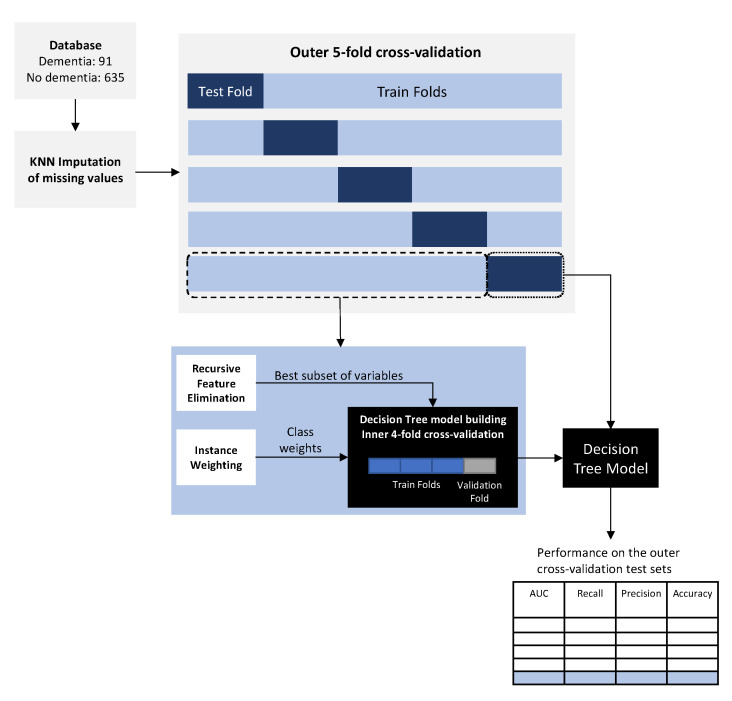
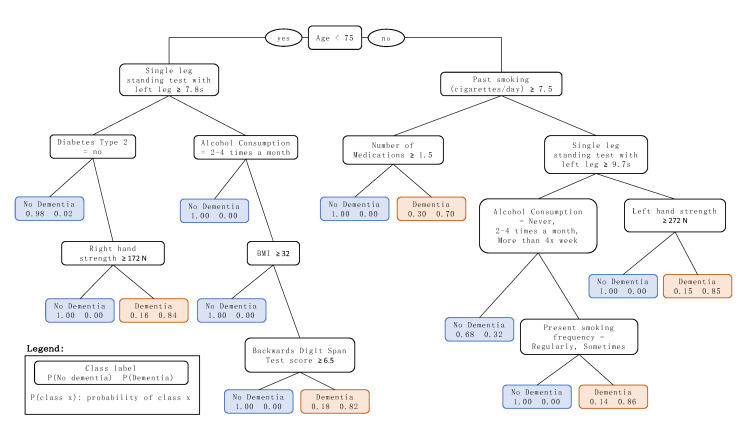
Dementia is a neurodegenerative disorder that affects the older adult population. To date, no cure or treatment to change its course is available. Since changes in the brains of affected individuals could be evidenced as early as 10 years before the onset of symptoms, prognosis research should consider this time frame. This study investigates a broad decision tree multifactorial approach for the prediction of dementia, considering 75 variables regarding demographic, social, lifestyle, medical history, biochemical tests, physical examination, psychological assessment and health instruments. Previous work on dementia prognoses with machine learning did not consider a broad range of factors in a large time frame. The proposed approach investigated predictive factors for dementia and possible prognostic subgroups. This study used data from the ongoing multipurpose Swedish National Study on Aging and Care, consisting of 726 subjects (91 presented dementia diagnosis in 10 years). The proposed approach achieved an AUC of 0.745 and Recall of 0.722 for the 10-year prognosis of dementia. Most of the variables selected by the tree are related to modifiable risk factors; physical strength was important across all ages. Also, there was a lack of variables related to health instruments routinely used for the dementia diagnosis.
痴呆症是一种影响老年人群体的神经退行性疾病。迄今为止,尚无治愈或改变其病程的方法。由于受影响个体大脑的变化早在症状出现前 10 年就可能出现,因此预后研究应考虑这一时间框架。本研究采用广泛的决策树多因素方法预测痴呆症,考虑了 75 个关于人口统计学、社会、生活方式、病史、生化测试、体检、心理评估和健康仪器的变量。以前使用机器学习进行痴呆症预后的研究没有考虑到在一个大时间框架内的广泛因素。所提出的方法研究了痴呆症的预测因素和可能的预后亚组。本研究使用了正在进行的瑞典全国老龄化和护理多用途研究的数据,该研究包括 726 名受试者(91 名在 10 年内出现痴呆症诊断)。该方法对痴呆症的 10 年预后的 AUC 为 0.745,召回率为 0.722。树选择的大多数变量都与可改变的危险因素有关;体力在所有年龄段都很重要。此外,与常规用于痴呆症诊断的健康仪器相关的变量也很少。