Institut de Biologie Structurale, UMR 5075, University Grenoble Alpes, CNRS, CEA, 38000 Grenoble, France.
Molecules. 2020 Sep 14;25(18):4215. doi: 10.3390/molecules25184215.
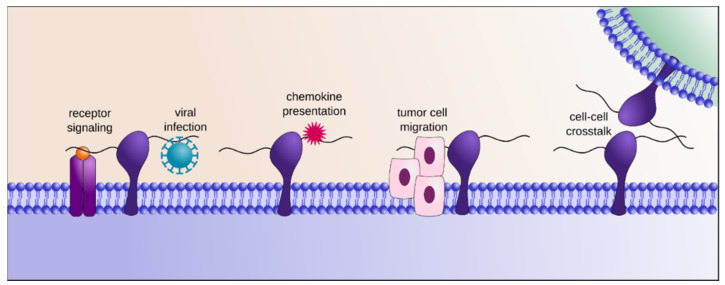
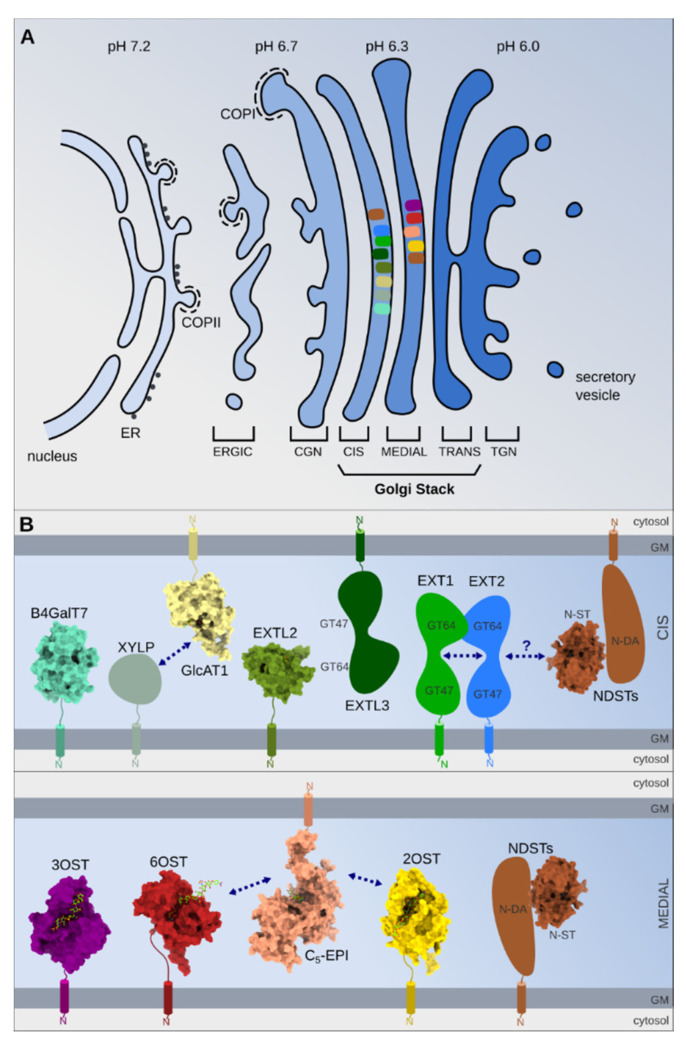
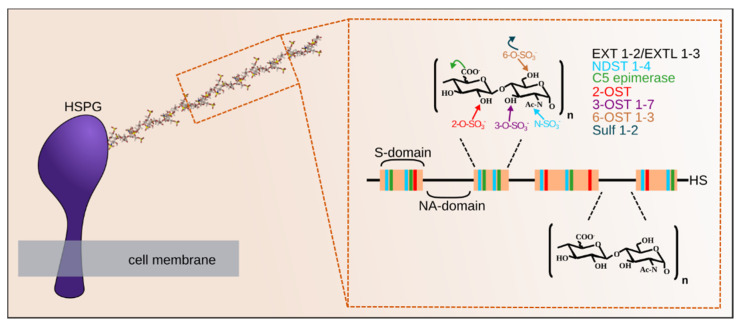
Glycosylation is a common and widespread post-translational modification that affects a large majority of proteins. Of these, a small minority, about 20, are specifically modified by the addition of heparan sulfate, a linear polysaccharide from the glycosaminoglycan family. The resulting molecules, heparan sulfate proteoglycans, nevertheless play a fundamental role in most biological functions by interacting with a myriad of proteins. This large functional repertoire stems from the ubiquitous presence of these molecules within the tissue and a tremendous structural variety of the heparan sulfate chains, generated through both biosynthesis and post synthesis mechanisms. The present review focusses on how proteoglycans are "gagosylated" and acquire structural complexity through the concerted action of Golgi-localized biosynthesis enzymes and extracellular modifying enzymes. It examines, in particular, the possibility that these enzymes form complexes of different modes of organization, leading to the synthesis of various oligosaccharide sequences.
糖基化是一种常见且广泛的翻译后修饰,影响着绝大多数蛋白质。其中,只有一小部分(约 20%)通过添加肝素硫酸酯来特异性修饰,肝素硫酸酯是糖胺聚糖家族的一种线性多糖。由此产生的分子,即肝素硫酸蛋白聚糖,通过与无数蛋白质相互作用,在大多数生物学功能中起着至关重要的作用。这种广泛的功能谱源于这些分子在组织中的普遍存在,以及肝素硫酸链的巨大结构多样性,这些多样性是通过生物合成和合成后机制产生的。本篇综述重点关注蛋白聚糖如何通过高尔基体定位的生物合成酶和细胞外修饰酶的协同作用“糖基化”并获得结构复杂性。特别探讨了这些酶是否以不同的组织方式形成复合物,从而导致各种寡糖序列的合成。