Department of Nursing Sciences, University of Fort Hare, 50 Church Street, East London 5201, South Africa.
Department of Public Health, University of Fort Hare, 5 Oxford Street, East London 5201, South Africa.
Int J Environ Res Public Health. 2020 Sep 14;17(18):6694. doi: 10.3390/ijerph17186694.
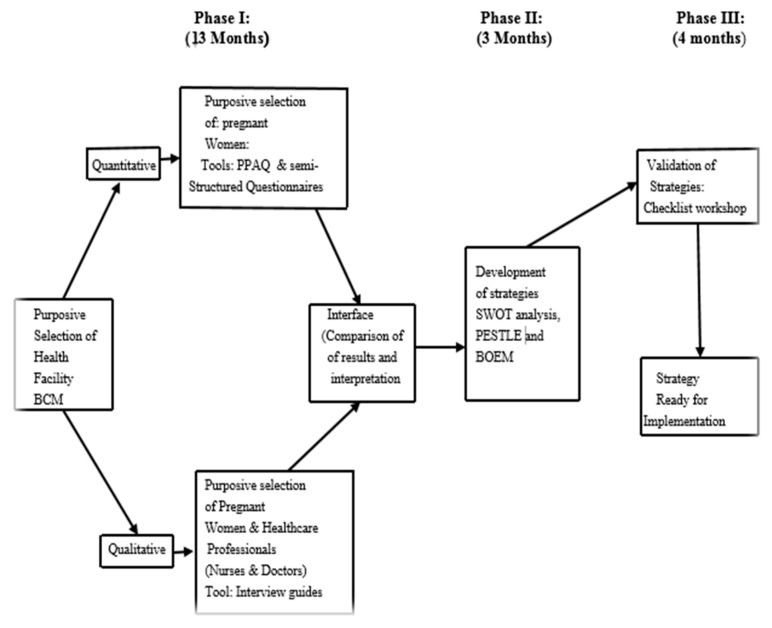
Despite global awareness about the importance and health benefits of physical activity (PA) during pregnancy, several studies have reported a low prevalence of PA participation among pregnant women in both developed and developing countries. This means that most pregnant women do not meet the current PA recommended guideline of 150 min of moderate intensity PA per week. The global call to prioritise PA participation levels in the general population necessitates evaluating the factors affecting PA practice. Seemingly, pregnant women mostly from low-to-middle income countries like South Africa are often predisposed to adverse pregnancy outcomes, possibly because of limited access to, and knowledge of, improved pregnancy and health outcomes as a result of PA participation. Physical activity has been sparsely studied among pregnant South African women, and specifically, there is no known study that assesses the PA levels, patterns, beliefs, sources of information, perceived benefits, barriers, attitudes of pregnant women concerning PA and exercise participation; nor one that explores the perspectives of healthcare providers regarding prenatal PA in the Eastern Cape Province. In addition, no PA intervention strategy exists to promote PA participation in the region. This study, in attempting to fill these gaps in knowledge, adopts two phases. In Phase I, a concurrent mixed-method (quantitative and qualitative) approach assesses the following factors related to PA participation in pregnant women: participation levels, beliefs, attitudes, perceived benefits, barriers to uptake and sources of information. It further ascertains if healthcare professionals are sufficiently informed about PA and if they are advising pregnant women about the need for PA participation during pregnancy. Data will be collected through a structured questionnaire, interviews and focus group discussions. Information on socio-demographic and maternal characteristics will be obtained, and the Pregnancy Physical Activity Questionnaire (PPAQ) will assess PA during pregnancy. A sample size of 384 pregnant women is the required minimum sample for an infinite population at a confidence level of 95%, a precision level of ± 5% and at a prevalence of PA or exercise during pregnancy of 50% ( < 0.05); however, a sample size larger than the minimum number necessary will be recruited to account for possible attrition and to protect against possible data loss. Data will be analysed using a multiple logistic regression to determine the factors that predict sedentary or moderate PA levels and chi-squared analysis to determine the associations between the PA levels of the participants and socio-demographic and clinical variables. The study will assess the data collected on the above-mentioned variables and draw conclusions based on patterns and themes that emerge during analysis. Phase II of the study focuses on strategy development and validation to facilitate the promotion of PA during pregnancy. The developed strategy will be validated through the application of the Delphi technique and the administration of a checklist to selected key stakeholders through organised workshops. Understanding the level and correlates of PA participation among this special population is fundamental to designing intervention strategies to enhance their understanding of, and participation in, PA and exercise. Furthermore, this study's findings will inform facility-based healthcare providers about the need to integrate health education on PA and pregnancy into antenatal and postnatal care visits in the setting.
尽管全球都意识到了在怀孕期间进行身体活动(PA)的重要性和健康益处,但多项研究报告称,在发达国家和发展中国家,孕妇参与 PA 的比例都很低。这意味着大多数孕妇都没有达到目前每周 150 分钟中等强度 PA 的推荐标准。全球呼吁优先提高普通人群的 PA 参与水平,这就需要评估影响 PA 实践的因素。南非等中低收入国家的孕妇似乎更容易出现不良妊娠结局,这可能是因为她们获得和了解 PA 参与对改善妊娠和健康结果的机会有限。在南非孕妇中,PA 研究相对较少,特别是没有研究评估孕妇对 PA 和运动参与的 PA 水平、模式、信念、信息来源、感知益处、障碍、态度;也没有研究探索医疗保健提供者在东开普省对产前 PA 的看法。此外,该地区没有促进 PA 参与的 PA 干预策略。这项研究试图填补这些知识空白,采用了两个阶段。在第一阶段,采用同时进行的混合方法(定量和定性)评估与孕妇 PA 参与相关的以下因素:参与水平、信念、态度、感知益处、障碍和信息来源。它还确定医疗保健专业人员是否对 PA 有足够的了解,以及他们是否在告知孕妇在怀孕期间需要参与 PA。数据将通过结构化问卷、访谈和焦点小组讨论收集。将获得社会人口统计学和产妇特征信息,并使用妊娠身体活动问卷(PPAQ)评估怀孕期间的 PA。在置信水平为 95%、精度水平为±5%和妊娠期间 PA 或运动的流行率为 50%(<0.05)的情况下,384 名孕妇是无限人群所需的最小样本量;然而,将招募大于必要最小数量的样本,以防止可能的流失和可能的数据丢失。将使用多项逻辑回归分析来确定预测久坐或中等 PA 水平的因素,并使用卡方分析来确定参与者的 PA 水平与社会人口统计学和临床变量之间的关联。该研究将评估上述变量的收集数据,并根据分析过程中出现的模式和主题得出结论。研究的第二阶段侧重于策略的制定和验证,以促进怀孕期间的 PA。制定的策略将通过德尔菲技术的应用和通过有组织的研讨会向选定的利益攸关方发放清单来验证。了解这一特殊人群的 PA 参与水平和相关因素,对于制定干预策略以增强他们对 PA 和运动的理解和参与至关重要。此外,本研究的结果将使医疗机构的医疗保健提供者了解在该环境中需要将 PA 健康教育纳入产前和产后护理访问中。