Queensland Brain Institute, The University of Queensland, St Lucia, Brisbane, QLD, 4072, Australia.
School of Mathematics and Physics, The University of Queensland, Brisbane, 4072, Australia.
BMC Biol. 2020 Sep 16;18(1):125. doi: 10.1186/s12915-020-00857-6.
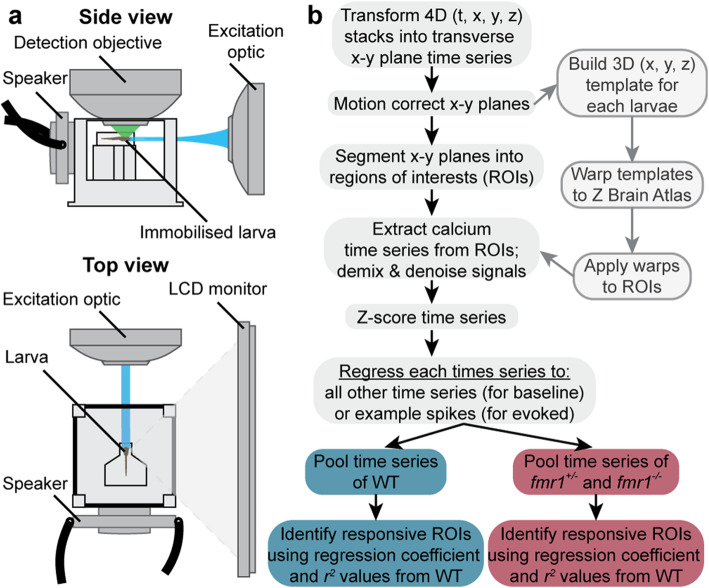
Loss or disrupted expression of the FMR1 gene causes fragile X syndrome (FXS), the most common monogenetic form of autism in humans. Although disruptions in sensory processing are core traits of FXS and autism, the neural underpinnings of these phenotypes are poorly understood. Using calcium imaging to record from the entire brain at cellular resolution, we investigated neuronal responses to visual and auditory stimuli in larval zebrafish, using fmr1 mutants to model FXS. The purpose of this study was to model the alterations of sensory networks, brain-wide and at cellular resolution, that underlie the sensory aspects of FXS and autism.
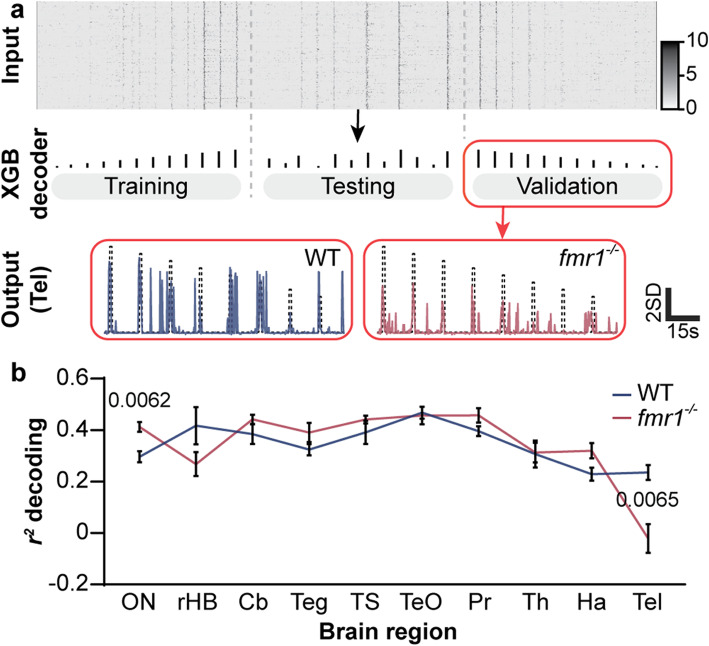
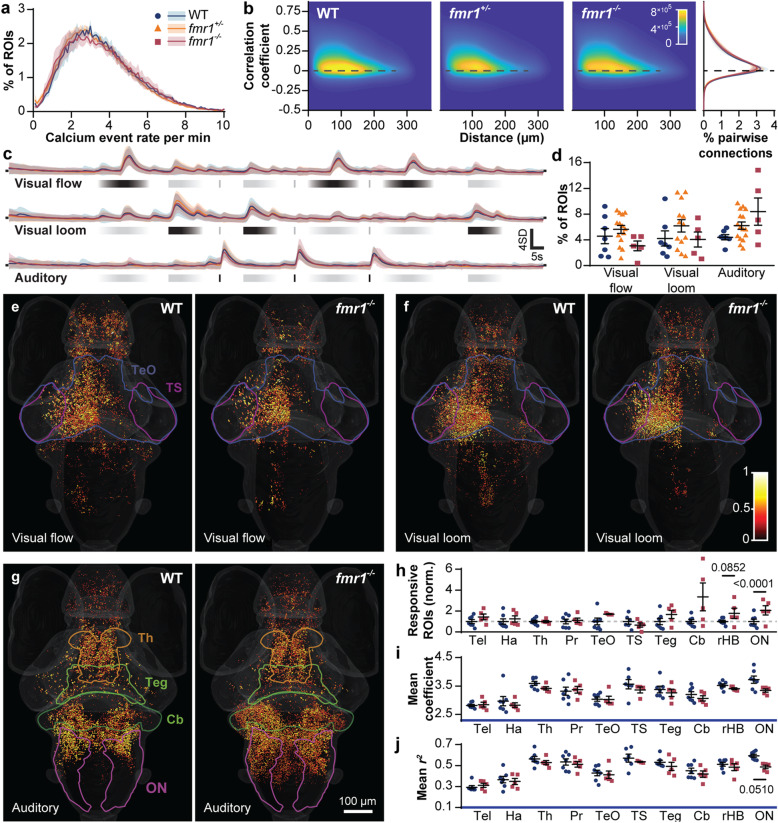
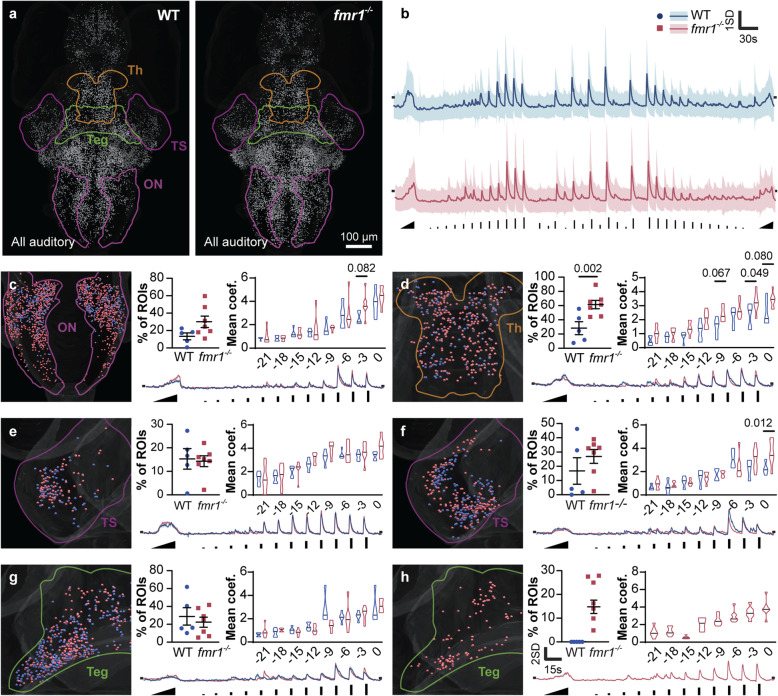
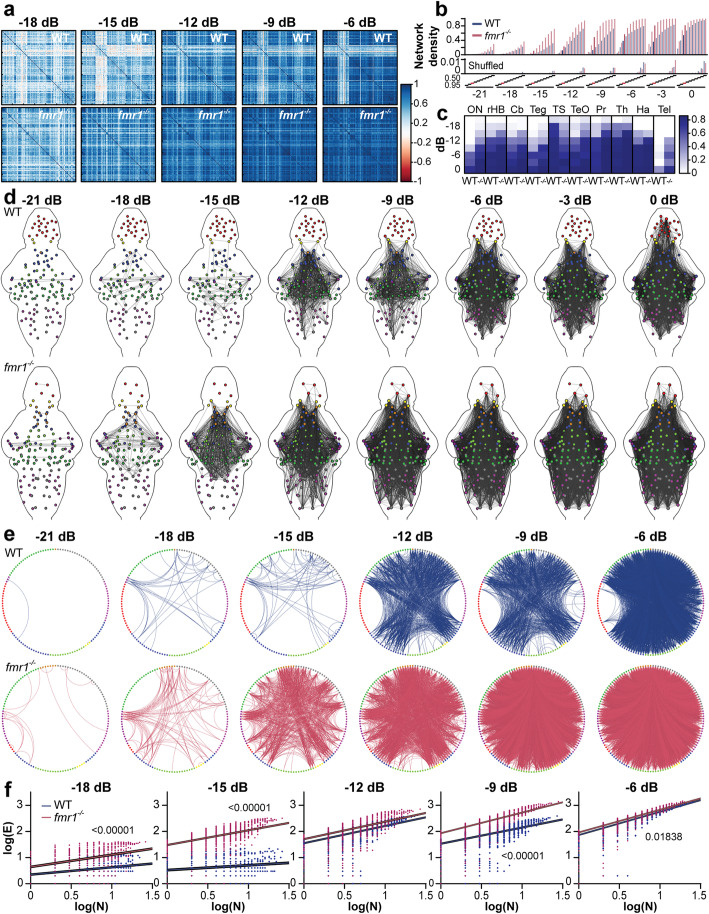
Combining functional analyses with the neurons' anatomical positions, we found that fmr1 animals have normal responses to visual motion. However, there were several alterations in the auditory processing of fmr1 animals. Auditory responses were more plentiful in hindbrain structures and in the thalamus. The thalamus, torus semicircularis, and tegmentum had clusters of neurons that responded more strongly to auditory stimuli in fmr1 animals. Functional connectivity networks showed more inter-regional connectivity at lower sound intensities (a - 3 to - 6 dB shift) in fmr1 larvae compared to wild type. Finally, the decoding capacities of specific components of the ascending auditory pathway were altered: the octavolateralis nucleus within the hindbrain had significantly stronger decoding of auditory amplitude while the telencephalon had weaker decoding in fmr1 mutants.
We demonstrated that fmr1 larvae are hypersensitive to sound, with a 3-6 dB shift in sensitivity, and identified four sub-cortical brain regions with more plentiful responses and/or greater response strengths to auditory stimuli. We also constructed an experimentally supported model of how auditory information may be processed brain-wide in fmr1 larvae. Our model suggests that the early ascending auditory pathway transmits more auditory information, with less filtering and modulation, in this model of FXS.
脆性 X 综合征(FXS)是人类最常见的单基因形式自闭症,其病因是 FMR1 基因的缺失或表达紊乱。尽管感觉处理障碍是 FXS 和自闭症的核心特征,但这些表型的神经基础仍知之甚少。本研究使用钙成像技术以细胞分辨率记录整个大脑的神经元活动,在幼鱼中利用 fmr1 突变体来模拟 FXS,研究视觉和听觉刺激下的神经元反应。目的是在全脑范围内,从细胞分辨率水平来模拟 FXS 和自闭症的感觉网络改变。
将功能分析与神经元的解剖位置相结合,我们发现 fmr1 动物对视觉运动有正常反应。然而,在 fmr1 动物的听觉处理中有几个改变。听觉反应在后脑结构和丘脑更为丰富。丘脑、半规管和脑桥有一簇神经元,在 fmr1 动物中对听觉刺激的反应更强。在 fmr1 幼虫中,与野生型相比,功能连接网络在更低的声音强度(-3 到-6dB 变化)下显示出更多的区域间连接。最后,特定听觉通路成分的解码能力发生改变:后脑内的八面体核对听觉幅度的解码能力显著增强,而中脑的解码能力减弱。
我们证明了 fmr1 幼虫对声音敏感,其敏感性有 3-6dB 的变化,并确定了四个亚皮质脑区对听觉刺激的反应更为丰富或反应强度更大。我们还构建了一个实验支持的模型,说明了在这个 FXS 模型中听觉信息如何在全脑范围内进行处理。我们的模型表明,在这个 FXS 模型中,早期的听觉上行通路传递了更多的听觉信息,过滤和调制较少。