Department of Psychology and Human Development, UCL Institute of Education, University College London, 25 Woburn Square, London, WC1H 0AA, UK.
Eur Child Adolesc Psychiatry. 2021 Nov;30(11):1695-1708. doi: 10.1007/s00787-020-01642-0. Epub 2020 Sep 17.
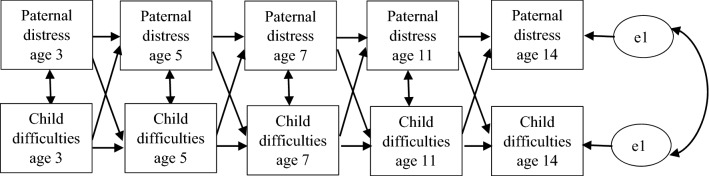
Research shows that paternal psychological distress is associated with child emotional and behavioural difficulties. However, little is known about the direction of this association including whether it is bidirectional. The aim of this study was to explore the reciprocal relationships between paternal psychological distress and child emotional and behavioural problems longitudinally (at ages 3, 5, 7, 11 and 14 years) in a sample of 13,105 children (49% girls) who participated in the UK's Millennium Cohort Study (MCS), a large-scale, nationally representative, longitudinal survey. Four domains of child problems (emotional symptoms, peer relations, conduct problems and hyperactivity/inattention) were measured with the Strengths and Difficulties Questionnaire and paternal psychological distress was measured with the Kessler K-6 scale. Data were analysed using cross-lagged path models. At all ages, paternal psychological distress predicted both subsequent child emotional symptoms as well as peer problems. Paternal psychological distress at child's age 3 was related to more hyperactivity at age 5 and, at age 5, paternal psychological distress was associated with more conduct problems at age 7. At age 11, paternal distress was also related to age 14 conduct problems and hyperactivity. Child effects were fewer and were found mainly for behavioural problems. Notably, we found bidirectional links between paternal psychological distress and child peer difficulties, from 11 to 14 years. Paternal psychological distress appears to influence child behaviour more consistently than the converse. However, in early adolescence, there appears to be a reciprocal relationship between fathers' mental health problems and children's peer problems.
研究表明,父亲的心理困扰与孩子的情绪和行为问题有关。然而,对于这种关联的方向,包括它是否是双向的,我们知之甚少。本研究的目的是在英国千禧年队列研究(MCS)中,探讨 13105 名儿童(49%为女孩)样本中,父亲的心理困扰与儿童情绪和行为问题在纵向(3、5、7、11 和 14 岁)上的相互关系,MCS 是一项大规模的、具有全国代表性的纵向调查。使用长处和困难问卷(Strengths and Difficulties Questionnaire)测量了儿童问题的四个领域(情绪症状、同伴关系、行为问题和多动/注意力不集中),使用凯斯勒 6 项量表(Kessler K-6 scale)测量了父亲的心理困扰。使用交叉滞后路径模型分析数据。在所有年龄段,父亲的心理困扰都预测了儿童随后的情绪症状和同伴问题。儿童 3 岁时的父亲心理困扰与 5 岁时的多动问题有关,而 5 岁时的父亲心理困扰与 7 岁时的行为问题有关。在 11 岁时,父亲的困扰也与 14 岁时的行为问题和多动有关。儿童的影响较少,主要是行为问题。值得注意的是,我们发现了父亲心理困扰与儿童同伴困难之间从 11 岁到 14 岁的双向联系。父亲的心理困扰似乎比相反的情况更能持续地影响孩子的行为。然而,在青少年早期,父亲的心理健康问题和孩子的同伴问题之间似乎存在着相互的关系。