Genetics Graduate Interdisciplinary Program, University of Arizona, Tucson, AZ 85719, USA.
The Biodesign Center for Fundamental and Applied Microbiomics, Center for Evolution and Medicine, School of Life Sciences, Arizona State University, Tempe, AZ 85287-5001, USA.
Viruses. 2020 Sep 15;12(9):1027. doi: 10.3390/v12091027.
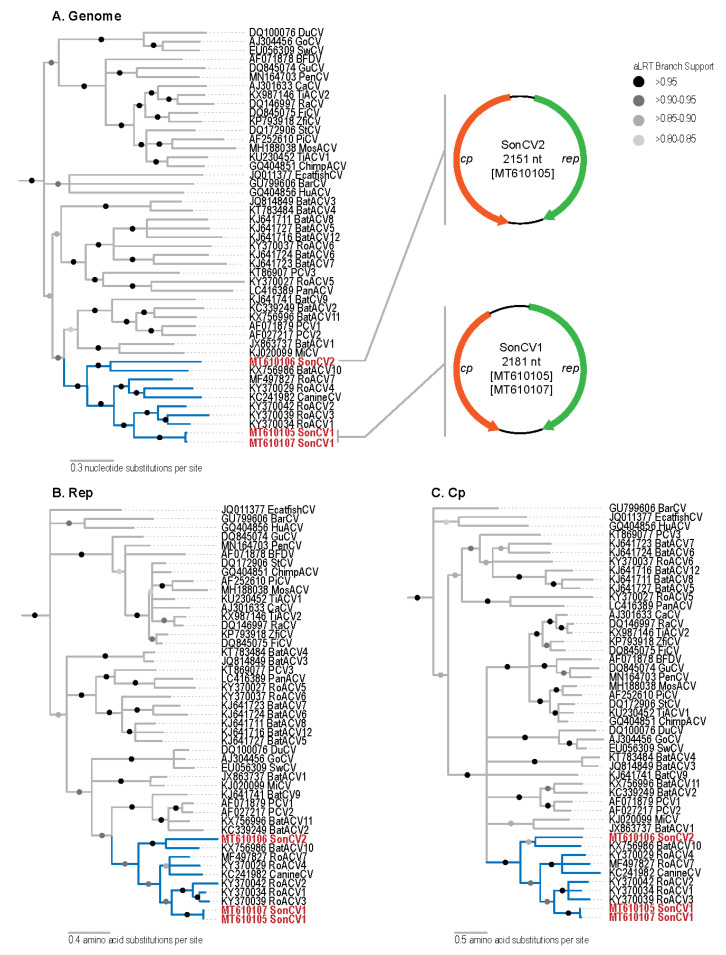
Sonoran felids are threatened by drought and habitat fragmentation. Vector range expansion and anthropogenic factors such as habitat encroachment and climate change are altering viral evolutionary dynamics and exposure. However, little is known about the diversity of viruses present in these populations. Small felid populations with lower genetic diversity are likely to be most threatened with extinction by emerging diseases, as with other selective pressures, due to having less adaptive potential. We used a metagenomic approach to identify novel circoviruses, which may have a negative impact on the population viability, from confirmed bobcat () and puma () scats collected in Sonora, Mexico. Given some circoviruses are known to cause disease in their hosts, such as porcine and avian circoviruses, we took a non-invasive approach using scat to identify circoviruses in free-roaming bobcats and puma. Three circovirus genomes were determined, and, based on the current species demarcation, they represent two novel species. Phylogenetic analyses reveal that one circovirus species is more closely related to rodent associated circoviruses and the other to bat associated circoviruses, sharing highest genome-wide pairwise identity of approximately 70% and 63%, respectively. At this time, it is unknown whether these scat-derived circoviruses infect felids, their prey, or another organism that might have had contact with the scat in the environment. Further studies should be conducted to elucidate the host of these viruses and assess health impacts in felids.
索诺兰猫科动物受到干旱和栖息地破碎化的威胁。随着栖息地的侵占和气候变化等人为因素的影响,病毒的传播范围扩大,这正在改变病毒的进化动态和暴露情况。然而,人们对这些种群中存在的病毒多样性知之甚少。遗传多样性较低的小型猫科动物种群,由于适应潜力较小,可能最容易受到新出现疾病的威胁,就像其他选择压力一样。我们使用宏基因组学方法,从墨西哥索诺拉州收集的已确认的山猫()和美洲狮()粪便中,确定了可能对种群生存力产生负面影响的新型圆环病毒。由于一些圆环病毒已知会在宿主中引起疾病,例如猪圆环病毒和禽圆环病毒,因此我们采用了一种非侵入性的方法,使用粪便来识别自由放养的山猫和美洲狮中的圆环病毒。确定了三个圆环病毒基因组,根据当前的物种划分,它们代表了两个新的物种。系统发育分析表明,一种圆环病毒物种与啮齿动物相关的圆环病毒更为密切相关,另一种与蝙蝠相关的圆环病毒更为密切相关,分别共享约 70%和 63%的最高全基因组序列同一性。目前尚不清楚这些粪便中分离出的圆环病毒是否感染猫科动物、它们的猎物或其他可能与粪便环境中接触的生物。应进一步开展研究,以阐明这些病毒的宿主,并评估对猫科动物的健康影响。