Department of Internal Medicine, University of Texas Southwestern Medical Center, Dallas, TX, 75390, USA.
Department of Internal Medicine, University of Texas Southwestern Medical Center, Dallas, TX, 75390, USA.
Public Health. 2020 Oct;187:111-114. doi: 10.1016/j.puhe.2020.08.009. Epub 2020 Aug 19.
Non-pharmaceutical interventions (NPIs) are effective in curbing the spread of severe acute respiratory syndrome coronavirus 2. All US states have adopted NPI policies, but the compliance to these measures and influence of sociopolitical factors on NPI adherence is unknown. NPI adherence may be approximated by personal mobility in a population that is tracked by anonymous mobile phone data.
This is a cross-sectional study of state-level mobility changes across the US.
State-level mobility was based on anonymous mobile phone data from multiple participating carriers collected by the University of Washington's Institute for Health Metrics and Evaluation (http://www.healthdata.org). Pearson's correlation coefficient was used to examine the strength and direction of the relationship between political affiliations and mobility restriction across states. Multivariable linear regression analyses were used to assess other factors that may impact personal travel.
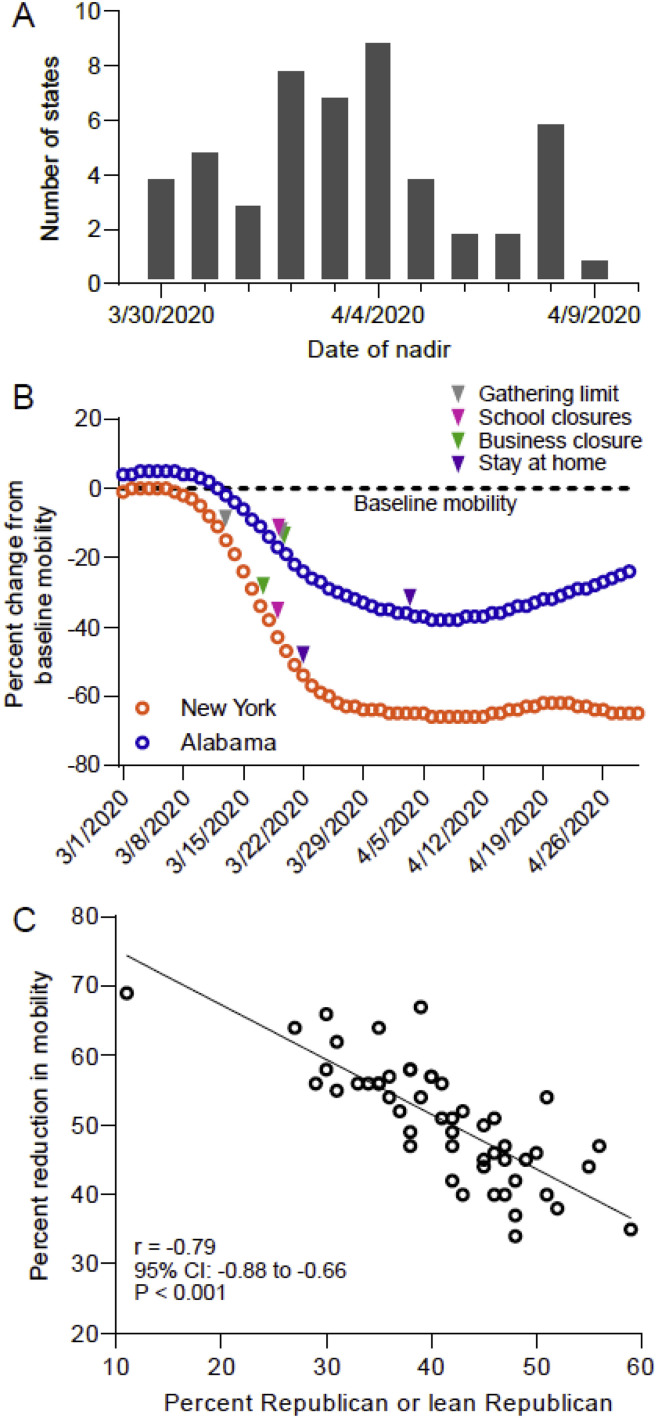
All states experienced a decline in personal mobility but had varying nadirs ranging from a 34% to a 69% reduction in mobility, which was not temporally related to the timing of state-level NPI measures. There was a statistically significant linear and negative correlation (r = -0.79) between the proportion of Republicans/leaning Republicans and NPI adherence across US states. The negative association between Republicans and NPI adherence was significant even when adjusting for urbanization, proportion of essential workers, population, Gini index, and poverty rates.
Political orientation affects risk perception, which may contribute to the unwillingness of some individuals to perceive the coronavirus disease 2019 pandemic as a risk and to comply with NPIs. Our results highlight the importance of sociopolitical factors in disease control and emphasize the importance of bipartisan efforts in fighting the pandemic. These results may have implications for the development, dissemination, and communication of public health policies.
非药物干预(NPI)可有效遏制严重急性呼吸综合征冠状病毒 2 的传播。美国所有州都采取了 NPI 政策,但这些措施的遵守情况以及社会政治因素对 NPI 遵守情况的影响尚不清楚。通过匿名手机数据跟踪的人群中的个人流动性可以近似估计 NPI 的遵守情况。
这是一项针对美国各州移动性变化的横断面研究。
州级流动性是基于华盛顿大学健康指标与评估研究所(http://www.healthdata.org)从多个参与运营商收集的匿名手机数据得出的。使用 Pearson 相关系数来检验各州之间政治关联与流动性限制之间的关系强度和方向。使用多变量线性回归分析来评估可能影响个人出行的其他因素。
所有州的个人流动性均下降,但最低点各不相同,从流动性减少 34%到减少 69%不等,与州级 NPI 措施的实施时间没有时间关系。在全美各州,共和党/倾向共和党比例与 NPI 遵守之间存在统计学上显著的线性负相关(r=-0.79)。即使在调整城市化程度、必要工人比例、人口、基尼指数和贫困率等因素后,共和党人与 NPI 遵守之间的负相关仍然显著。
政治倾向影响风险感知,这可能导致一些人不愿意将 2019 年冠状病毒病大流行视为风险,也不愿意遵守 NPI。我们的研究结果强调了社会政治因素在疾病控制中的重要性,并强调了两党在抗击大流行方面合作的重要性。这些结果可能对公共卫生政策的制定、传播和沟通产生影响。