Department of Psychology, University of Amsterdam, PO Box 15906, Amsterdam, 1001 NK, The Netherlands.
Department of Psychology, University of Tübingen, Tübingen, Germany.
Behav Res Methods. 2021 Jun;53(3):1060-1076. doi: 10.3758/s13428-020-01448-7.
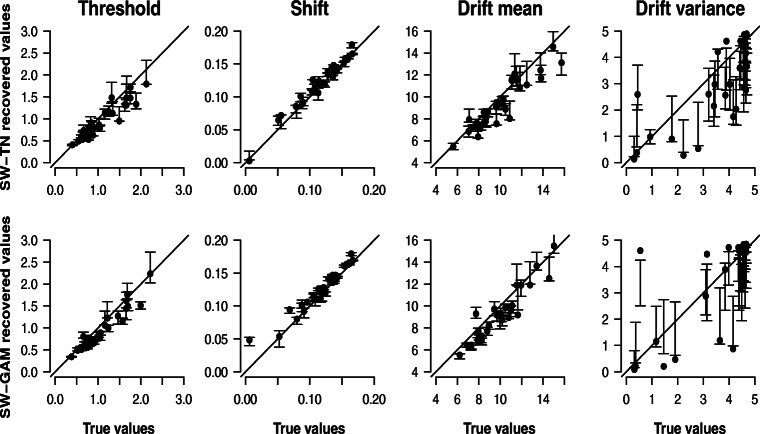
The shifted-Wald model is a popular analysis tool for one-choice reaction-time tasks. In its simplest version, the shifted-Wald model assumes a constant trial-independent drift rate parameter. However, the presence of endogenous processes-fluctuation in attention and motivation, fatigue and boredom-suggest that drift rate might vary across experimental trials. Here we show how across-trial variability in drift rate can be accounted for by assuming a trial-specific drift rate parameter that is governed by a positive-valued distribution. We consider two candidate distributions: the truncated normal distribution and the gamma distribution. For the resulting distributions of first-arrival times, we derive analytical and sampling-based solutions, and implement the models in a Bayesian framework. Recovery studies and an application to a data set comprised of 1469 participants suggest that (1) both mixture distributions yield similar results; (2) all model parameters can be recovered accurately except for the drift variance parameter; (3) despite poor recovery, the presence of the drift variance parameter facilitates accurate recovery of the remaining parameters; (4) shift, threshold, and drift mean parameters are correlated.
转移 Wald 模型是一种用于单项反应时任务的流行分析工具。在其最简单的版本中,转移 Wald 模型假设了一个恒定的、与试验无关的漂移率参数。然而,内源性过程的存在——注意力和动机的波动、疲劳和厌倦——表明漂移率可能在实验试验中变化。在这里,我们展示了如何通过假设一个由正值分布控制的特定于试验的漂移率参数来解释漂移率的跨试验变异性。我们考虑了两个候选分布:截断正态分布和伽马分布。对于第一个到达时间的分布,我们推导出了分析和基于采样的解决方案,并在贝叶斯框架中实现了这些模型。恢复研究和对包含 1469 名参与者的数据集的应用表明:(1)两种混合分布都能得到相似的结果;(2)除了漂移方差参数外,所有模型参数都可以准确恢复;(3)尽管恢复效果不佳,但漂移方差参数的存在有助于准确恢复其余参数;(4)转换、阈值和漂移均值参数是相关的。