Yaden Mary, Yaden David, Buffone Anneke, Eichstaedt Johannes, Crutchley Patrick, Smith Laura, Cass Jonathan, Callahan Clara, Rosenthal Susan, Ungar Lyle, Schwartz Andrew, Hojat Mohammadreza
Department of Psychiatry at the University of Pennsylvania, Philadelphia, PA, USA.
Department of Psychiatry and Behavioral Sciences at Johns Hopkins Medicine, Baltimore, MD, USA.
Int J Med Educ. 2020 Sep 18;11:186-190. doi: 10.5116/ijme.5f2d.0359.
This study aimed to determine whether words used in medical school admissions essays can predict physician empathy.
A computational form of linguistic analysis was used for the content analysis of medical school admissions essays. Words in medical school admissions essays were computationally grouped into 20 'topics' which were then correlated with scores on the Jefferson Scale of Empathy. The study sample included 1,805 matriculants (between 2008-2015) at a single medical college in the North East of the United States who wrote an admissions essay and completed the Jefferson Scale of Empathy at matriculation.
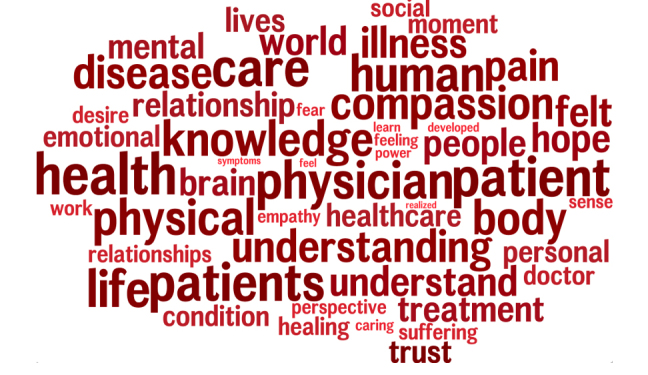
After correcting for multiple comparisons and controlling for gender, the Jefferson Scale of Empathy scores significantly correlated with a linguistic topic (r = .074, p < .05). This topic was comprised of specific words used in essays such as "understanding," "compassion," "empathy," "feeling," and "trust." These words are related to themes emphasized in both theoretical writing and empirical studies on physician empathy.
This study demonstrates that physician empathy can be predicted from medical school admission essays. The implications of this methodological capability, i.e. to quantitatively associate linguistic features or words with psychometric outcomes, bears on the future of medical education research and admissions. In particular, these findings suggest that those responsible for medical school admissions could identify more empathetic applicants based on the language of their application essays.
本研究旨在确定医学院入学申请文书中使用的词汇是否能够预测医生的同理心。
采用一种计算形式的语言分析方法对医学院入学申请文书进行内容分析。通过计算将医学院入学申请文书中的词汇分组为20个“主题”,然后将这些主题与杰斐逊同理心量表的得分进行关联。研究样本包括美国东北部一所医学院的1805名入学新生(2008年至2015年期间),他们撰写了入学申请文书,并在入学时完成了杰斐逊同理心量表的测试。
在对多重比较进行校正并控制性别因素后,杰斐逊同理心量表得分与一个语言主题显著相关(r = 0.074,p < 0.05)。这个主题由申请文书中使用的特定词汇组成,如“理解”“同情”“同理心”“感受”和“信任”。这些词汇与医生同理心的理论写作和实证研究中强调的主题相关。
本研究表明,医学院入学申请文书能够预测医生的同理心。这种方法能力的意义,即定量地将语言特征或词汇与心理测量结果联系起来,对医学教育研究和招生的未来具有重要影响。特别是,这些发现表明,负责医学院招生的人员可以根据申请文书的语言来识别更具同理心的申请者。