Computer and Information Science Department, University of Pennsylvania, Philadelphia.
Leonard Davis Institute of Health Economics, University of Pennsylvania, Philadelphia.
JAMA Netw Open. 2024 Nov 4;7(11):e2446890. doi: 10.1001/jamanetworkopen.2024.46890.
Online review platforms offer valuable insights into patient satisfaction and the quality of health care services, capturing content and trends that traditional metrics might miss. The COVID-19 pandemic has disrupted health care services, influencing patient experiences.
To examine health care facility numerical ratings and patient experience reported on an online platform by facility type and area demographic characteristics after the COVID-19 pandemic (ie, post-COVID).
DESIGN, SETTING, AND PARTICIPANTS: All reviews of US health care facilities posted on one online platform from January 1, 2014, to December 31, 2023, were obtained for this cross-sectional study. Analyses focused on facilities providing essential health benefits, which are service categories that health insurance plans must cover under the Affordable Care Act. Facility zip code tabulation area level demographic data were obtained from US census and rural-urban commuting area codes.
The primary outcome was the change in the percentage of positive reviews (defined as reviews with ≥4 of 5 stars) before and post-COVID. Secondary outcomes included the association between positive ratings and facility demographic characteristics (race and ethnicity and urbanicity), and thematic analysis of review content using latent Dirichlet allocation.
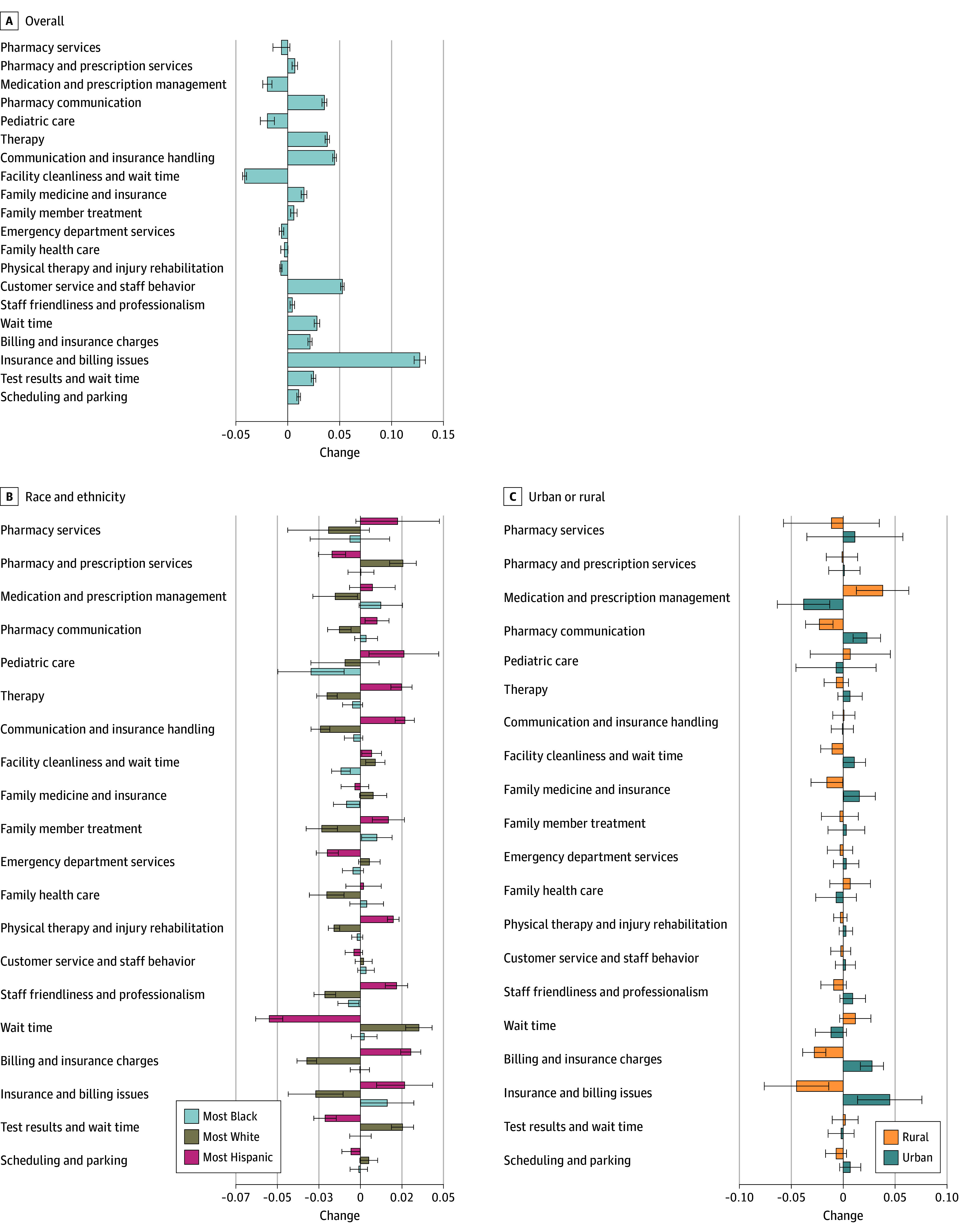
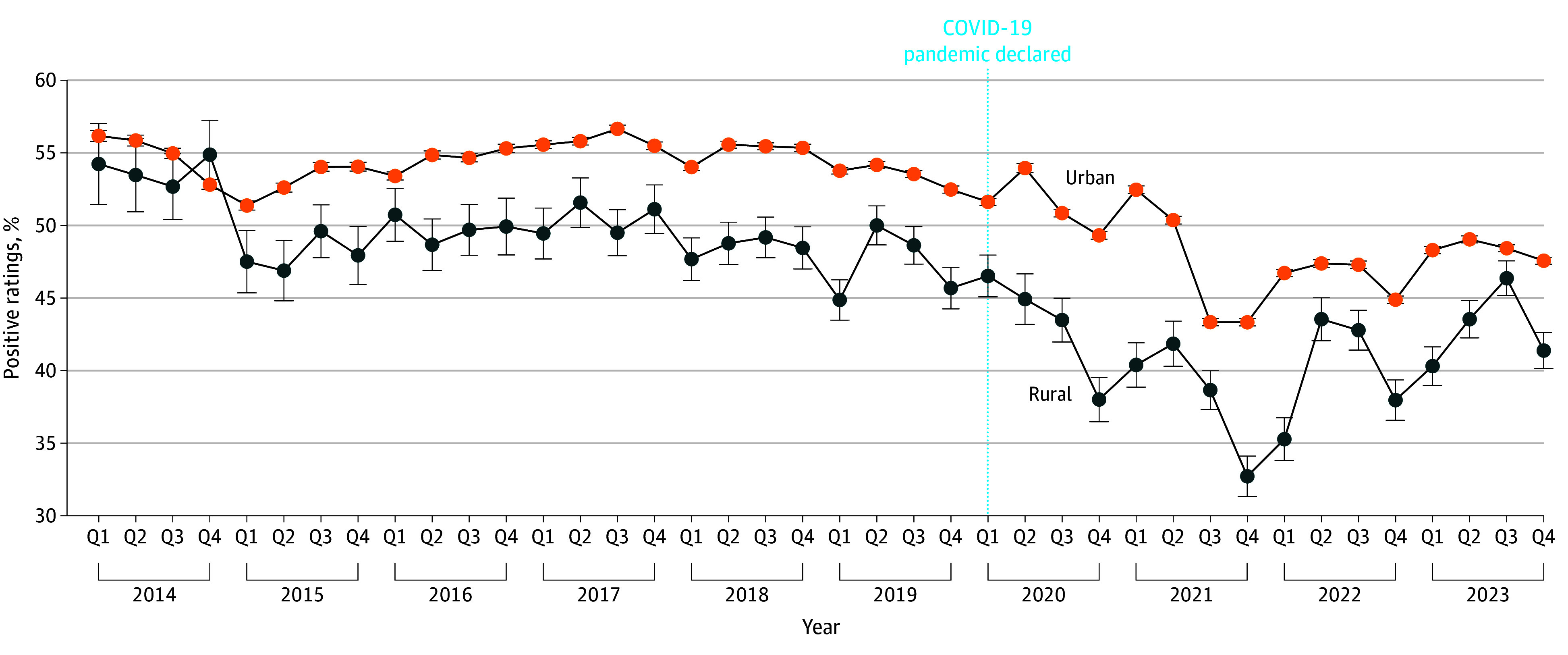
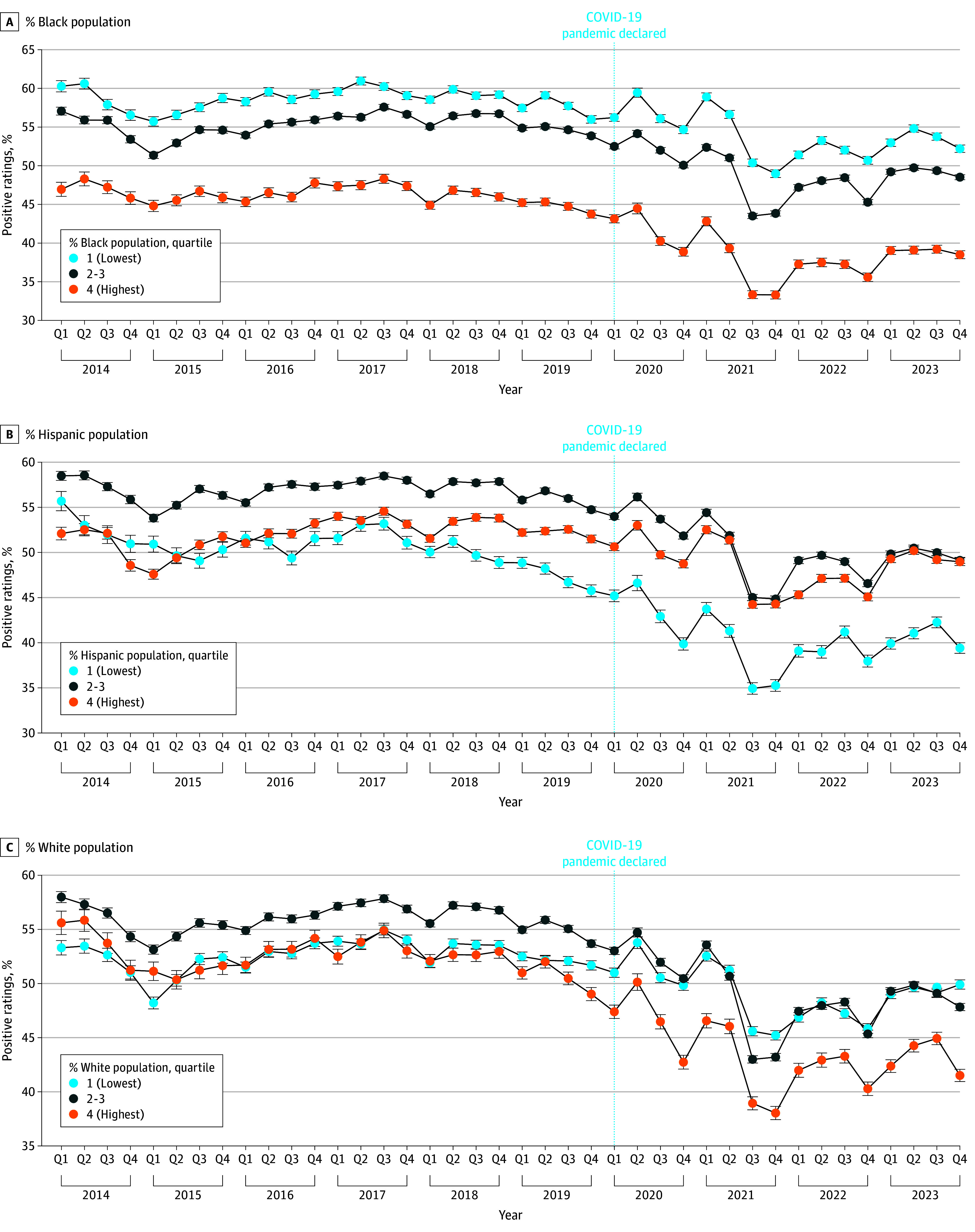
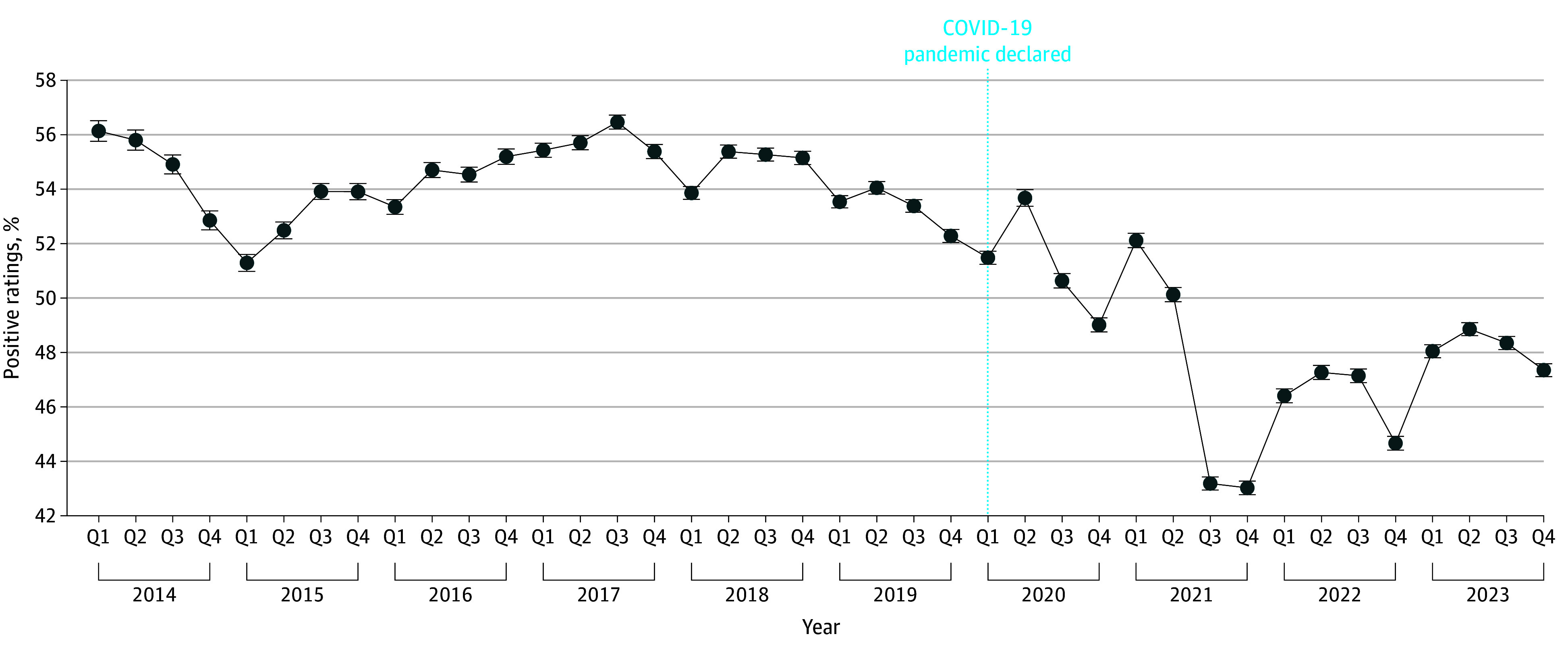
A total of 1 445 706 reviews across 151 307 facilities were included. The percent of positive reviews decreased from 54.3% to 47.9% (P < .001) after March 2020. Rural areas, areas with a higher proportion of Black residents, and areas with a higher proportion of White residents experienced lower positive ratings post-COVID, while reviews in areas with a higher proportion of Hispanic residents were less negatively impacted (P < .001 for all comparisons). For example, logistic regression showed that rural areas had significantly lower odds of positive reviews post-COVID compared with urban areas (odds ratio, 0.77; 95% CI, 0.72-0.83). Latent Dirichlet allocation identified themes such as billing issues, poor customer service, and insurance handling that increased post-COVID among certain communities. For instance, areas with a higher proportion of Black residents and areas with a higher proportion of Hispanic residents reported increases in insurance and billing issues, while areas with a higher proportion of White residents reported increases in wait time among negative reviews.
This serial cross-sectional study observed a significant decrease in positive reviews for health care facilities post-COVID. These findings underscore a disparity in patient experience, particularly in rural areas and areas with the highest proportions of Black and White residents.
在线评论平台提供了有价值的患者满意度和医疗服务质量见解,捕捉了传统指标可能遗漏的内容和趋势。COVID-19 大流行扰乱了医疗服务,影响了患者体验。
检查医疗设施的数值评级和患者体验,根据设施类型和地区人口特征,在 COVID-19 大流行后(即 COVID 后)在在线平台上报告。
设计、地点和参与者:本横断面研究从 2014 年 1 月 1 日至 2023 年 12 月 31 日期间从一个在线平台上获取了美国所有医疗设施的所有评论。分析重点是提供基本健康福利的设施,这些服务类别是《平价医疗法案》下医疗保险计划必须涵盖的。设施邮政编码区域级别人口统计数据是从美国人口普查和农村-城市通勤区代码中获得的。
主要结果是 COVID 前后阳性评价(定义为 5 星中≥4 星的评价)的百分比变化。次要结果包括阳性评分与设施人口统计学特征(种族和民族以及城市性)之间的关联,以及使用潜在狄利克雷分配对评论内容进行主题分析。
共纳入了 151307 家医疗机构的 1445706 条评论。自 2020 年 3 月以来,阳性评价的百分比从 54.3%下降至 47.9%(P<.001)。农村地区、黑人群体比例较高的地区和白人群体比例较高的地区 COVID 后阳性评分较低,而西班牙裔居民比例较高的地区受影响较小(所有比较 P<.001)。例如,逻辑回归显示,农村地区 COVID 后阳性评分的可能性明显低于城市地区(优势比,0.77;95%CI,0.72-0.83)。潜在狄利克雷分配确定了一些主题,例如计费问题、客户服务不佳和保险处理,这些问题在某些社区中 COVID 后有所增加。例如,黑人群体比例较高的地区和西班牙裔居民比例较高的地区报告说保险和计费问题增加,而白人群体比例较高的地区报告说负面评论中的等待时间增加。
本系列横断面研究观察到 COVID 后医疗设施的阳性评价显著下降。这些发现强调了患者体验的差异,尤其是在农村地区和黑人和白人群体比例最高的地区。