Liu Hongzhou, Li Nan, Jin Mengmeng, Miao Xinyu, Zhang Xinjie, Zhong Wenwen
Department of Endocrinology, First Hospital of Handan City, No. 25 Congtai Road, Handan, Hebei Province 056002, China.
Department of Endocrinology, The Second Medical Center & National Clinical Research Center for Geriatric Diseases, Chinese PLA General Hospital, No. 28 Fuxing Road, Beijing 100853, China.
Iran J Basic Med Sci. 2020 Aug;23(8):990-998. doi: 10.22038/ijbms.2020.40859.9650.
Diabetes mellitus has been suggested to be the most common metabolic disorder associated with magnesium deficiency. This study aimed to investigate the effects and mechanisms of magnesium supplementation on insulin receptor activity in elderly type 2 diabetes using a rat model and to provide experimental evidence for insulin resistance improvement by magnesium supplementation.
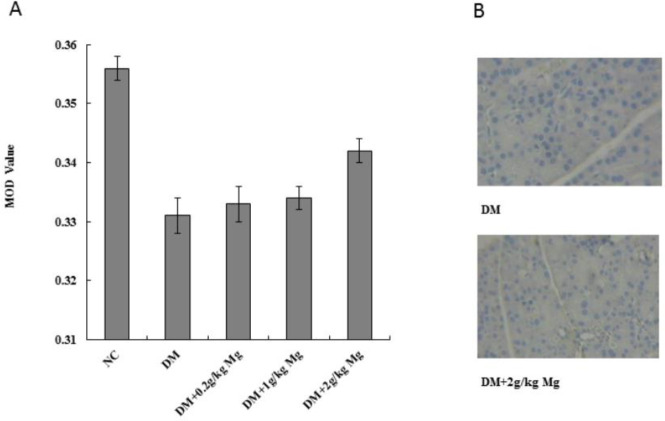
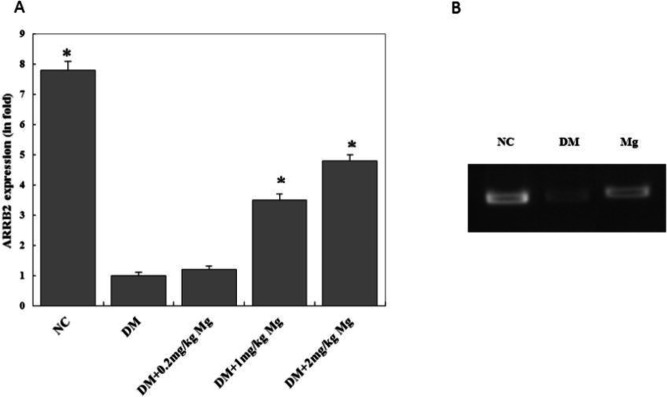
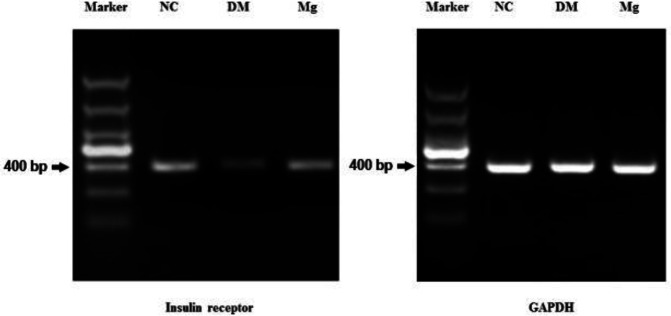
Rat model of type 2 diabetes was developed using a high-fat diet along with low dose streptozotocin (STZ) treatment. Magnesium supplement was given orally by mixing with the high-fat diet. Serum insulin level, insulin sensitivity, and insulin receptor affinity were assessed using radioimmunoassay (RIA). Insulin receptor, insulin receptor substrate (IRS-2), and β-Arrestin-2 gene and protein expression levels were measured using immunohistochemistry and RT-PCR. Xanthine oxidase assay, thiobarbituric acid reactive substance assay (TCA method), colorimetric assay, and ELISA were used to determine the serum SOD, MDA, T-AOC, and ox-LDL levels, respectively.
Magnesium supplementation enhanced insulin sensitivity and decreased insulin resistance in diabetic rats mainly through increasing insulin receptor expression, affinity, and augmenting insulin receptor signaling. Magnesium supplementation also inhibited lipid peroxidation in diabetic rats and protected against pancreatic cell injury in diabetic rats. In addition, we found that β-arrestin-2 gene expression was suppressed in diabetes, which was possibly attributed to gene methylation modification, as β-arrestin 2 promotor was rich in methylation-regulating sites. Magnesium supplementation could affect β-arrestin-2 gene expression and methylation.
Magnesium supplementation has a positive effect on insulin receptor activity and insulin sensitivity in type 2 diabetes.
糖尿病被认为是与镁缺乏相关的最常见代谢紊乱。本研究旨在利用大鼠模型探讨补充镁对老年2型糖尿病胰岛素受体活性的影响及机制,并为补充镁改善胰岛素抵抗提供实验依据。
采用高脂饮食联合低剂量链脲佐菌素(STZ)处理建立2型糖尿病大鼠模型。将镁补充剂与高脂饮食混合口服。采用放射免疫分析法(RIA)评估血清胰岛素水平、胰岛素敏感性和胰岛素受体亲和力。采用免疫组织化学和RT-PCR检测胰岛素受体、胰岛素受体底物(IRS-2)和β-抑制蛋白-2基因及蛋白表达水平。分别采用黄嘌呤氧化酶法、硫代巴比妥酸反应物质法(TCA法)、比色法和ELISA法测定血清超氧化物歧化酶(SOD)、丙二醛(MDA)、总抗氧化能力(T-AOC)和氧化型低密度脂蛋白(ox-LDL)水平。
补充镁主要通过增加胰岛素受体表达、亲和力及增强胰岛素受体信号传导,增强糖尿病大鼠胰岛素敏感性并降低胰岛素抵抗。补充镁还抑制糖尿病大鼠脂质过氧化,保护糖尿病大鼠胰腺细胞免受损伤。此外,我们发现糖尿病时β-抑制蛋白-2基因表达受到抑制,这可能归因于基因甲基化修饰,因为β-抑制蛋白2启动子富含甲基化调控位点。补充镁可影响β-抑制蛋白-2基因表达及甲基化。
补充镁对2型糖尿病胰岛素受体活性和胰岛素敏感性有积极作用。