Lin Hao, Liu Tianfeng, Li Xiao, Gao Xiang, Wu Tingrui, Li Peng
Orthopedic Center, Affiliated Hospital of Guangdong Medical University, Zhanjiang, China.
Stem Cell Research and Cellular Therapy Center, Affiliated Hospital of Guangdong Medical University, Zhanjiang, China.
Ann Transl Med. 2020 Aug;8(16):1009. doi: 10.21037/atm-20-5307.
Osteoporosis (OP) is a prevalent metabolic bone disease characterized by bone loss and structural deterioration, which increases the risk of fracture especially in older people. Recent research has shown that gut microbes play an important role in OP. Trimethylamine N-oxide (TMAO), a gut microbiota-derived metabolite, has been implicated in the pathogenesis of diseases, including Alzheimer's and cerebrovascular disease. This study aimed to examine the effect of TMAO in OP.
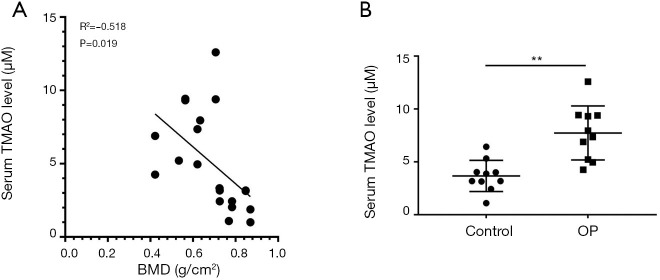
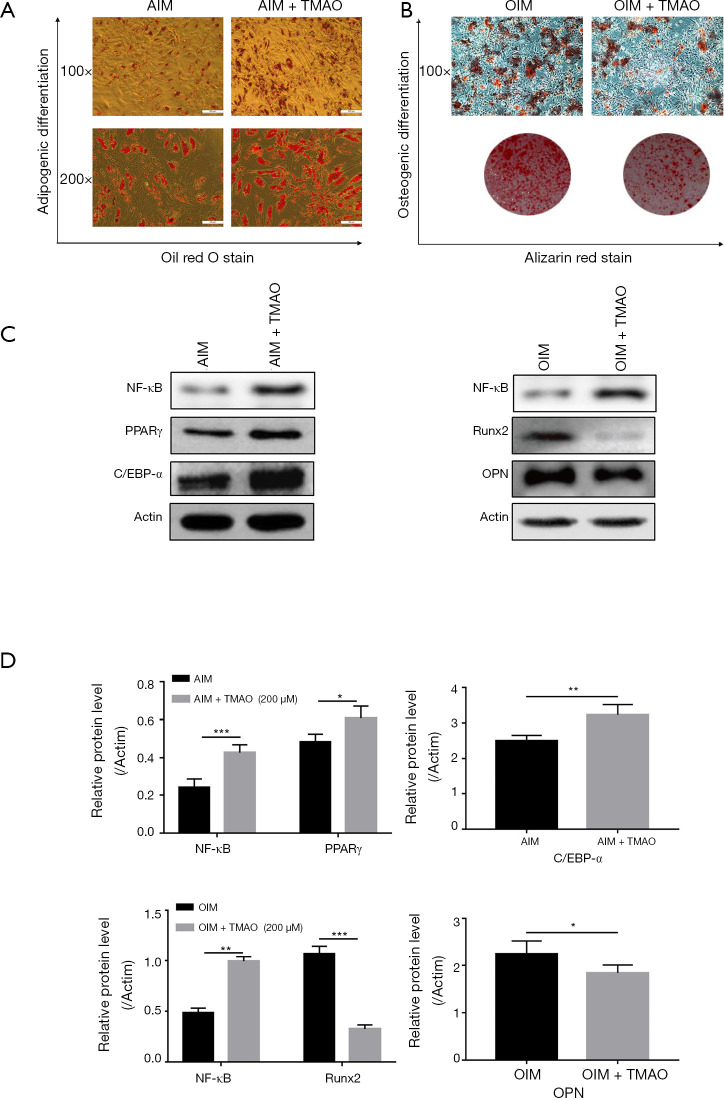
In this study, we firstly investigated the relationship between TMAO and OP. Serum samples were collected from patients with OP (n=10), and healthy participants (n=10), and the TMAO level in the serum was detected by ELISA assay. Then, bone marrow mesenchymal stem cells (BMSCs) were treated with TMAO, and we observed its effect on adipogenic and osteogenic differentiation, cell proliferation, reactive oxygen species (ROS) release, and inflammatory cytokine[interleukin (IL)-1β, IL-6 and tumor necrosis factor-alpha (TNF-α)] levels. Finally, we illustrated the underlying mechanism through which TMAO influenced BMSCs functions.
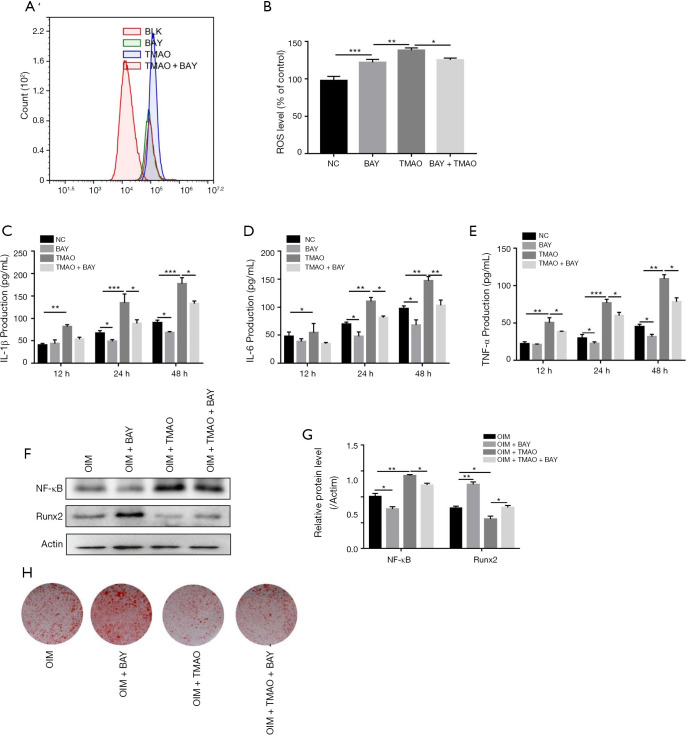
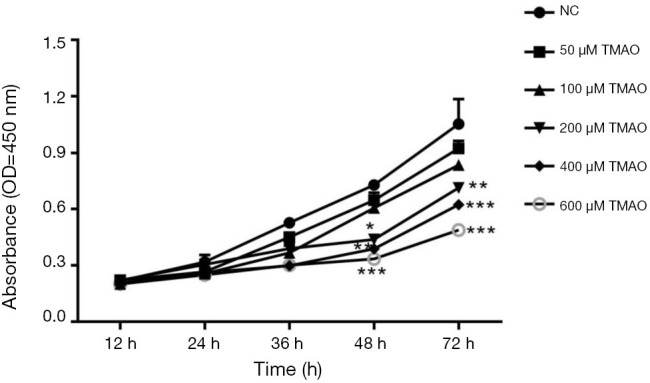
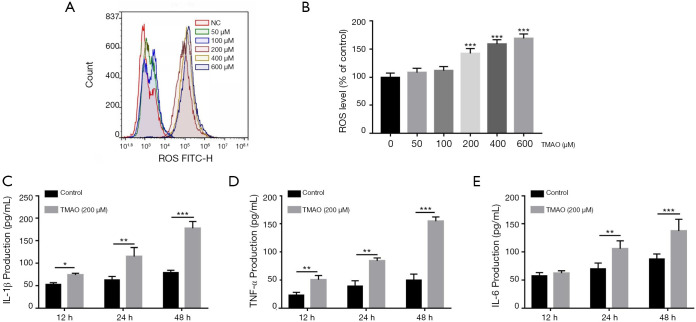
Compared to the healthy group, highly significant TMAO levels were observed in the serum of the OP patients. When studied in vitro, TMAO treatment significantly promoted BMSCs adipogenesis and attenuated osteogenesis, increased ROS release and pro-inflammatory cytokine IL-1β, IL-6 and TNF-α production, and inhibited cell proliferation. Furthermore, we found that activation of the nuclear factor-κB (NF-κB) signaling pathway was necessary for TMAO to induce pro-inflammatory cytokine production, ROS release, and adipogenic and osteogenic differentiation in BMSCs.
Elevated TMAO levels have a strong negative correlation with the degree of bone mineral density (BMD) in OP. TMAO regulates BMSCs cell function by activating the NF-κB signaling pathway, which affects the balance of bone metabolism, leading to acceleration of bone loss and further progression of OP.
骨质疏松症(OP)是一种常见的代谢性骨病,其特征为骨质流失和结构退化,尤其在老年人中会增加骨折风险。最近的研究表明,肠道微生物在OP中起重要作用。氧化三甲胺(TMAO)是一种源自肠道微生物群的代谢产物,与包括阿尔茨海默病和脑血管疾病在内的多种疾病的发病机制有关。本研究旨在探讨TMAO在OP中的作用。
在本研究中,我们首先调查了TMAO与OP之间的关系。收集了OP患者(n = 10)和健康参与者(n = 10)的血清样本,并通过ELISA测定法检测血清中的TMAO水平。然后,用TMAO处理骨髓间充质干细胞(BMSCs),观察其对成脂和成骨分化、细胞增殖、活性氧(ROS)释放以及炎性细胞因子[白细胞介素(IL)-1β、IL-6和肿瘤坏死因子-α(TNF-α)]水平的影响。最后,我们阐明了TMAO影响BMSCs功能的潜在机制。
与健康组相比,OP患者血清中TMAO水平显著升高。体外研究时,TMAO处理显著促进BMSCs成脂,减弱成骨,增加ROS释放以及促炎细胞因子IL-1β、IL-6和TNF-α的产生,并抑制细胞增殖。此外,我们发现核因子-κB(NF-κB)信号通路的激活是TMAO诱导BMSCs产生促炎细胞因子、释放ROS以及进行成脂和成骨分化所必需的。
OP患者中TMAO水平升高与骨矿物质密度(BMD)程度呈强烈负相关。TMAO通过激活NF-κB信号通路调节BMSCs细胞功能,影响骨代谢平衡,导致骨质流失加速以及OP进一步发展。