Du Zhipo, Feng Xinxing, Cao Guangxiu, She Zhending, Tan Rongwei, Aifantis Katerina E, Zhang Ruihong, Li Xiaoming
Department of Orthopedics, The Fourth Central Hospital of Baoding City, Baoding, 072350, China.
Endocrinology and Cardiovascular Disease Centre, Fuwai Hospital, National Center for Cardiovascular Diseases, Chinese Academy of Medical Sciences and Peking Union Medical College, Beijing, 100037, China.
Bioact Mater. 2020 Sep 1;6(2):333-345. doi: 10.1016/j.bioactmat.2020.08.015. eCollection 2021 Feb.
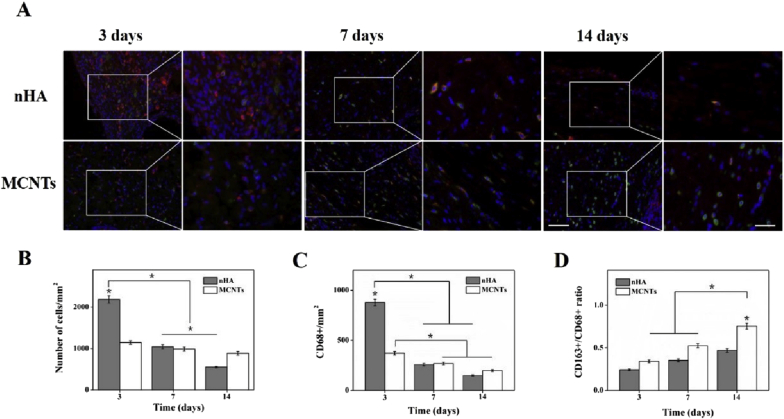
It has been well recognized that the development and use of artificial materials with high osteogenic ability is one of the most promising means to replace bone grafting that has exhibited various negative effects. The biomimetic features and unique physiochemical properties of nanomaterials play important roles in stimulating cellular functions and guiding tissue regeneration. But efficacy degree of some nanomaterials to promote specific tissue formation is still not clear. We hereby comparatively studied the osteogenic ability of our treated multi-walled carbon nanotubes (MCNTs) and the main inorganic mineral component of natural bone, nano-hydroxyapatite (nHA) in the same system, and tried to tell the related mechanism. culture of human adipose-derived mesenchymal stem cells (HASCs) on the MCNTs and nHA demonstrated that although there was no significant difference in the cell adhesion amount between on the MCNTs and nHA, the cell attachment strength and proliferation on the MCNTs were better. Most importantly, the MCNTs could induce osteogenic differentiation of the HASCs better than the nHA, the possible mechanism of which was found to be that the MCNTs could activate Notch involved signaling pathways by concentrating more proteins, including specific bone-inducing ones. Moreover, the MCNTs could induce ectopic bone formation while the nHA could not, which might be because MCNTs could stimulate inducible cells in tissues to form inductive bone better than nHA by concentrating more proteins including specific bone-inducing ones secreted from M2 macrophages. Therefore, MCNTs might be more effective materials for accelerating bone formation even than nHA.
人们已经充分认识到,开发和使用具有高成骨能力的人工材料是替代已呈现出各种负面影响的骨移植的最有前景的手段之一。纳米材料的仿生特性和独特的物理化学性质在刺激细胞功能和引导组织再生方面发挥着重要作用。但是一些纳米材料促进特定组织形成的功效程度仍不明确。在此,我们在同一体系中比较研究了我们处理过的多壁碳纳米管(MCNTs)和天然骨的主要无机矿物质成分纳米羟基磷灰石(nHA)的成骨能力,并试图阐明相关机制。在MCNTs和nHA上培养人脂肪来源间充质干细胞(HASCs)表明,虽然在MCNTs和nHA上的细胞黏附量没有显著差异,但MCNTs上的细胞附着强度和增殖情况更好。最重要的是,MCNTs比nHA能更好地诱导HASCs的成骨分化,其可能的机制是MCNTs可以通过聚集更多的蛋白质(包括特定的骨诱导蛋白)来激活Notch相关信号通路。此外,MCNTs可以诱导异位骨形成,而nHA则不能,这可能是因为MCNTs比nHA能更好地通过聚集更多包括M2巨噬细胞分泌的特定骨诱导蛋白在内的蛋白质来刺激组织中的诱导细胞形成诱导性骨。因此,MCNTs可能是比nHA更有效的加速骨形成的材料。