
模拟长效抗逆转录病毒疗法对肯尼亚青少年和青年的健康影响及成本阈值。
Modeling the health impact and cost threshold of long-acting ART for adolescents and young adults in Kenya.
作者信息
Culhane Jessica, Sharma Monisha, Wilson Kate, Roberts D Allen, Mugo Cyrus, Wamalwa Dalton, Inwani Irene, Barnabas Ruanne V, Kohler Pamela K
机构信息
Department of Epidemiology,University of Washington, 1959 NE Pacific Street, Health Sciences Bldg, Box 357236, Seattle, WA, United States.
University of Nairobi, Nairobi, Kenya.
出版信息
EClinicalMedicine. 2020 Jul 16;25:100453. doi: 10.1016/j.eclinm.2020.100453. eCollection 2020 Aug.
BACKGROUND
Despite high efficacy of oral antiretroviral therapy (ART), viral suppression among adolescents and young adults (AYA) living with HIV in sub-Saharan Africa (SSA) remains low. Compared to daily oral ART, bimonthly long-acting injectable ART (LA-ART) may simplify adherence, improve clinical outcomes, and decrease HIV transmission in this priority population. However, LA-ART will likely cost more than oral ART and the cost threshold at which LA-ART will be cost effective in SSA has not been evaluated.
METHODS
We adapted a mathematical model of HIV transmission and progression in Kenya to include HIV acquisition and viral suppression among AYA (age 10-24). We projected the population-level health and economic impact of providing LA-ART to AYA over a 10-year time horizon assuming oral ART costs of US$233 annually and a two-month duration of viral suppression per LA-ART injection. We calculated the maximum cost at which switching from oral to LA-ART would be considered cost-effective, using thresholds of $500 and $1,508 per disability-adjusted life year averted (WHO's threshold of HIV treatment interventions and Kenya's gross domestic product per capita).
FINDINGS
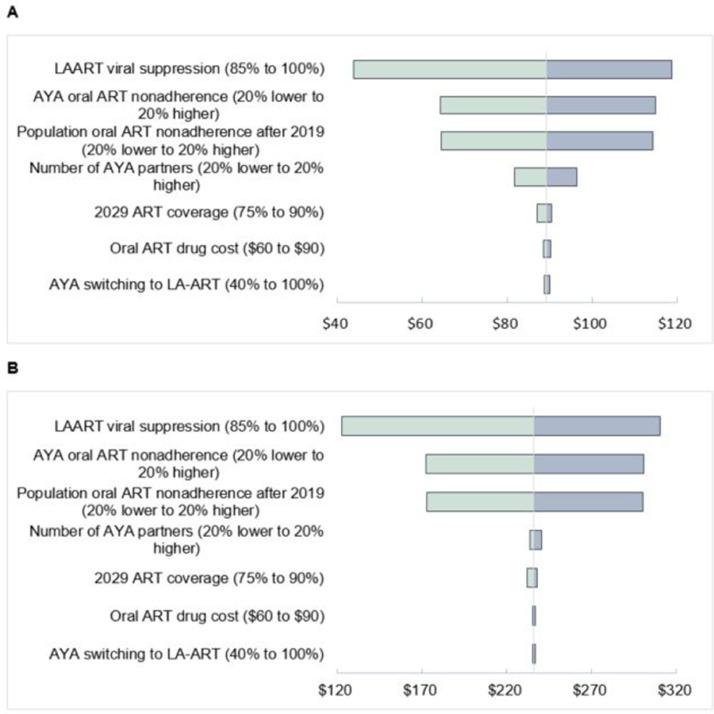
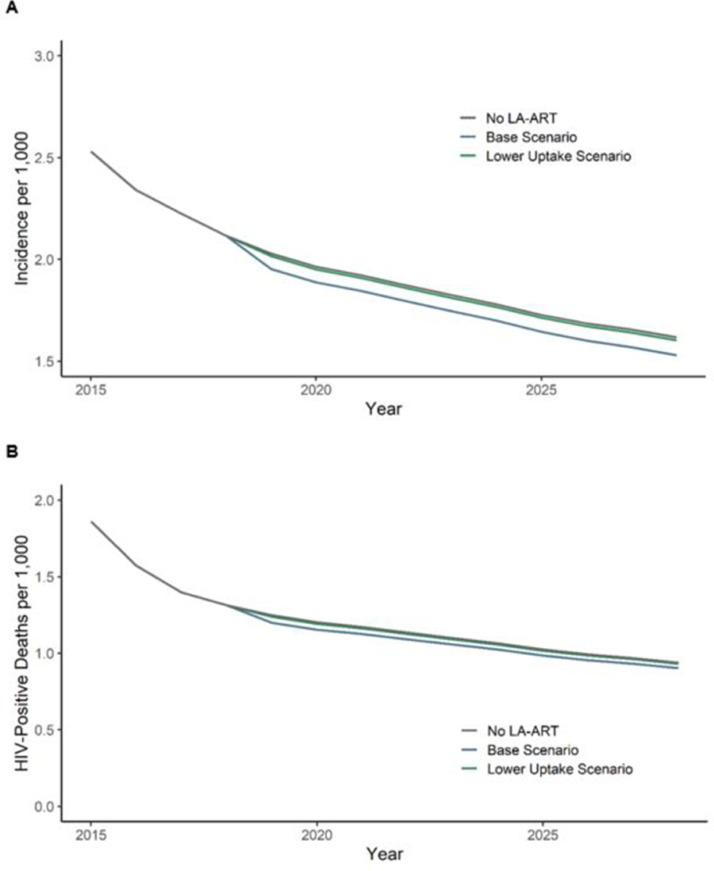
Assuming 85% of AYA switch from oral to injectable formulations, LA-ART is estimated to prevent 40,540 infections and 20,480 deaths over 10 years. The maximum increase in the annual per-person cost of receiving LA-ART is estimated to be $89 and $236 for LA-ART to be cost-effective under the thresholds of $500 and $1,508 per DALY averted, respectively. The cost threshold was lower when non-adherent oral ART AYA users were assumed to be less likely to switch to LA-ART.
INTERPRETATION
Providing LA-ART to AYA can be cost-effective in Kenya if it is less than twice the cost of oral ART. Long-acting injectable ART for priority populations with low viral suppression has the potential to cost-effectively avert disability and death.
FUNDING
National Institutes of Health (R01 HD085807; PI: Kohler).
背景
尽管口服抗逆转录病毒疗法(ART)疗效显著,但撒哈拉以南非洲(SSA)地区感染艾滋病毒的青少年和青年(AYA)的病毒抑制率仍然很低。与每日口服ART相比,每两个月一次的长效注射用ART(LA-ART)可能会简化依从性,改善临床结果,并减少这一重点人群中的艾滋病毒传播。然而,LA-ART的成本可能会高于口服ART,且尚未评估LA-ART在SSA具有成本效益的成本阈值。
方法
我们对肯尼亚艾滋病毒传播和进展的数学模型进行了调整,以纳入AYA(10至24岁)中的艾滋病毒感染和病毒抑制情况。我们假设口服ART的年成本为233美元,且每次LA-ART注射可实现两个月的病毒抑制,在此基础上预测了在10年时间内为AYA提供LA-ART对人群健康和经济的影响。我们使用每避免一个残疾调整生命年500美元和1508美元的阈值(世卫组织艾滋病毒治疗干预措施的阈值和肯尼亚人均国内生产总值),计算了从口服ART转换为LA-ART被认为具有成本效益的最高成本。
研究结果
假设85%的AYA从口服制剂转换为注射制剂,预计LA-ART在10年内可预防40540例感染和20480例死亡。在每避免一个残疾调整生命年分别为500美元和1508美元的阈值下,接受LA-ART的人均年成本的最大增幅估计分别为89美元和236美元时,LA-ART才具有成本效益。当假设不依从口服ART的AYA使用者转换为LA-ART的可能性较小时,成本阈值较低。
解读
如果LA-ART的成本低于口服ART成本的两倍,那么在肯尼亚为AYA提供LA-ART可能具有成本效益。为病毒抑制率低的重点人群提供长效注射用ART有潜力以具有成本效益的方式避免残疾和死亡。
资助
美国国立卫生研究院(R01 HD085807;项目负责人:科勒)

 Zotero 插件