Laboratory of Exercise Physiology, Department of Movement, Human and Health Sciences, University of Rome "Foro Italico", Piazza Lauro De Bosis 6, 00135 Roma, Italy.
Laboratory of Biochemistry of Movement, Department of Movement, Human and Health Sciences, University of Rome "Foro Italico", Piazza Lauro De Bosis 6, 00135 Roma, Italy.
Nutrients. 2020 Sep 17;12(9):2850. doi: 10.3390/nu12092850.
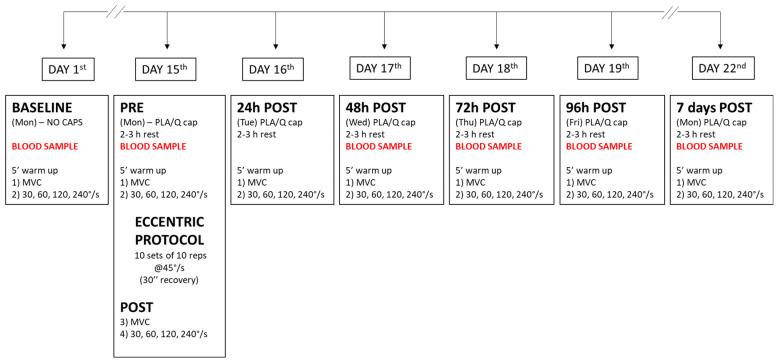
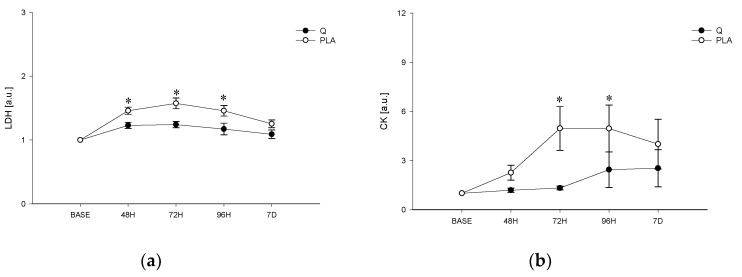
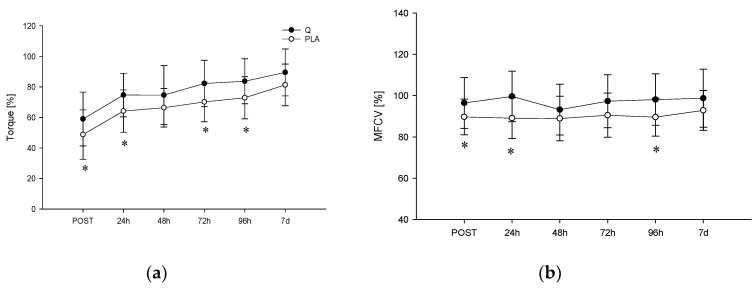
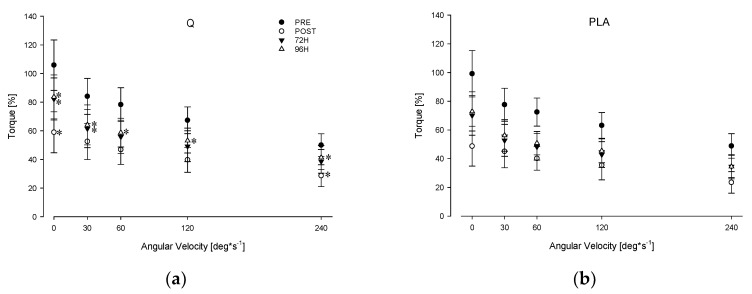
This study was aimed at investigating whether quercetin (Q) may improve the recovery of neuromuscular function and biochemical parameters in the 7 days following an eccentric exercise-induced muscle damage (EEIMD). Sixteen men (25.9 ± 3.3 y) ingested Q (1000 mg/day) or placebo (PLA) for 14 days following a double-blind crossover study design. A neuromuscular (NM) test was performed pre-post, 24 h, 48 h, 72 h, 96 h and 7 days after an intense eccentric exercise. The force-velocity relationship of the elbow flexor muscles and their maximal voluntary isometric contraction (MVIC) were recorded simultaneously to the electromyographic signals (EMG). Pain, joint angle, arm circumference, plasma creatine kinase (CK) and lactate-dehydrogenase (LDH) were also assessed. The results showed that Q supplementation significantly attenuated the strength loss compared to PLA. During the recovery, force-velocity relationship and mean fibers conduction velocity (MFCV) persisted significantly less when participants consumed PLA rather than Q, especially at the highest angular velocities ( < 0.02). A greater increase in biomarkers of damage was also evident in PLA with respect to Q. Q supplementation for 14 days seems able to ameliorate the recovery of eccentric exercise-induced weakness, neuromuscular function impairment and biochemical parameters increase probably due to its strong anti-inflammatory and antioxidant action.
本研究旨在探讨槲皮素(Q)是否可以改善离心运动引起的肌肉损伤(EEIMD)后 7 天内的神经肌肉功能和生化参数的恢复。16 名男性(25.9 ± 3.3 岁)采用双盲交叉设计,在进行一次剧烈的离心运动后,连续 14 天每天摄入 Q(1000mg/天)或安慰剂(PLA)。在进行一次强烈的离心运动之前、之后 24 小时、48 小时、72 小时、96 小时和 7 天进行神经肌肉(NM)测试。肘屈肌的力-速度关系及其最大自主等长收缩(MVIC)同时记录肌电图(EMG)信号。还评估了疼痛、关节角度、臂围、血浆肌酸激酶(CK)和乳酸脱氢酶(LDH)。结果表明,与 PLA 相比,Q 补充剂可显著减轻力量损失。在恢复期间,当参与者服用 PLA 而不是 Q 时,力-速度关系和平均纤维传导速度(MFCV)的恢复明显较差,尤其是在最高角速度(<0.02)时。与 Q 相比,PLA 中损伤生物标志物的增加也更为明显。14 天的 Q 补充似乎能够改善离心运动引起的无力、神经肌肉功能障碍和生化参数增加的恢复,这可能是由于其强大的抗炎和抗氧化作用。