Department of Statistical Science, University College London, London, UK.
Delta Hat Limited, Nottingham, UK.
Clin Trials. 2020 Dec;17(6):607-616. doi: 10.1177/1740774520944855. Epub 2020 Sep 21.
While placebo-controlled randomised controlled trials remain the standard way to evaluate drugs for efficacy, historical data are used extensively across the development cycle. This ranges from supplementing contemporary data to increase the power of trials to cross-trial comparisons in estimating comparative efficacy. In many cases, these approaches are performed without in-depth review of the context of data, which may lead to bias and incorrect conclusions.
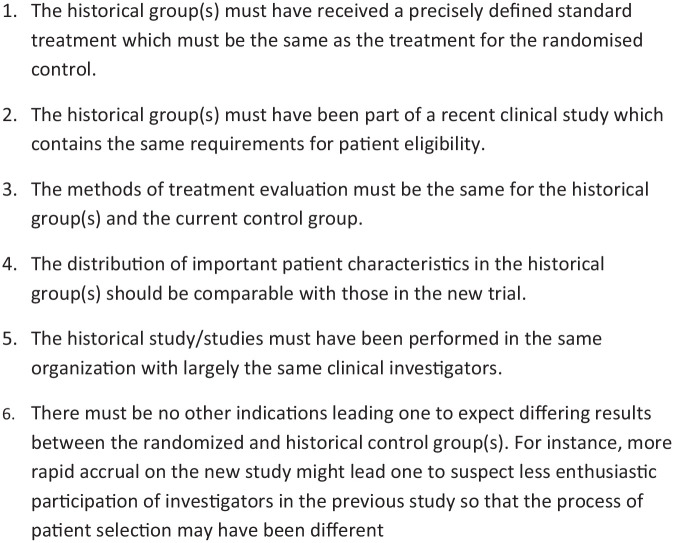
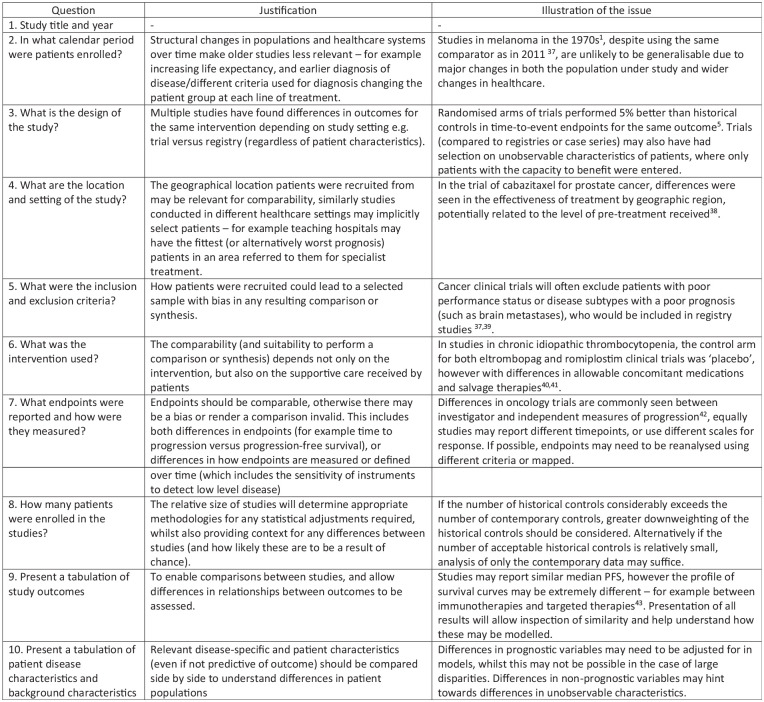
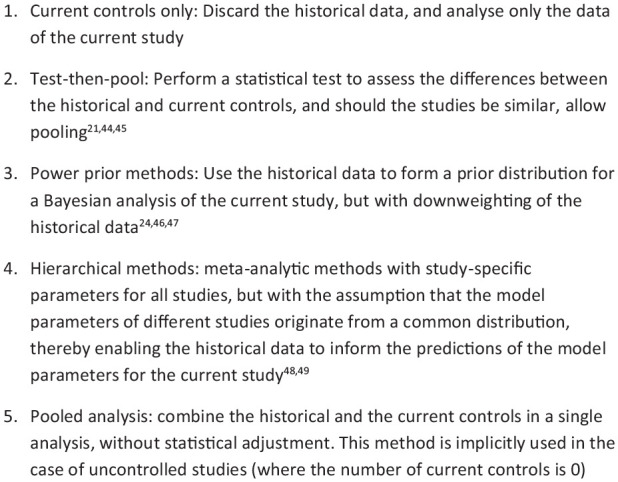
We discuss the original 'Pocock' criteria for the use of historical data and how the use of historical data has evolved over time. Based on these factors and personal experience, we created a series of questions that may be asked of historical data, prior to their use. Based on the answers to these questions, various statistical approaches are recommended. The strategy is illustrated with a case study in colorectal cancer.
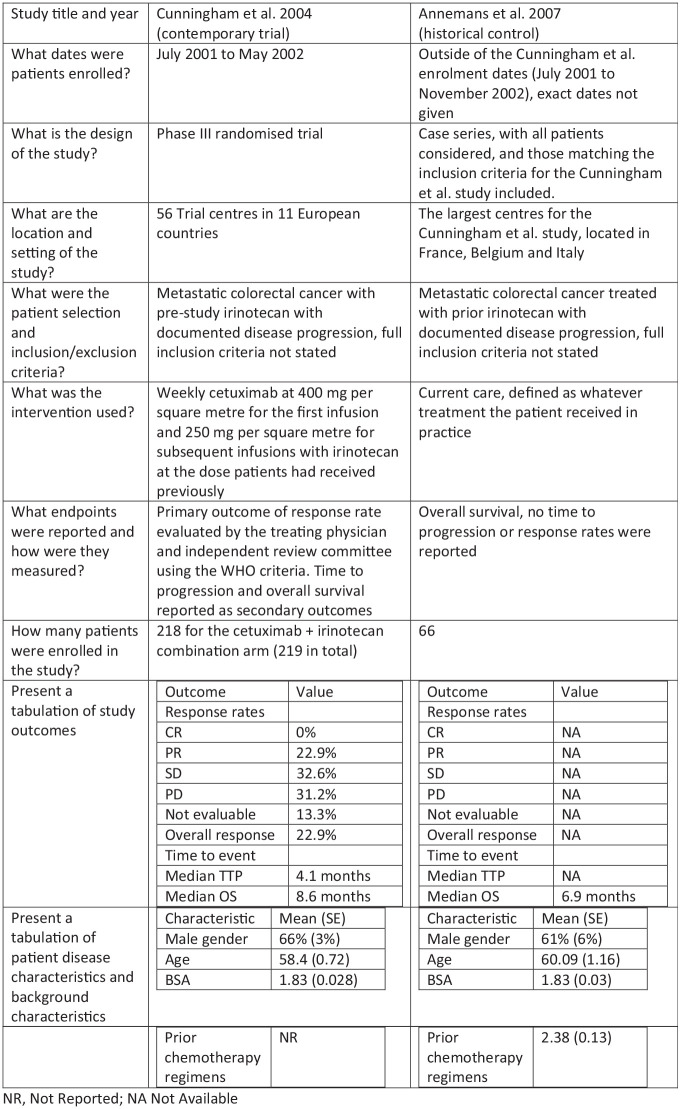
A number of areas need to be considered with historical data, which we split into three categories: outcome measurement, study/patient characteristics (including setting and inclusion/exclusion criteria), and disease process/intervention effects. Each of these areas may introduce issues if not appropriately handled, while some may preclude the use of historical data entirely. We present a tool (in the form of a table) for highlighting any such issues. Application of the tool to a colorectal cancer data set demonstrates under what conditions historical data could be used and what the limitations of such an analysis would be.
Historical data can be a powerful tool to augment or compare with contemporary trial data, though caution is required. We present some of the issues that may be considered when involving historical data and what (if any) statistical approaches may account for differences between studies. We recommend that, where historical data are to be used in analyses, potential differences between studies are addressed explicitly.
虽然安慰剂对照随机对照试验仍然是评估药物疗效的标准方法,但在整个开发周期中广泛使用历史数据。这从补充当代数据以提高试验的效力到跨试验比较以估计比较疗效不等。在许多情况下,这些方法都没有深入审查数据的背景,这可能导致偏差和错误的结论。
我们讨论了原始的“Pocock”标准,用于使用历史数据,以及随着时间的推移,历史数据的使用方式是如何演变的。基于这些因素和个人经验,我们提出了一系列在使用历史数据之前可能会提出的问题。根据这些问题的答案,推荐了各种统计方法。该策略通过结直肠癌的案例研究进行说明。
需要考虑历史数据的许多方面,我们将其分为三类:结果测量、研究/患者特征(包括设置和纳入/排除标准)和疾病过程/干预效果。如果处理不当,每个领域都可能会引入问题,而有些则可能完全排除使用历史数据。我们提出了一种工具(以表格形式),用于突出显示任何此类问题。将该工具应用于结直肠癌数据集,演示了在什么条件下可以使用历史数据,以及这种分析的局限性是什么。
历史数据可以是增强或与当代试验数据进行比较的有力工具,但需要谨慎使用。我们提出了在涉及历史数据时可能需要考虑的一些问题,以及哪些(如果有)统计方法可以解释研究之间的差异。我们建议,在分析中使用历史数据的情况下,应明确解决研究之间的潜在差异。