Grupo Interdisciplinar de Sistemas Complejos, Departamento de Matemáticas, Universidad Carlos III de Madrid, 28911, Leganés, Madrid, Spain.
Unidad Mixta Interdisciplinar de Comportamiento y Complejidad Social (UMICCS), Madrid, Spain.
Sci Rep. 2020 Sep 21;10(1):15359. doi: 10.1038/s41598-020-71664-w.
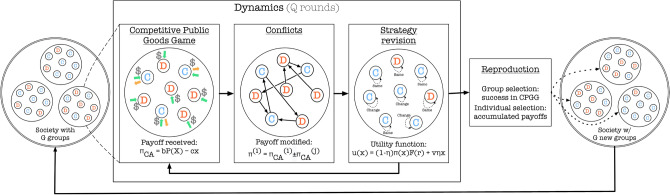
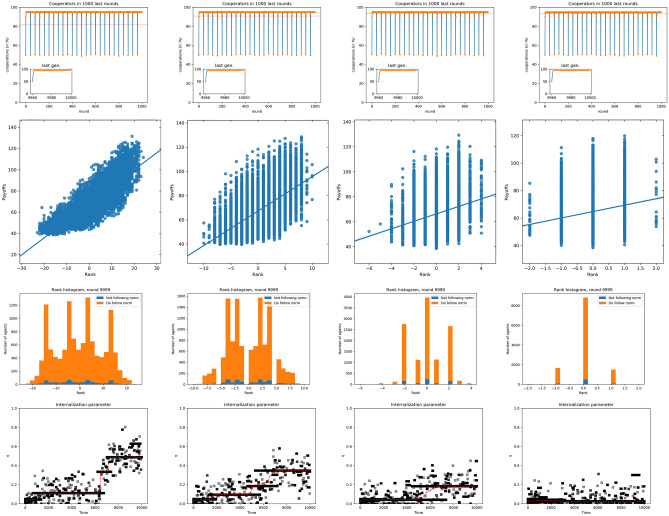
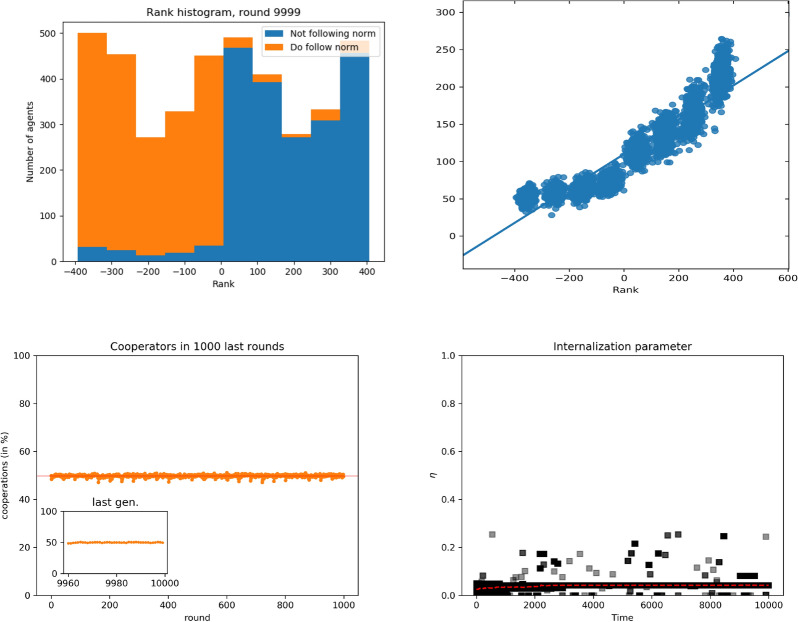
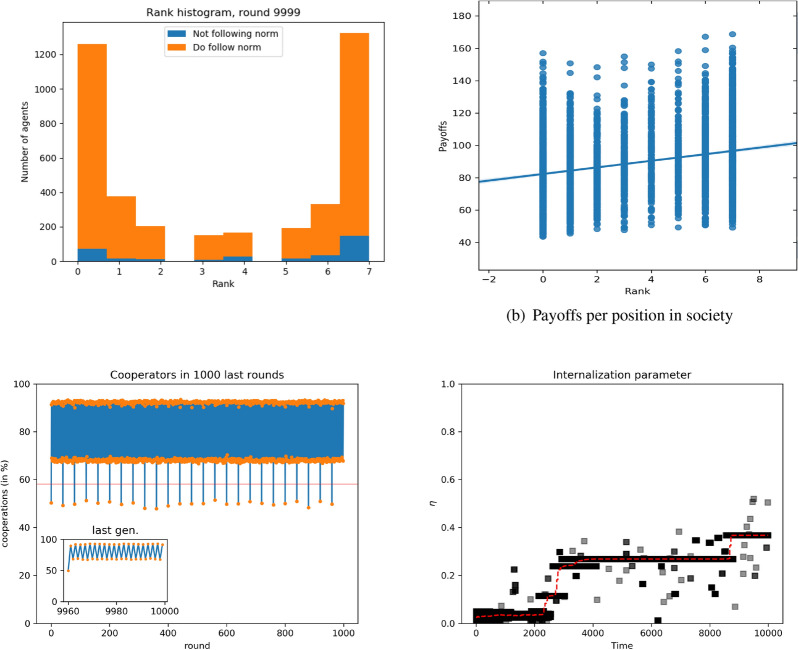
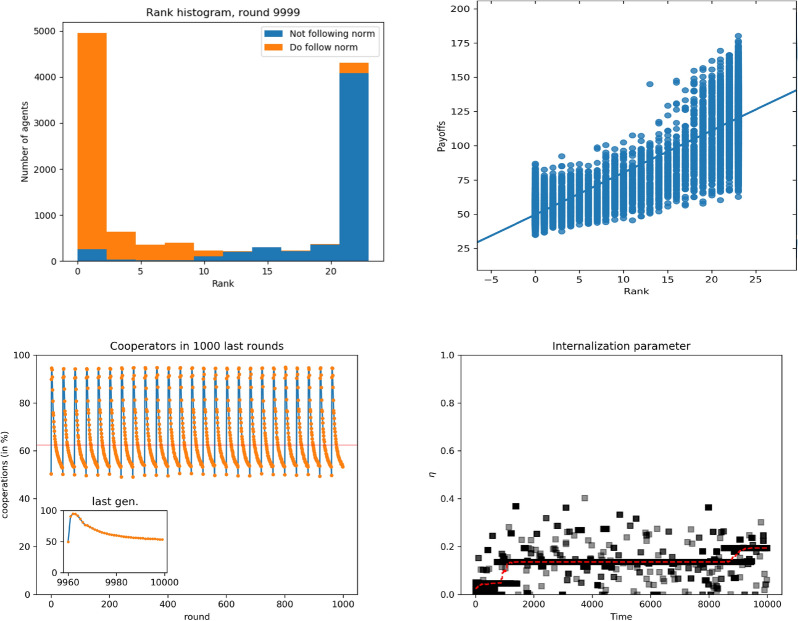
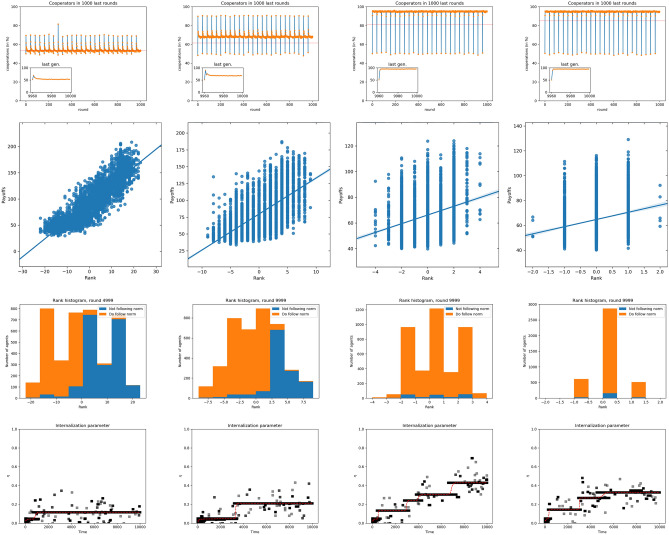
Many animal and human societies exhibit hierarchical structures with different degrees of steepness. Some of these societies also show cooperative behavior, where cooperation means working together for a common benefit. However, there is an increasing evidence that rigidly enforced hierarchies lead to a decrease of cooperation in both human and non-human primates. In this work, we address this issue by means of an evolutionary agent-based model that incorporates fights as social interactions governing a dynamic ranking, communal work to produce a public good, and norm internalization, i.e. a process where acting according to a norm becomes a goal in itself. Our model also includes the perception of how much the individual is going to retain from her cooperative behavior in future interactions. The predictions of the model resemble the principal characteristics of human societies. When ranking is unconstrained, we observe a high concentration of agents in low scores, while a few ones climb up the social hierarchy and exploit the rest, with no norm internalization. If ranking is constrained, thus leading to bounded score differences between agents, individual positions in the ranking change more, and the typical structure shows a division of the society in upper and lower classes. In this case, we observe that there is a significant degree of norm internalization, supporting large fractions of the population cooperating in spite of the rank differences. Our main results are robust with respect to the model parameters and to the type of rank constraint. We thus provide a mechanism that can explain how hierarchy arises in initially egalitarian societies while keeping a large degree of cooperation.
许多动物和人类社会都表现出具有不同陡峭程度的层级结构。其中一些社会也表现出合作行为,即共同为共同利益而合作。然而,越来越多的证据表明,严格执行的层级制度会导致人类和非人类灵长类动物的合作减少。在这项工作中,我们通过一个进化的基于代理的模型来解决这个问题,该模型将战斗作为管理动态排名的社会互动,将共同工作以产生公共利益,以及规范内化(即根据规范行事本身成为目标的过程)纳入其中。我们的模型还包括对个体在未来互动中从合作行为中保留多少的感知。该模型的预测与人类社会的主要特征相似。当排名不受限制时,我们观察到大量的代理处于低分数,而少数代理爬上社会阶层并剥削其余的代理,没有规范内化。如果排名受到限制,从而导致代理之间的分数差异有限,那么排名中的个体位置变化更大,典型结构显示社会分为上层阶级和下层阶级。在这种情况下,我们观察到规范内化程度很高,尽管存在等级差异,但很大一部分人口仍然合作。我们的主要结果对模型参数和等级限制的类型具有鲁棒性。因此,我们提供了一种机制,可以解释在最初平等的社会中等级制度是如何产生的,同时保持高度的合作。