Lozano Pablo, Antonioni Alberto, Sánchez Angel
Grupo Interdisciplinar de Sistemas Complejos (GISC), Departamento de Matemáticas, Universidad Carlos III de Madrid, 28911 Leganés, Madrid, Spain.
Department of Networks and Data Science, Central European University, Quellenstraße 51, A-1100 Vienna, Austria.
PNAS Nexus. 2022 Dec 7;2(1):pgac283. doi: 10.1093/pnasnexus/pgac283. eCollection 2023 Jan.
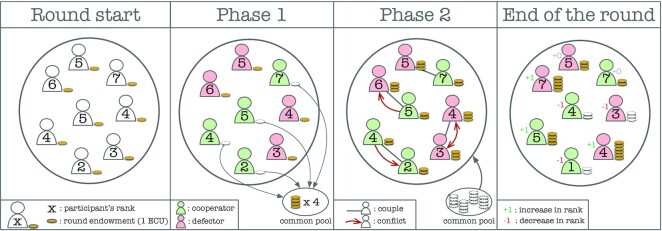
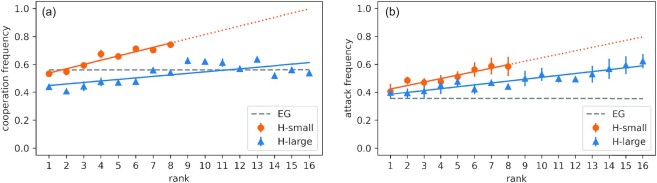
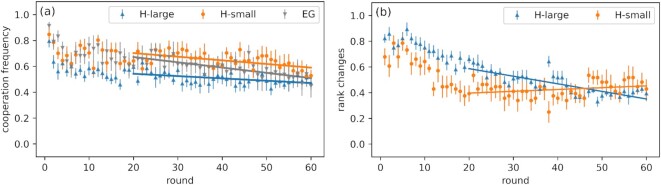
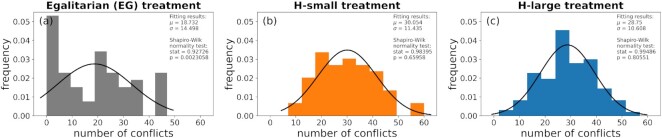
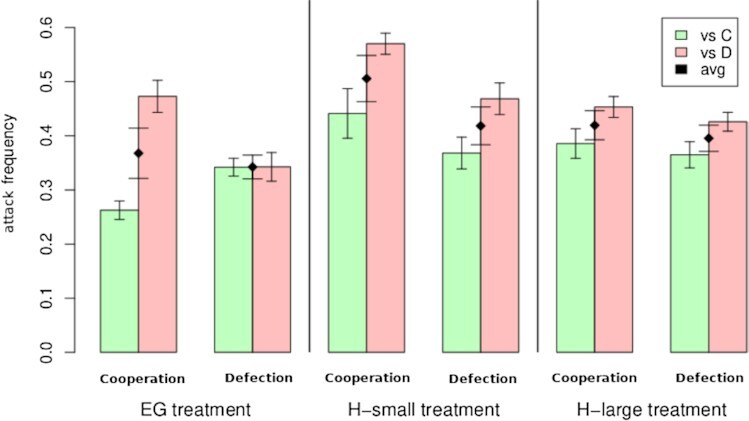
Previous research suggests that it is difficult to maintain cooperation in a large society when there is a strong hierarchical structure. In this study, we implement online human experiments to study the effects of exogenous variation in a particular notion of hierarchy on cooperation and conflict within groups. We demonstrate how cooperation can be maintained when collective action is accompanied by dyadic conflicts whose outcome feeds back on the hierarchical rank of the contestants. We find that the majority of individuals take part in conflicts and that highly ranked individuals mostly cooperate and engage in conflicts as a way to punish noncooperators. As a consequence, stable hierarchical groups can arise and maintain high levels of cooperation. Our results are in agreement with the prediction of earlier theoretical models on hierarchical societies and are relevant to understanding the interplay of hierarchy, cooperation, and conflict.
先前的研究表明,当存在强大的等级结构时,在一个大型社会中维持合作是困难的。在本研究中,我们进行在线人类实验,以研究等级制度这一特定概念的外生变化对群体内合作与冲突的影响。我们证明了,当集体行动伴随着二元冲突,且冲突结果反馈到参与者的等级地位时,合作是如何得以维持的。我们发现,大多数个体参与冲突,并且高等级个体大多会合作,并将参与冲突作为惩罚不合作者的一种方式。因此,稳定的等级群体能够出现并维持高水平的合作。我们的结果与早期关于等级社会的理论模型的预测一致,并且对于理解等级制度、合作与冲突之间的相互作用具有重要意义。