University West, Trollhättan, Sweden.
School of Health and Welfare, Jönköping University, Jönköping, Sweden.
Res Child Adolesc Psychopathol. 2021 Feb;49(2):141-154. doi: 10.1007/s10802-020-00705-9. Epub 2020 Sep 22.
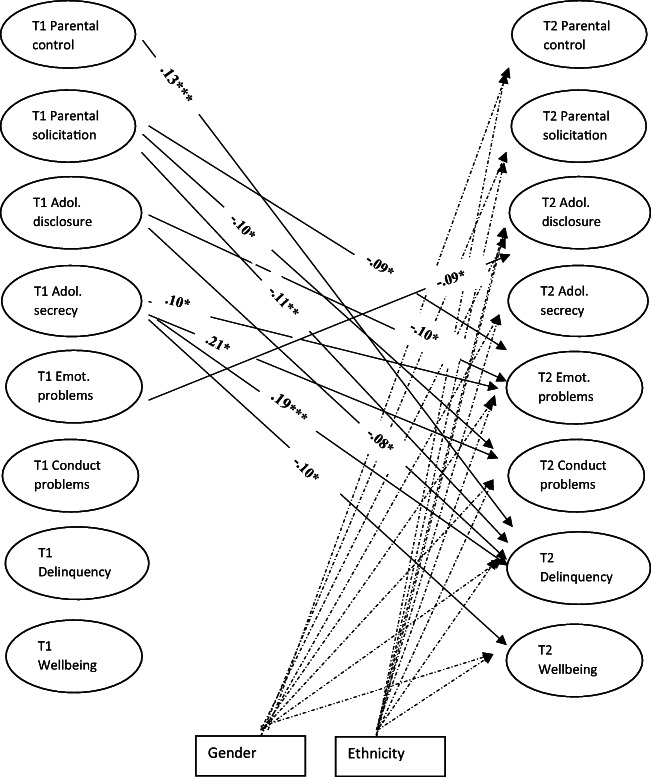
The current study was designed to extend the parenting literature by testing the moderating role of the family's emotional climate, operationalized with parent-adolescent emotional closeness and adolescent feelings of being overly controlled by parents on the longitudinal associations between parent-driven communication efforts (i.e. parental behavioral control and solicitation of information from their adolescent), adolescent-driven communication efforts (i.e. adolescent disclosure and secrecy) and adolescent psychosocial functioning (i.e. emotional problems, conduct problems, delinquency, and wellbeing). We conducted a series of cross-lagged models controlling for adolescent gender and ethnicity using a two-wave Swedish longitudinal set of self-report data (N = 1515, 51% girls, M age = 13.0 and 14.3 years at T1 and T2, respectively). Multi-group analyses revealed that the negative links between T1 parental control and T2 adolescent delinquency, T1 parental solicitation and T2 adolescent conduct problems and delinquency, and T1 emotional problems and T2 adolescent disclosure were moderated by the family's emotional climate. When the family's emotional climate was positive, the parenting strategies had a more positive effect on adolescent psychosocial functioning, and adolescents with emotional problems communicated more openly with their parents. These findings suggest that the relational context in the family is an important protective factor and add specificity to the previously established role of parent-adolescent communication in adolescent psychosocial development. In terms of preventive interventions, strategies to enhance the family's emotional climate should be considered prior to teaching specific parenting strategies.
本研究旨在扩展父母教养文献,通过检验家庭情绪氛围(由父母与青少年的情感亲密程度和青少年感到被父母过度控制来操作化)对亲子沟通努力(即父母的行为控制和从青少年那里获取信息)、青少年驱动的沟通努力(即青少年的披露和保密)与青少年心理社会功能(即情绪问题、行为问题、犯罪和幸福感)之间纵向关联的调节作用来实现这一目标。我们使用来自瑞典的两波自我报告数据(N=1515,51%为女孩,T1 和 T2 的平均年龄分别为 13.0 岁和 14.3 岁),控制了青少年性别和种族,进行了一系列交叉滞后模型分析。多组分析表明,T1 父母控制与 T2 青少年犯罪、T1 父母询问与 T2 青少年行为问题和犯罪以及 T1 情绪问题与 T2 青少年披露之间的负向联系受到家庭情绪氛围的调节。当家庭情绪氛围积极时,教养策略对青少年心理社会功能的影响更为积极,情绪问题青少年与父母的沟通更为开放。这些发现表明,家庭中的关系背景是一个重要的保护因素,并为先前确立的父母-青少年沟通在青少年心理社会发展中的作用增加了特异性。在预防干预方面,在教授特定的父母教养策略之前,应考虑增强家庭情绪氛围的策略。