Division of Systems Biomedicine and Pharmacology, Leiden Academic Centre for Drug Research, Leiden University, 2311 G Leiden, The Netherlands.
School of Pharmaceutical Sciences, University of Geneva, Rue Michel Servet 1, 1211 4 Geneva, Switzerland.
Anal Chem. 2020 Oct 20;92(20):14103-14112. doi: 10.1021/acs.analchem.0c03129. Epub 2020 Oct 1.
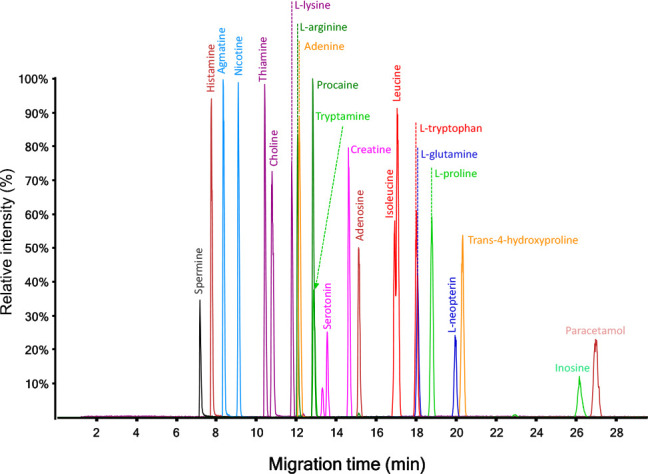
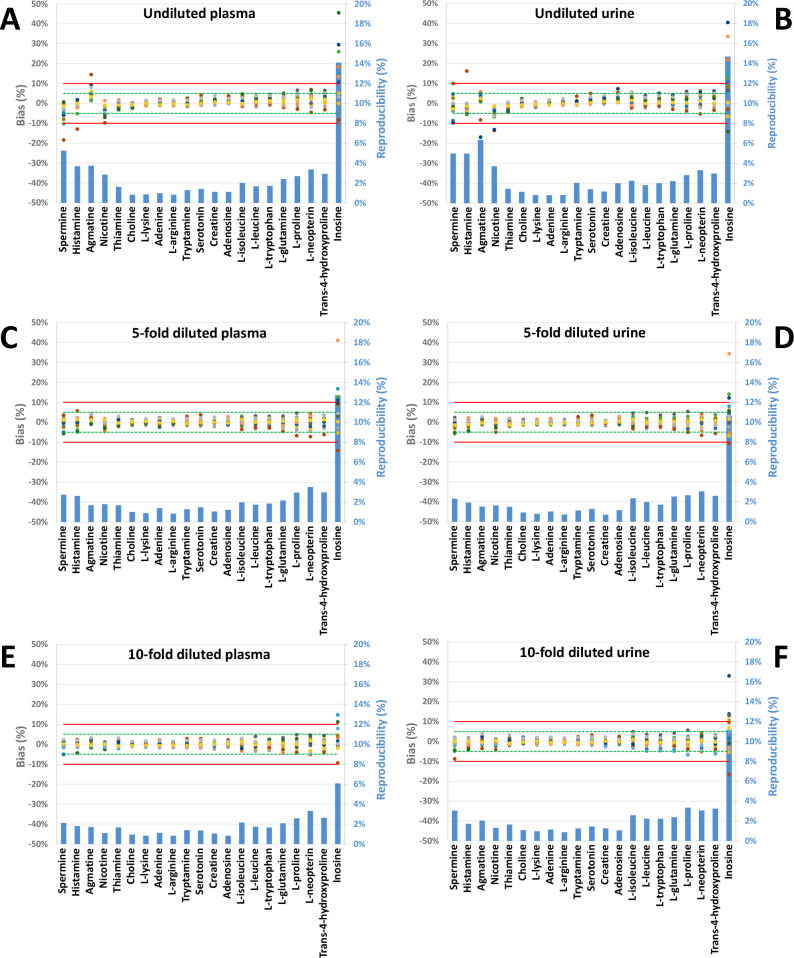
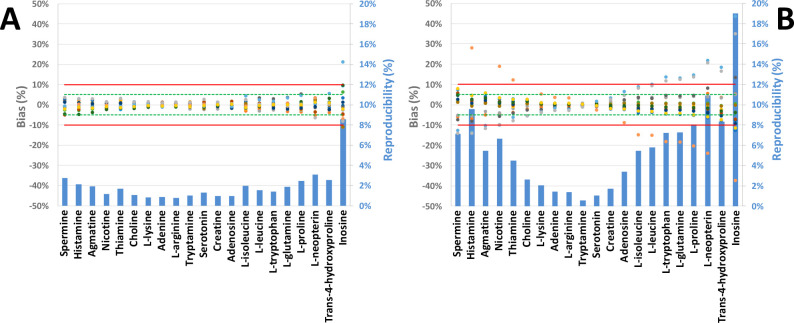
Capillary zone electrophoresis-mass spectrometry (CE-MS) is a mature analytical tool for the efficient profiling of (highly) polar and ionizable compounds. However, the use of CE-MS in comparison to other separation techniques remains underrepresented in metabolomics, as this analytical approach is still perceived as technically challenging and less reproducible, notably for migration time. The latter is key for a reliable comparison of metabolic profiles and for unknown biomarker identification that is complementary to high resolution MS/MS. In this work, we present the results of a Metabo-ring trial involving 16 CE-MS platforms among 13 different laboratories spanning two continents. The goal was to assess the reproducibility and identification capability of CE-MS by employing effective electrophoretic mobility (μ) as the key parameter in comparison to the relative migration time (RMT) approach. For this purpose, a representative cationic metabolite mixture in water, pretreated human plasma, and urine samples spiked with the same metabolite mixture were used and distributed for analysis by all laboratories. The μ was determined for all metabolites spiked into each sample. The background electrolyte (BGE) was prepared and employed by each participating lab following the same protocol. All other parameters (capillary, interface, injection volume, voltage ramp, temperature, capillary conditioning, and rinsing procedure, etc.) were left to the discretion of the contributing laboratories. The results revealed that the reproducibility of the μ for 20 out of the 21 model compounds was below 3.1% vs 10.9% for RMT, regardless of the huge heterogeneity in experimental conditions and platforms across the 13 laboratories. Overall, this Metabo-ring trial demonstrated that CE-MS is a viable and reproducible approach for metabolomics.
毛细管区带电泳-质谱联用(CE-MS)是一种高效分析(高)极性和可离子化化合物的成熟分析工具。然而,与其他分离技术相比,CE-MS 在代谢组学中的应用仍然相对较少,因为这种分析方法仍然被认为具有技术挑战性,且重现性较差,尤其是在迁移时间方面。后者是可靠比较代谢谱和识别互补于高分辨 MS/MS 的未知生物标志物的关键。在这项工作中,我们展示了涉及两个大陆的 13 个不同实验室的 16 个 CE-MS 平台的 Metabo-ring 试验结果。目的是通过采用有效的电泳淌度(μ)作为关键参数来评估 CE-MS 的重现性和鉴定能力,与相对迁移时间(RMT)方法进行比较。为此,使用了在水中、预处理的人血浆和尿液样本中加标有相同代谢物混合物的代表性阳离子代谢物混合物,并分发给所有实验室进行分析。测定了所有加标到每个样本中的代谢物的μ。每个参与实验室都按照相同的方案制备和使用背景电解质(BGE)。所有其他参数(毛细管、接口、进样体积、电压斜坡、温度、毛细管条件和冲洗程序等)都留给贡献实验室自行决定。结果表明,21 种模型化合物中有 20 种的μ重现性优于 RMT(3.1%对 10.9%),无论 13 个实验室的实验条件和平台存在巨大的异质性。总体而言,这项 Metabo-ring 试验表明 CE-MS 是代谢组学的一种可行且可重现的方法。